
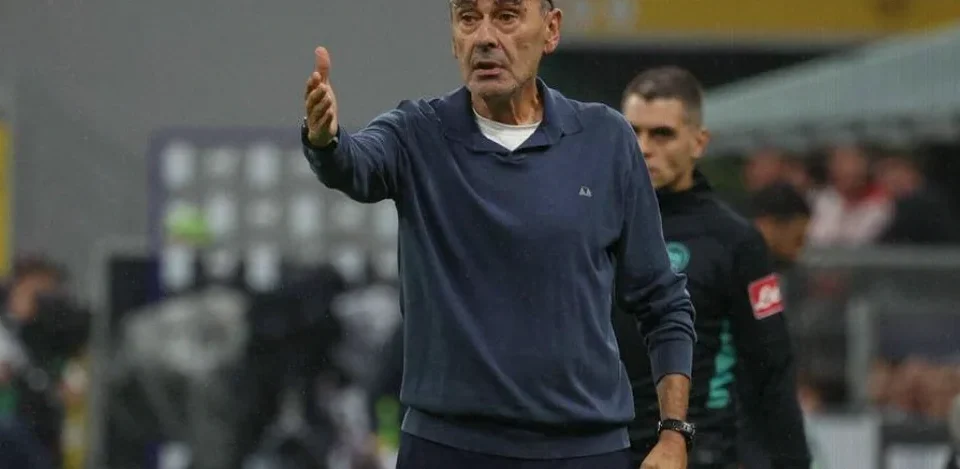
Maurizio Sarri’s dissatisfaction with the officiating became one of the lasting notes from Atalanta’s meeting with Milan at San Siro. The Atalanta coach objected both to referee Daniele Chiffi’s management of dissent and to a series of handball decisions, arguing that the balance of key calls had gone against his side.
Sarri challenges Chiffi’s handling of dissent
Sarri’s sharpest complaint concerned an exchange he said took place during the first half. Without naming the player involved, he suggested that one Milan player had directed an insult at Chiffi yet remained on the pitch after receiving only a yellow card.
“Today I learned that some players can tell the referee where to go,” Sarri said. “I mentioned it to the referee and he replied that he had booked him. Let us leave it there: if I do it, I am sent off.”
The episode appeared to concern Adrien Rabiot, who was cautioned for dissent in the 41st minute. Milan coach Amorim was visibly angered by his midfielder’s reaction, shouting from the touchline, but Rabiot responded in the most useful manner possible two minutes later when he scored to make it 2-0.
- Rabiot received a yellow card in the 41st minute for protesting.
- Amorim reacted angrily from the technical area.
- Two minutes later, Rabiot scored Milan’s second goal.
- Sarri said he had heard an insulting remark aimed at Chiffi, although he did not identify the player.
Sarri’s broader judgement of the referee was equally clear. He said the match had not been conducted in a manner he appreciated and added that his experiences with Chiffi at San Siro had repeatedly followed a similar pattern.
Rabiot accepts the need for restraint
Rabiot did not deny that emotion had taken hold. He said his frustration had helped bring him into the match, while accepting that he must be more controlled in conversations with the referee.
“I needed some anger, something to switch me on,” he explained. “Mike Maignan was angry too. There were three or four obvious fouls against us without a yellow card, then a decision was given against De Ketelaere. We get frustrated because we are trying to play and there are incorrect decisions.”
The midfielder added that players are human and can reach a point where they feel compelled to object, though he recognised that he must remain calm rather than argue with the official.
Handball calls add to Atalanta’s grievance
For Sarri, the dispute was not limited to Rabiot’s booking. Atalanta also examined the referee’s threshold for handball incidents inside both penalty areas. The coach counted three such episodes and believed they had not been assessed consistently.
- Obric was penalised for handball in the Atalanta area, leading to a penalty.
- Kristensen was also judged to have handled the ball in front of Marco Carnesecchi’s goal, resulting in another penalty.
- De Winter’s handball in Milan’s area, with Maignan in goal, was not punished.
Sarri described the first penalty against Obric as particularly soft, arguing that the player’s movement had appeared natural and appropriate. His point was that, if VAR intervention was warranted in that instance, then the De Winter incident should also have been reviewed with the same scrutiny.
It left Atalanta feeling that a sequence of pivotal decisions had fallen on one side of the contest. In a Serie A afternoon already shaped by goals, discipline and touchline tension, the referee’s interpretation became another part of the match’s story.