Five rounds into the Serie A season, Italy’s refereeing chapter is being written less by the name of Gianluca Rocchi’s new designator team than by a wider shift in football’s laws. Matches are lasting longer in active play, the whistle is being used more selectively and VAR has been asked to intervene only at a high threshold — a policy that has already brought both smoother afternoons and heated objections from the benches.
Key takeaways
- Serie A has averaged 59 minutes and 24 seconds of ball-in-play time across its first five matchdays.
- The figure is up by 5 minutes and 5 seconds on 2024-25, making Italy the most improved of Europe’s major leagues.
- Only Ligue 1 has a higher overall active-play average, at 60 minutes and 3 seconds.
- Italian referees have awarded five penalties and two red cards so far, both sharply down on the previous two seasons.
- VAR has produced one on-field review and three overturned decisions in the opening five rounds.
- Officials have acknowledged six refereeing errors in Serie A and two in the Coppa Italia.
More football, but not simply an Orsato effect
Italy’s 59:24 average places Serie A ahead of La Liga, which stands at 58:12, the Premier League at 56:48 and the Bundesliga at 56:45. Ligue 1 remains narrowly in front at 60:03, although its rise has been smaller.
The contrast is especially clear when measured against last season. Serie A’s active football has increased by 5 minutes and 5 seconds, compared with rises of 3:03 in France, 2:24 in Spain, 1:46 in England and just 30 seconds in Germany. The Italian figure is also 5 minutes and 53 seconds above the preceding campaign.
At the extremes, Atalanta’s meeting with Cagliari contained 1 hour, 6 minutes and 54 seconds of active action, while Genoa-Frosinone registered only 46:55.
The change cannot be credited solely to the domestic refereeing leadership. A higher tolerance for contact, encouraged by the new designator, has reduced the number of interruptions, but similar increases across Europe point primarily to regulations introduced by IFAB before the World Cup.
Those measures include quicker restarts, stricter expectations around substitutions, the possibility of briefly removing a player treated on the pitch when no caution is shown to the opponent, and an eight-second limit for goalkeepers to put the ball back into play.
Technology may eventually add another layer. A ball fitted with a microchip, capable of identifying the final touch in disputed offside situations, is under consideration but is not expected soon because of its cost and a reported pre-order period of at least a year. The system proved decisive at the last World Cup in Portugal-Croatia, when Matanovic’s touch established Gvardiol’s offside position, and it could have mattered in the Lobotka incident during Inter-Napoli.
A restrained VAR line brings scrutiny
The higher foul threshold is a distinct domestic choice. Serie A referees have called 22.74 fouls per match, almost identical to the Champions League average of 22.83 and the Premier League’s 22.64. Germany is slightly lower at 22.31, while La Liga and Ligue 1 are higher at 24.4 and 24.7 respectively.
That approach has also coincided with a marked fall in major sanctions. Five penalties have been given in Serie A so far, the lowest total among Europe’s leading leagues. There had been 12 at the same stage last season and 20 two years earlier. There have also been only two dismissals, after totals of eight and nine in the previous two campaigns.
VAR’s footprint has become particularly small. One incident has led the referee to the monitor, and three decisions have been reversed. Last season’s equivalent early figures were 14 on-field reviews and eight reversals.
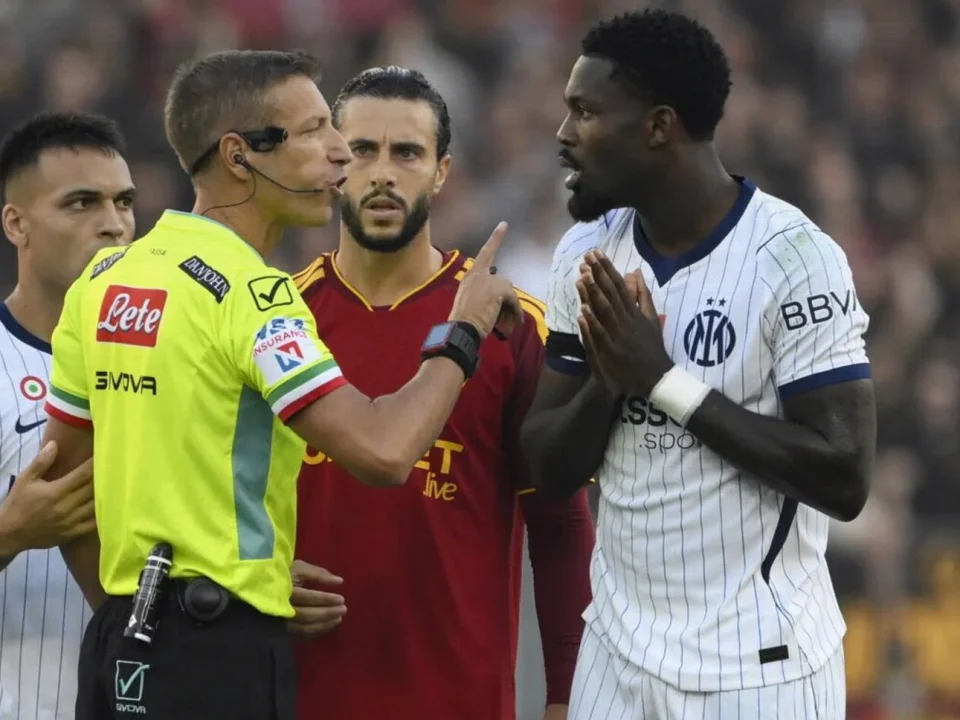
Yet the desire to avoid constant intervention has not removed controversy. The refereeing leadership has accepted that some fouls were missed, describing them as a consequence of allowing younger officials to develop. Across the first 50 Serie A matches, there have been six acknowledged errors, alongside two in the Coppa Italia.
The cases include penalties not awarded — with Kalulu’s challenge on Rowe in Juventus-Atalanta considered the most serious — a red card not shown to Caqueret in Como-Parma, and incorrect VAR involvement. These incidents were discussed with Serie A coaches during a meeting at Lissone, the home of the VAR operation.
Other disputed episodes, including those in Cagliari-Lecce, Genoa-Napoli and Bologna-Torino, have remained under debate. The stated position is that if an incident is open to interpretation, VAR should not become the deciding voice. “The line is set and it will remain in place until the end,” the designator said. “If I change my mind every week, I unsettle everyone. We will take stock in June.”
For the clubs, however, the accounting has already begun. Serie A may be gaining minutes of play, but each unpunished challenge and each restrained video review will continue to shape the arguments surrounding a long season.