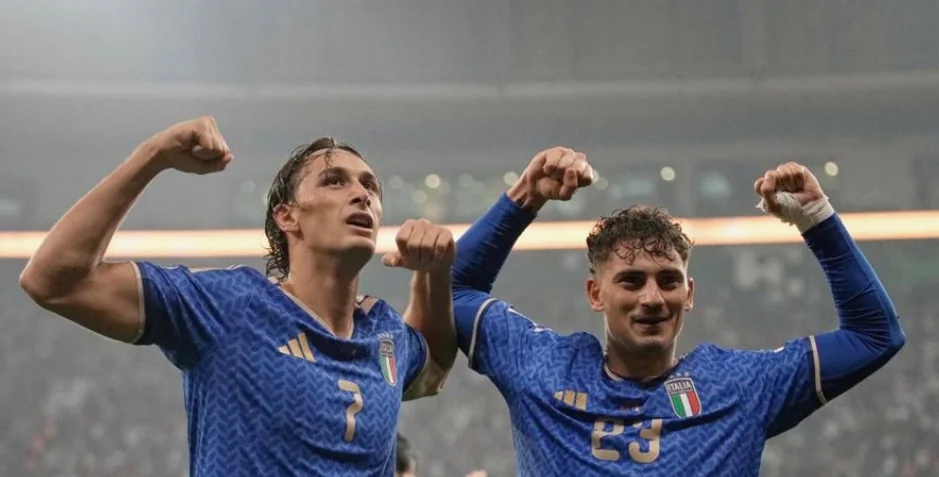
The Esposito brothers offered a small image of Italy’s football map in Bursa: two boys born in Castellammare di Stabia, raised in Brescia, lining up with nine team-mates for the national side. In an Italy attack also featuring Giacomo Raspadori, they carried both Campanian imagination and Lombard formation.
That blend is increasingly unusual. A count of Italian Serie A players by birthplace shows that the country’s northern regions hold the deepest reservoir, while much of the south is losing ground. The exercise is based on city of birth, meaning players such as Seydou Fini, born in Ivory Coast but eligible for Italy’s youth teams, are not included.
Quick facts
- Lombardy leads Serie A with 40 Italian-born players, ahead of Lazio on 26.
- Emilia-Romagna has 16 representatives, Piedmont 14 and Veneto 11.
- Campania, once level with Lazio behind Lombardy around a decade ago, is now seventh.
- Sicily has one Serie A representative born and raised on the island: Lecce defender Antonino Gallo.
- Molise and Basilicata currently have no representatives in Serie A.
Lombardy sets the standard
Italy’s side in Bursa reflected the imbalance. Giorgio Scalvini, Alessandro Bastoni and Matteo Ruggeri gave the defence a strong Lombard presence, while Michael Kayode, born in Borgomanero, represented Piedmont. The midfield of Sandro Tonali, Nicolò Fagioli and Davide Frattesi connected Lombardy, Emilia-Romagna and Lazio.
Lombardy’s total of 40 is built on a long chain of development. Atalanta, Inter, Milan and Brescia have supplied major academy pathways, supported by resources and facilities that remain difficult to match elsewhere in Italy. The tradition runs from Gaetano Scirea and Franco Baresi to Tonali.
The regional production is especially rich in defence, with Bastoni, Federico Dimarco, Scalvini, Matteo Gabbia, Alessandro Marcandalli, Davide Bartesaghi, Raoul Bellanova, Lorenzo Bernasconi, Cristiano Biraghi and Enrico Delprato among the examples.
Lombardy’s complete Serie A list is: Bartesaghi, Bastoni, Bellanova, Bernasconi, Biraghi, Marco Brescianini, Francesco Camarda, Niccolò Cambiaghi, Cassano, Cittadini, Leo. Colombo, Lor. Colombo, Andrea Colpani, Patrick Cutrone, Delprato, Raffaele Di Gennaro, Dimarco, Dossena, Gabbia, Roberto Gagliardini, Ghidotti, Ghion, Goldaniga, Liberali, Manuel Locatelli, Daniel Maldini, Marcandalli, Martins, Mosconi, Cher Ndour, Daniele Padelli, Panada, Mas. Pessina, Mat. Pessina, Roberto Piccoli, Nicolò Rovella, Scalvini, Marco Sportiello, Torriani and Turati.
Rome remains a reliable production line
Lazio is second with 26 players, with the influence of Roma and Lazio clear across the list. Roma’s pathway includes Niccolò Pisilli, Matteo Politano, Lorenzo Pellegrini, Luca Pellegrini, Lulli and Stefano Sabelli; Lazio’s includes Frattesi, Danilo Cataldi, Lorenzo De Silvestri and Michael Folorunsho.
Gianluca Scamacca and Romano Floriani have links to both clubs, having worn the shirts of Roma and Lazio in their development. The competitive environment of the capital continues to produce players with personality, while Lulli, born in 2007 and already used as a starter by Gian Piero Gasperini, is presented as another sign of continuity.
The full Lazio list is: Aurelio, Bracaglia, Calvani, Cancellieri, Cataldi, Cichella, Ciervo, Comotto, De Silvestri, Wladimiro Falcone, Felici, Floriani, Folorunsho, Frattesi, Lezzerini, Lulli, Palmisani, Lo. Pellegrini, Lu. Pellegrini, Pisilli, Politano, Renzetti, Sabelli, Scamacca, Valeri and Zappacosta.
The stable centre-north
Tuscany has 18 Serie A players and remains a varied football territory rather than a single system. Florence has little in common with the Massa-Carrara area, while Arezzo, Siena and Grosseto have their own patterns. Empoli remains a particularly productive exception, represented by Tommaso Baldanzi and Jacopo Fazzini.
Creative and attacking Tuscan players remain part of the region’s identity, from Nicolò Zaniolo and Federico Bernardeschi to younger prospects. Fiorentina’s Kouadio is well regarded, while Croci, born in 2010, has yet to be seen at senior level with the Viola.
Tuscany’s list is: Baldanzi, Bernardeschi, Bertola, Birindelli, Croci, Giovanni Di Lorenzo, Fazzini, Fortini, Gelli, Ghilardi, Kouadio, Lucchesi, Gianluca Mancini, Marianucci, Mascardi, Samuele Ricci, Daniele Rugani and Zaniolo.
Emilia-Romagna has 16 players and several national-team level figures, including Marco Carnesecchi, Cesare Casadei, Fagioli, Raspadori and Mattia Zaccagni. Its full group is Adorante, Carnesecchi, Casadei, Cinquegrano, Ciurria, Corvi, Fagioli, Pierluigi Gollini, Grandi, Lontani, Pierini, Pisseri, Raimondo, Raspadori, Zaccagni and Zanoli.
Piedmont contributes 14, with Moise Kean, Alessandro Buongiorno and Federico Gatti its most prominent names. The complete list is Boloca, Buongiorno, Daffara, Desplanches, Gatti, Wilfried Gnonto, Kean, Lorenzo Lucca, Montipò, Motta, Mout, Carlo Pinsoglio, Riccardo Sottil and Zerbin.
Veneto has 11 representatives and appears less deep than its neighbours, although its player pool is becoming more diverse. Alphadjo Cisse was born in Treviso, while Wisdom Amey grew up in Bassano del Grappa with a Togolese father and Nigerian mother. The list is Amey, Elia Caprile, Casale, Cisse, Fabbian, Furlanetto, Manuel Lazzari, Pieragnolo, Siviero, Filippo Terracciano and Nadir Zortea.
Campania’s difficult chapter
Campania is the most striking decline. In a similar count roughly ten years ago, it stood second behind Lombardy and level with Lazio; in 2026, it is seventh. The recent symbols of the region’s Serie A strength — Lorenzo Insigne, Ciro Immobile and Fabio Quagliarella — have all moved on.
Gianluca Gaetano and Antonio Vergara still have long careers ahead of them, while Salvatore, Sebastiano and Pio Esposito offer a different route. All three were born in Castellammare di Stabia but moved to Brescia in 2011, a family story that brings Campanian flair into a Lombard development setting.
The regional list is Gaetano, Rolando Mandragora, Pasquale Mazzocchi, Gaetano Oristanio, Giuseppe Pezzella Parisi, Pio Esposito, Sebastiano Esposito, Terracciano and Vergara. The broader question is why so many local talents fail to reach the professional game during their teenage years.
Smaller systems still hold their place
Liguria, Friuli and Sardinia have maintained distinctive local structures. Liguria continues to lean on its two major clubs, although Genoa currently has the stronger youth record than Sampdoria, having developed Stephan El Shaarawy, Jeff Ekhator, Andrea Cambiaso, Michele Masini, Pietro Pellegri and Lipani, as well as Ahanor before his recent departure.
Liguria’s Serie A group is Cambiaso, Ekhator, El Shaarawy, Lipani, Masini, Pellegri, Ranieri, Sommariva and Venturino. Friuli’s list is Calò, Comuzzo, Bryan Cristante, Alex Meret, Tommaso Pobega, Ivan Provedel, Guglielmo Vicario and Vinciati.
Friuli has long produced goalkeepers around Udine, with Meret and Vicario following earlier examples such as Simone Scuffet. Provedel comes from Pordenone, while Trieste has offered a second focal point through Calò and Pobega.
Sardinia has its captain in Nicolò Barella and a Cagliari area that continues to draw players together, including Alessandro Deiola and Carboni. Its representatives are Barella, Carboni, Deiola, Grandu, Idrissi, Serra and Vigorito.
The south’s thinning supply
The picture is most severe in Sicily, where Gallo is the only current Serie A player both born and raised on the island. The distance from the eras of Salvatore Schillaci, Pietro Anastasi and Giuseppe Mascara is stark.
Calabria’s modern reference point remains Domenico Berardi, but he left for Emilia at 16 after being spotted while visiting his older brother, then studying in Modena. It was an exceptional route rather than a model readily available to most young players.
Calabria’s list is D. Berardi, Farcomeni and Favasuli. Puglia has only Bleve, Monterisi and Satalino, with two of the three not playing regularly. Sicily has Gallo alone.
Facilities are part of the problem, along with the quality of coaching and the opportunities available to emerging players. The reasons are too broad for a single explanation, but the regional numbers show the scale of the challenge.
Isolated talents and empty spaces
Some areas are represented by individual stories rather than a wider production line. Marche looks to wide creativity, with Cacciamani following Riccardo Orsolini; its list is Cacciamani, Orsolini and Pompei.
Abruzzo has Dagasso, who reached Serie A through Pescara, alongside L. Berardi. Trentino’s representatives are Kofler and Andrea Pinamonti. Leonardo Spinazzola is Umbria’s leading figure, born in Foligno and married in Assisi, while Nicolussi Caviglia carries Valle d’Aosta’s representation after Sergio Pellissier.
Valle d’Aosta has Nicolussi Caviglia and Umbria has Spinazzola. Molise, once represented by Mirco Antenucci, and Basilicata, which had Simone Zaza and Nicola Sansone, have no current Serie A players in the count.
The championship’s map is therefore not simply a north-versus-south argument. It is a reminder that academies, local infrastructure and the ability to guide players through adolescence shape the national game long before Sunday afternoon arrives.