Five rounds into the Serie A season, the revised VAR approach has brought more uninterrupted football and longer periods of active play. Yet the quieter intervention model is already raising a more consequential question: will the same tolerance be accepted when points later decide the Scudetto, European qualification or relegation?
A higher threshold, and unresolved mistakes
The concern is not that referees are allowing matches to breathe. The concern is that clear errors may now be left untouched in the name of protecting the original on-field call.
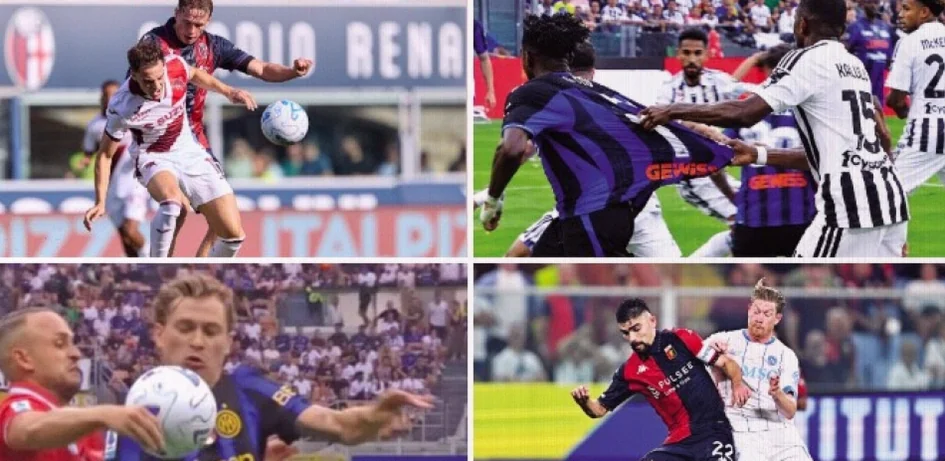
The strongest recent example came in the incident involving Heggem and Oristanio. Referee Marco Guida allowed play to continue, while VAR official Santoro did not recommend a review. Oristanio slowed and changed direction before Heggem’s leg displaced the Torino attacker’s right foot. The contact should have resulted in a penalty.
Guida may have been influenced by Oristanio taking another step after the challenge, suggesting that the trip had not stopped him. But the decisive point remained the same: the attacker’s right foot had plainly been moved by the contact. No review followed.
There is an acceptance within the refereeing hierarchy that Guida’s decision was one that could be respected either way. Had he awarded the spot-kick, there would have been no objection to the field decision. That does not remove the underlying error, however, and it leaves an uncomfortable uncertainty over when VAR will step in.
- In Bologna, the Heggem-Oristanio contact did not produce a penalty or an on-field review.
- In Venezia-Lazio, a penalty was awarded five minutes into the second half after a VAR check for the Yeboah-Taylor incident.
- The Yeboah challenge, in which the attacker crossed his leg, appeared less forceful than the Heggem-Oristanio collision.
- Sozza had earlier correctly declined to award a penalty in the Juan Jesus-Cancellieri episode.
The contrast between Bologna and Venice has sharpened the discussion over the threshold for intervention: how much contact is enough, and when does a blow become a punishable offence?
Earlier episodes still shape the debate
The first weeks have supplied a growing file of contested decisions. The discussion began on the opening matchday with Kevin De Bruyne’s push on Johan Vasquez in Genoa-Napoli, overseen by Di Bello. It continued with the decision not to award a penalty for Ivan Vlasic’s arm in Torino-Milan.
That interpretation was then applied consistently in the Coppa Italia meeting between Torino and Monza, when Lucchesi’s hand contact was also not punished. Consistency has value, but it has not ended the arguments around individual cases.
- In Inter-Napoli, Stanislav Lobotka’s possible handball remained unresolved because the available camera angles were judged insufficiently conclusive, despite images suggesting a change in the ball’s spin before it travelled towards Nicolò Barella’s chest.
- The Alajbegovic-Keita incident did not lead to a penalty, correctly so, as the contact was not deemed worthy of one.
- Jimenez appeared to strike Bracaglia twice in Fiorentina-Frosinone, an evident act of violent conduct that went unpunished.
- Gagliardini’s blow on N’Dri in Cagliari-Lecce was another penalty appeal that passed without the expected intervention.
- Kalulu repeatedly pulled the shirt of Rowe before the English player went to ground. Although Rowe fell after the shirt had been released, the earlier obstruction had been clear and prolonged. Zufferli did not give a penalty and VAR did not intervene.
The rare on-field review
The scarcity of VAR referrals has become a story in itself. A date now stands out in the calendar: 12 September, the fourth matchday, when Genoa faced Frosinone.
Rapuano was sent to the monitor after VAR official Camplone identified Cittadini’s handball. The referee then awarded a penalty. It was the first on-field review of the league campaign, arriving in the season’s 32nd match.
That number underlines the scale of the current shift. The intention is to avoid VAR becoming an automatic second referee, but the league will need greater certainty as the season deepens. In September, disputed calls produce debate; by spring, the same decisions may carry the weight of a title, a Champions League place, a European berth or survival.