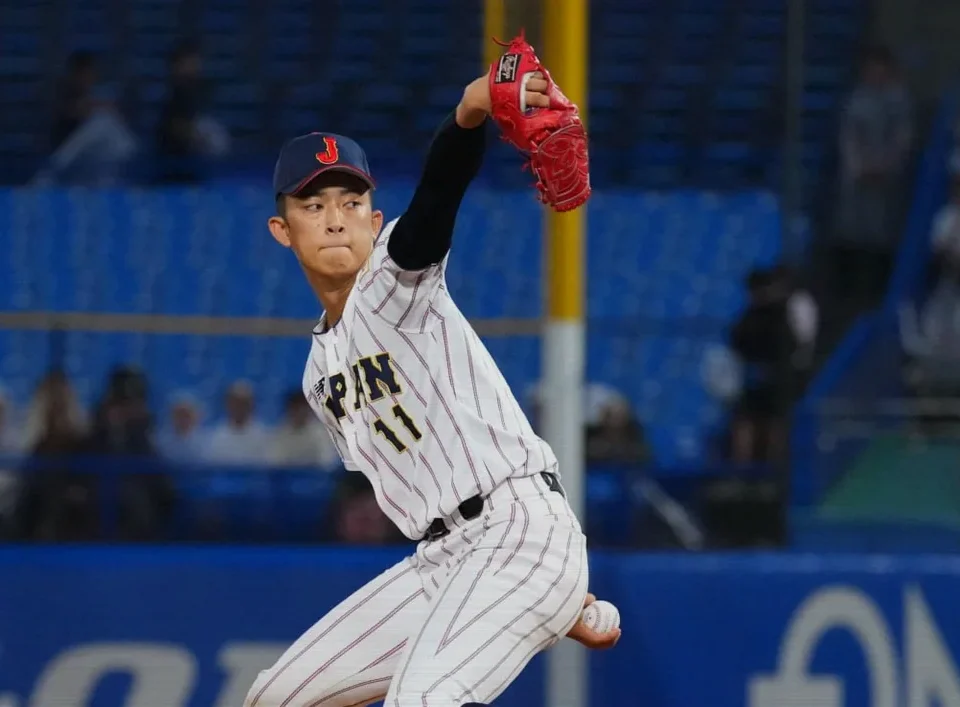
Shoki Oda, the 18-year-old right-hander from Yokohama High School, has chosen a U.S. path rather than enter the NPB Draft, stepping away from a first-round projection to explore either an MLB international signing or an American college program.
Key takeaways
- Oda became a national name after reaching 97.6 mph at the Summer Koshien, a tournament high-school record.
- The 6-foot-1 right-hander helped Yokohama reach the semifinals after escaping a bases-loaded bullpen assignment.
- Japan finished second at the U-18 World Cup Qualifiers, where Oda allowed one run and struck out seven against Chinese Taipei.
- His pitch mix includes a slider, curveball, changeup, splitter and cutter alongside the power fastball.
- Oda joins a small but growing group of Japanese amateurs bypassing the NPB Draft for opportunities in the United States.
A Koshien fastball that changed the conversation
Oda already had scouts circling before his announcement, but his summer work at Koshien gave his profile another jolt. Yokohama High School, the same program that launched Daisuke Matsuzaka into national prominence in 1998, called on Oda with the bases loaded and trouble brewing.
He answered with a 97.6 mph heater, the hardest fastball recorded in the history of the celebrated high-school tournament, to get Yokohama out of the inning. The club continued on to the semifinal round, and Oda’s velocity immediately placed him in rare company among Japanese teenage arms.
Shohei Ohtani reached 99.4 mph during his high-school years, while Roki Sasaki also touched 99.4 mph in an official high-school game. Oda has not matched those readings, but his Koshien mark made clear that he owns the kind of fastball that pulls evaluators into the ballpark.
There is more than one pitch in the package. Oda works with a full set of secondary options: slider, curveball, changeup, splitter and cutter. He showed that breadth again during the U-18 World Cup Qualifiers, allowing just one run while fanning seven Chinese Taipei hitters as Japan finished runner-up. He was regarded as the event’s top prospect.
Choosing an American route
Instead of waiting for the NPB Draft, Oda will look west. His stated choices are to sign as an international amateur with a Major League organization or to continue his development at a college in the United States.
The decision follows a route that remains unusual but no longer stands alone. Rintaro Sasaki became the most prominent early example of a Japanese player declining the NPB Draft to chase a Major League future. He later joined the Marlins after they selected him in the seventh round this summer.
Other recent cases have widened that trail. Athletics prospect Shotaro Morii signed with an MLB club instead of entering Japan’s draft. Genei Sato left Sendai University for Penn State, positioning himself for next year’s MLB Draft. Kenny Ishikawa, a two-way player at the University of Georgia who began his college career in Japan, went to the Reds in the 13th round this past summer.
For Oda, it is a significant turn before his professional career has even started. The NPB Draft would have offered the familiar next step for a high-school arm with his heat and tournament résumé. He has instead elected to see what his right arm can open in the American game.