Madrid’s early-season confidence around Kang-in Lee has travelled as far as Seoul, where South Korea’s latest international setback has sharpened a debate over how its most gifted attacking player should be used. Atlético Madrid’s summer arrival has made a fast impression in Spain, but the 25-year-old was unable to reproduce that influence as the Taegeuk Warriors fell 4-1 to Uruguay under new coach Robert Moreno.
Lee has begun life at Atlético with two goals and one assist across his first eight appearances for the club. In La Liga, his opening seven matches have brought the same return, along with consecutive man-of-the-match awards. The contrast with the Uruguay defeat has been stark enough for South Korean observers to focus not on the player’s ability, but on the structure around him.
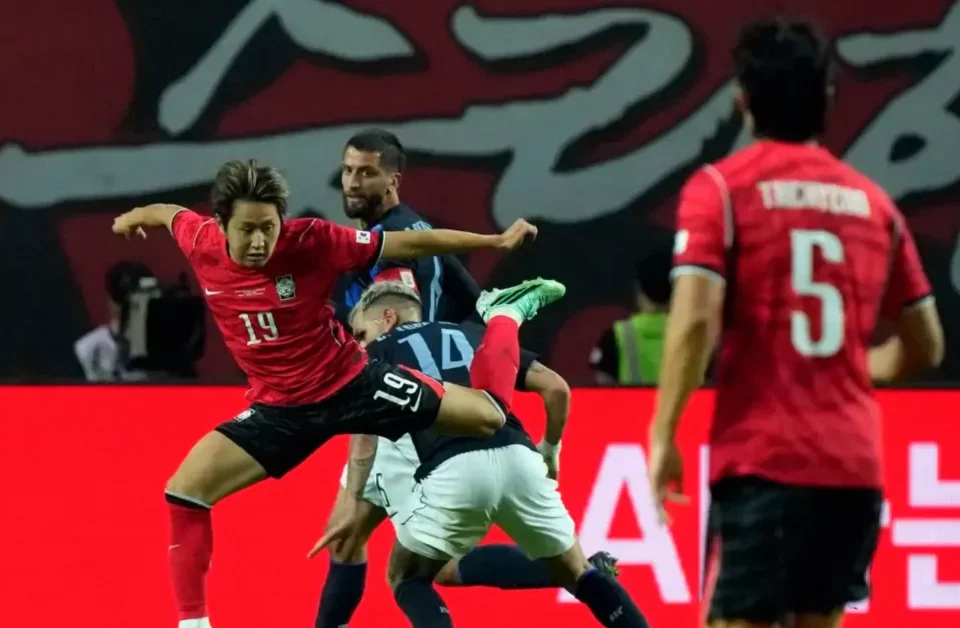
Moreno selected a 4-4-2 and stationed Lee on the right flank, a decision that drew particular criticism after the heavy loss. The view in South Korea is that the role required too much defensive running and kept Lee away from the areas where he can most damage opponents. “The issue is not Lee Kang-in himself, but the position he has been given, which is far from convincing,” was the verdict in the local analysis.
At Atlético, Diego Simeone has offered the midfielder a much looser attacking brief. Although Lee can begin from the right, he has appeared on both wings and frequently moved into the spaces of a second striker. His movement across the final third has already produced 108 progressive passes in that area of the pitch, underlining how often Atlético’s attacks have gone through him.
South Korea, by contrast, struggled to establish a working attacking rhythm against Uruguay. The visitors’ pressure closed down Lee quickly, often surrounding him with two or three players whenever he received possession. With little support nearby, the team’s forward momentum disappeared. Son Heung-min and Oh Hyun-kyu, the intended attacking partnership, were also unable to connect, and South Korea were three goals behind by half-time.
Lee still provided the moment that softened the scoreline. In the 80th minute, he delivered a precise diagonal pass for Son to score, an individual piece of quality in an otherwise frustrating night. Moreno argued afterwards that the limitations had been collective rather than the responsibility of one player, saying that when the entire side cannot make the game flow, every individual inevitably suffers.
A central role demanded
The response in South Korea has nevertheless been emphatic: the national side should be built around Lee rather than asking him to fit a restrictive wide assignment. Moreno had spoken before the match of allowing his star greater freedom, yet that promise was seen as unfulfilled in the Uruguay defeat.
The preferred solution is clear. Lee’s strongest club performances have come when he can operate closer to the strikers, and the recommendation for the coming international fixtures is to place him in one of the two central forward positions. For Moreno, the lesson may lie in the flexible role Simeone has already fashioned in Madrid: let Lee drift, let him receive nearer goal, and give South Korea more than one route through their most influential player.