Juventus left Cagliari with more than a difficult afternoon to consider. Luciano Spalletti’s side recovered after falling behind and came close to winning late on, but the match was shaped by the frustration Cagliari had intended to create: broken rhythm, repeated confrontations and a final exchange that earned both Spalletti and Fabio Pisacane red cards.
For Pisacane, the tension around the result was evidence of Cagliari’s growing standing. His team had already beaten Juventus at the Unipol Domus on 17 January, taking their decisive chance while defending their lead with determination and the kind of game management common in a demanding Serie A fixture.
Spalletti had expected another hostile test. Before this meeting, he had spoken respectfully of Pisacane and club president Tommaso Giulini for what Cagliari had achieved, while maintaining that Juventus had not deserved to lose the previous encounter. His preparations also included a warning to his players not to become involved in the battles that could reduce the difference in technical quality.
Mina at the centre of a difficult contest
Yerry Mina was the player Spalletti particularly wanted Juventus to avoid being drawn towards. The Colombian defender again became a central figure in Cagliari’s approach, pressing the emotional limits of opponents as his side took the lead and Juventus began chasing the game.
Spalletti saw Mina mock Weston McKennie while the American attempted to retrieve the ball, although McKennie did not respond. There were also flashpoints involving Douglas Luiz, who was pushed, and Sarr, who was confronted by an emphatic celebration after Cagliari won a throw-in from a deflection. Juventus players reacted more strongly than McKennie, and Spalletti repeatedly brought his concerns to the fourth official.
The Juventus coach then waited for Mina near the tunnel at half-time and challenged him over his conduct. Afterwards, Spalletti said his side should receive greater protection from certain behaviour. Mina rejected the suggestion that he had acted unfairly, saying that he simply played his own game and told Spalletti: “I have affection for you, coach.”
Changes after an ambitious first half
Spalletti had initially resisted rotation despite several international players returning to Continassa only days earlier. He selected a strong side for the opening 45 minutes, seeking to underline the importance of the occasion and manage a squad affected by absences across league and cup commitments.
Nico Gonzalez had been identified as an important attacking option, with Juventus hoping to use his movement behind Kolo Muani. But the first half did not bring the control Spalletti wanted, and he altered his plan at the interval.
McKennie and Francisco Conceiçao were withdrawn, while Alajbegovic and Edon Zhegrova were introduced to add unpredictability. Zhegrova helped Juventus find more life in possession as they worked their way back towards parity. They remained short of their best in front of goal, however, an issue that continues to accompany the side regardless of the opponent or context.
Cagliari made it difficult for Juventus to establish any sustained tempo, using every available pause to disrupt the visitors’ momentum. Juventus did enough in the second half to bring the match back into balance and could even have taken the points at the end, but the inability to turn pressure into a decisive finish left Spalletti increasingly agitated.
Handshake turns into confrontation
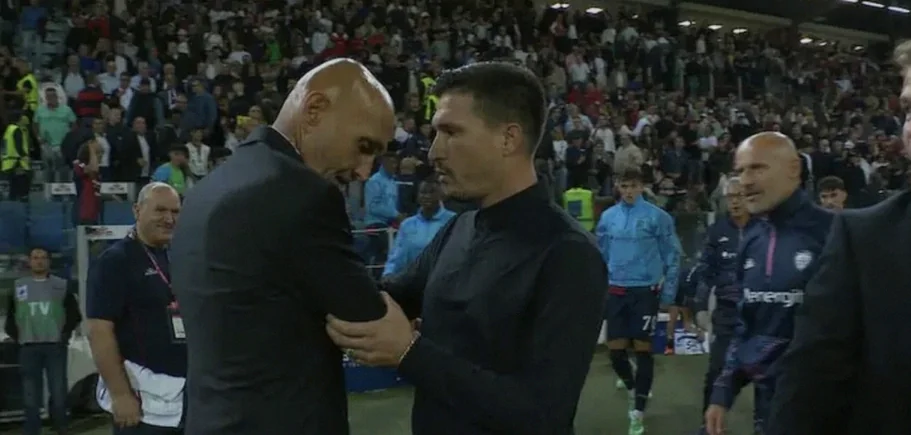
The pressure finally surfaced after the final whistle. What should have been the conventional handshake between the coaches became an argument, with Pisacane touching Spalletti’s arm as they spoke. Spalletti reacted sharply and threatened to slap his counterpart before Pisacane’s assistant stepped in to separate them.
The referee, standing nearby, sent off both coaches.
Spalletti later sought to reduce the incident to an on-field disagreement, though he returned to Cagliari’s management of the clock. He said he had told Pisacane that Cagliari were a good team who also knew how to run down time. Pisacane challenged that accusation, after which the two benches intervened and the exchange ended.
Pisacane said the situation could have concluded with an embrace, while admitting it was regrettable that it did not. He also argued that Spalletti had appeared concerned even before the match, and said that should make Cagliari proud. In his view, Juventus being troubled by the prospect of failing to win in Cagliari after only six rounds was a sign of respect for his team’s work.
For Juventus, the chapter will be remembered less for the point recovered than for the manner in which a familiar Serie A examination unsettled them. Spalletti had warned his players about the contest they were entering; by the end, he too had been caught in it.