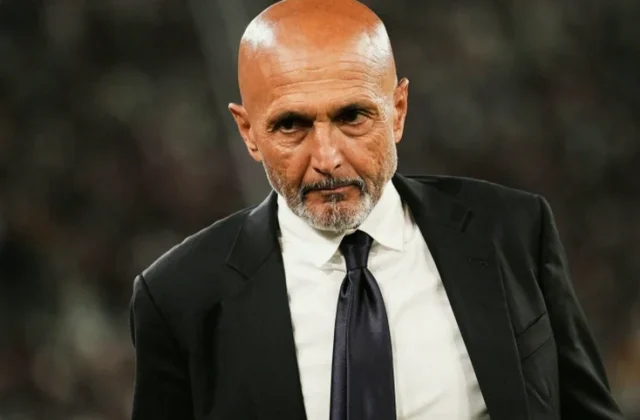
There are championship afternoons when the pressure leaves the pitch and reaches the touchline. Cagliari-Juventus offered one of those scenes, as Luciano Spalletti and Cagliari coach Fabio Pisacane clashed at the final handshake and both were sent off. It was an argument of a few seconds, held apart by players and staff, but it carried the familiar weight of a match in which every gesture had become contested.
The coach and the club
Spalletti played down the incident afterwards. He said he had merely congratulated Cagliari, adding that they were also adept at running down the clock, and insisted that the matter ended there. The exchange had begun with the two coaches confronting one another and repeatedly asking, “What are you doing?”
Pisacane saw it differently. He described it as an overly forceful greeting and said he had not expected the referee to dismiss either man. The Cagliari coach added that Spalletti had seemed concerned from his pre-match press conference onwards, suggesting that Cagliari’s work was beginning to attract fear from opponents.
For both benches, the red cards were a consequence of the same moment. Such confrontations remain uncommon, particularly in Italy, but Serie A has never been entirely free of them. The dugout can become another part of a match when a disputed decision, a late delay or a season’s accumulated strain finds no other outlet.
Italian football has seen the pattern before
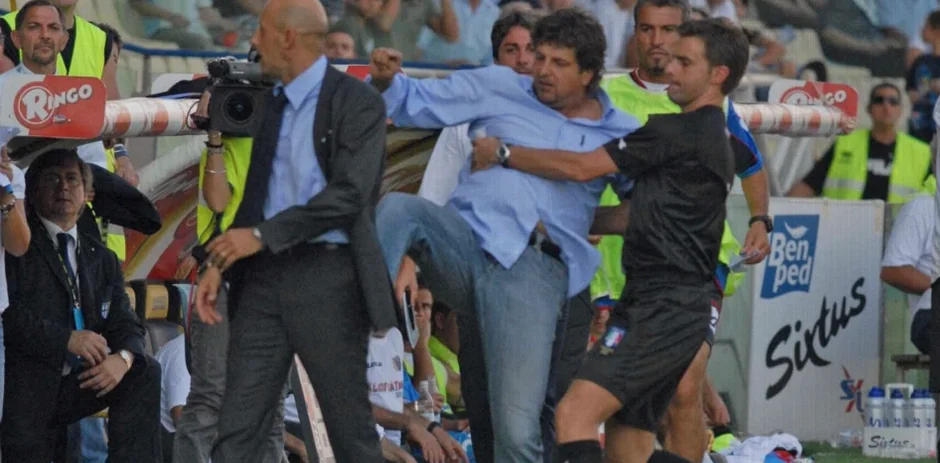
- In the summer of 2007, Parma-Catania on the opening weekend of the league season produced an extraordinary scene. Silvio Baldini became involved with Mimmo Di Carlo near the sideline and kicked him from behind. A young Nicola Rizzoli attempted to restore order, while Baldini later received a five-match ban from the sporting judge.
- In September 2018, Fiorentina beat Atalanta at the Franchi, but the attention moved to Gian Piero Gasperini and Stefano Pioli. Gasperini disputed the penalty awarded after a heavily debated Rafael Toloi challenge on Federico Chiesa. Pioli said his response had been simple: the decision had not been his to make.
- In 2021, Juventus lost at Napoli’s Maradona Stadium after surrendering their lead. Massimiliano Allegri protested fiercely against the officials and accused Spalletti of putting excessive pressure on the fourth official. Spalletti replied that he had lost often enough and, having won for once, did not need a lecture.
One of the most serious Italian episodes came in January 2016, after Inter won in Naples to reach the Coppa Italia semi-finals with one of their strongest displays of that campaign. Roberto Mancini and Maurizio Sarri had argued furiously close to the benches, and the post-match discussion centred on the language used in their exchange.
Mancini said Sarri had directed homophobic insults at him, adding that such conduct would not be accepted in English football and that someone behaving that way should not be in the game. Sarri apologised in private and in public; Inter accepted the apology, bringing the immediate dispute to a close after days of debate.
Conte and Mourinho, a rivalry beyond Italy
Antonio Conte and José Mourinho supplied some of the more memorable managerial stand-offs of the modern era. In the 2016-17 Premier League season, Conte’s Chelsea defeated Mourinho’s Manchester United 4-0 at Stamford Bridge. Mourinho objected to Conte’s celebrations with the score already settled, arguing that such behaviour could be understandable at 1-0 but felt humiliating at 4-0.
Conte maintained that he had asked the stadium to applaud Chelsea because the players had earned it, not because he wished to mock United.
The tension returned in March 2017, when Chelsea and United met in an FA Cup quarter-final. The fourth official had difficulty keeping the two technical areas under control from the opening stages. Conte complained that Chelsea had received only kicks from United and said it was not football. Mourinho answered on a separate subject, responding to Chelsea supporters who called him a traitor by saying that nobody had surpassed his status at the club until winning four trophies there. He described himself as “Judas Number One.”
Conte’s later spell at Tottenham brought another confrontation, this time with Thomas Tuchel in August 2022. Tottenham’s equaliser against Chelsea made it 1-1 midway through the second half, prompting an emphatic Conte celebration. At full time their handshake escalated, with neither coach willing to let go and both exchanging words before being separated.
Tuchel said he believed a handshake should include eye contact, implying Conte saw it otherwise. Conte responded online with a joke that he had been fortunate not to see Tuchel, because Tuchel might have deserved a trip.
A touchline history across Europe
Mourinho has featured in several of these episodes. In October 2014, during Chelsea’s meeting with Arsenal, he asked the fourth official to ensure Arsène Wenger stayed in his technical area. Wenger lost his patience, approached Mourinho and went face to face with him. Wenger later accepted that neither manager had set a proper example and said there was reason for embarrassment.
In the 2011-12 Manchester title race, Roberto Mancini and Sir Alex Ferguson also confronted each other following a derby. Ferguson objected to what he felt were Mancini’s repeated protests towards the referee. Cameras then captured the pair shaking hands. Manchester City won that derby through Vincent Kompany and eventually took the title in the last seconds of the final day, thanks to Sergio Agüero.
Portugal had its own heated moment in 2015, when Porto met Benfica. Jorge Jesus and Julen Lopetegui disagreed over incidents during the match and were close to physical confrontation before their assistants intervened.
Spain produced one of Mourinho’s most notorious acts. After the 2011 Spanish Super Cup Clásico, the Real Madrid coach put a finger into the eye of Tito Vilanova, then Pep Guardiola’s Barcelona assistant. Mourinho later said he did not know who Vilanova was. A year later, during another confrontation with Germán “Mono” Burgos, Diego Simeone’s assistant at Atlético Madrid, Mourinho was told: “I am not Tito.”
These incidents rarely define a coach or a season on their own. Yet they reveal what exists beneath the tactical plans and post-match explanations: the authority each manager feels responsible for defending, and the narrow distance between an ordinary handshake and a championship afternoon that lingers in memory.