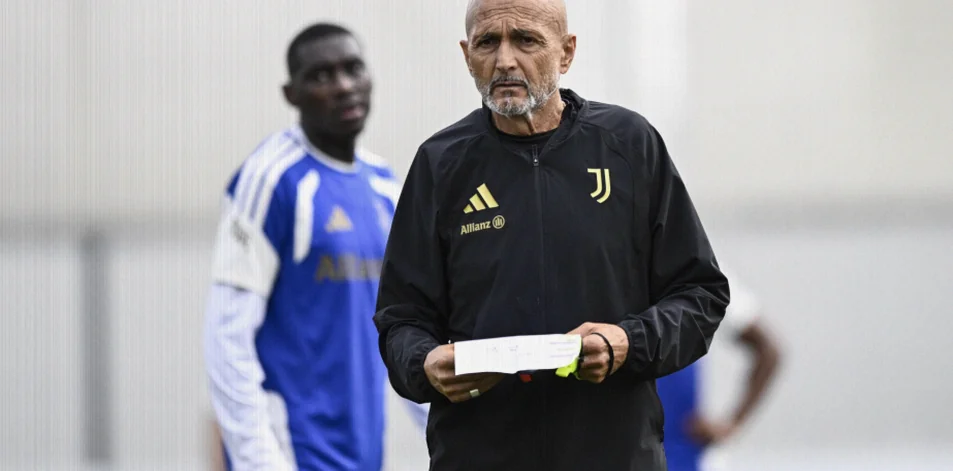
Luciano Spalletti’s Juventus have returned to a back three at a moment when the season has demanded certainty rather than flourish. Nine days after the home collapse against Lazio, discussions within the squad and a mounting injury list have led the coach back to a system that has followed him through much of his career: the 3-5-2.
The shape used against Rennes and Lecce is not simply a nostalgic revival. It is a more guarded version of a framework Spalletti first studied in depth nearly three decades ago, and one designed to give Juventus greater defensive clarity during a difficult stretch of results.
“We changed a few things and moved to three midfielders, with this 5-3-2, because at times like these you need more solidity and clarity,” Spalletti said. His explanation carried the sense of a practical adjustment rather than a permanent declaration of footballing faith.
A system rooted at Coverciano
Spalletti’s relationship with the 3-5-2 began long before his current work in Turin. During the 1998-99 season, while coaching Sampdoria in Serie A, he was also completing the UEFA Pro Master course at Coverciano. His dissertation, awarded top marks of 110 with honours, was titled The 3-5-2 Playing System.
The six-part study, supervised by Franco Ferrari and prepared with Sergio Brescia, now technical director of the Inter Academy, examined staffing, player roles, tactical principles, on-pitch terminology and attacking and defensive exercises. Diagonal movements, cover and the balance between short and long play were among its recurring themes.
Spalletti later explained during Euro 2024 that his original attraction was straightforward: “I simply liked having teams play that way.” He returned to it with Italy partly because several players from Inter’s core were accustomed to the formation at club level.
Although he became strongly associated with more creative 4-2-3-1 and 4-3-3 systems, the 3-5-2 has appeared repeatedly in his coaching journey, from Empoli and Udinese to Roma, Italy and now Juventus.
Empoli’s early blueprint
The first significant Spalletti 3-5-2 emerged at Empoli, where the Tuscan club rose twice in succession from Serie C1 to Serie A before securing survival in the top division.
His defence combined two direct markers, Baldini and Bianconi, with a former wide player used on the right side of the three. Ametrano and Tonetto provided running from the flanks, while Ficini and Pane offered control in midfield alongside the more combative Martusciello.
Up front, Massimiliano Cappellini and Carmine Esposito regularly exchanged positions. Cappellini scored nine league goals and Esposito 14, while Empoli finished the campaign with 13 more goals than Fabio Capello’s Milan.
Spalletti attempted to carry the approach into his following season at Sampdoria, without the same success. A difficult spell at Venezia, which included two dismissals in one season and a more conventional 4-4-2, followed. But he regained momentum after taking over mid-season at Udinese in 2001 and at Ancona in 2001-02, keeping both sides in Serie A.
Udinese and Roma brought the formula to its peak
The most complete early expression of Spalletti’s three-man defence arrived during his second Udinese spell. In 2004-05, the club qualified for the Champions League with a side built around Bertotto and Kroldrup as markers, Felipe as the more assured distributor, and David Pizarro directing midfield.
Pinzi and Muntari supplied energy, recovery work and late runs, while Damiano Zenoni and Jankulovski drove forward from the wings. Vincenzo Iaquinta offered a physical reference in attack and David Di Michele moved around him, scoring 15 Serie A goals, his best total in the division.
When Spalletti left for Roma, however, he increasingly put the 3-5-2 aside. His 4-2-3-1 became the defining shape of his first Roman period and later brought him success at Zenit St Petersburg, where he won his first league title.
His return to Roma between January 2016 and May 2017 produced a hybrid. After a 3-1 win over Napoli in October 2016, Spalletti described the side as operating with “three and a half” defenders: a back four while defending, then a three-man line in possession.
Alessandro Florenzi’s demanding role was central to the idea, pushing high before recovering against opponents such as Dries Mertens and Lorenzo Insigne. Juan Jesus had a shorter route to becoming the fourth defender, while Diego Perotti often dropped towards the ball instead of joining the defensive line.
Florenzi’s cruciate ligament injury forced another change. Roma then used a clearer back three of Antonio Rudiger, Federico Fazio and Kostas Manolas, with Bruno Peres, Kevin Strootman, Daniele De Rossi and Emerson Palmieri across midfield. Radja Nainggolan moved between a midfield role and advanced positions, in a manner comparable to Weston McKennie’s current responsibilities, behind Mohamed Salah and Edin Dzeko.
Dzeko ended that campaign as Serie A’s leading scorer with 29 goals, while Salah registered 15, his highest Italian league return before his subsequent rise at Liverpool.
A selective choice at Inter, then a return with Italy
At Inter, the formation was an exception rather than a habit. Spalletti used it only once, in a 1-0 defeat away to Torino in January 2019. He said he wanted more physicality, but the decision was also shaped by Ivan Perisic’s absence, the lack of form of Rafinha and Borja Valero, and a wish to mirror Walter Mazzarri’s Torino setup. It was not used again.
Napoli’s title-winning 2022-23 campaign was instead built entirely around 4-3-3 and 4-2-3-1 principles. Spalletti began his Italy tenure with similar ideas, before Euro 2024 brought the old shape back into view.
After beating Albania in the opening match and then suffering a heavy loss to Spain, Italy faced Croatia in a decisive final group game. Spalletti spoke with his players, many of whom knew the structure from their clubs, but rejected the suggestion that there had been a dressing-room “pact”.
“Anyone who reveals what is said in the dressing room harms the national team,” he said. “There is an inside and an outside. Of course I speak to the players and listen to them. The 3-5-2 was my Coverciano thesis and we had already worked on it. It was not a pact; I speak with the players.”
Italy did not move away from the system afterwards. Spalletti’s national-team spell ended in Oslo on 6 June the following year, when Norway overwhelmed his side.
Juventus seek stability after Lazio setback
At Juventus, Spalletti initially inherited Igor Tudor’s three-defender base. He adapted it by using Teun Koopmeiners as a left-sided centre-back and granting Pierre Kalulu licence to advance from the right of the defence.
Bremer’s return then helped prompt a switch to 4-2-3-1. Juventus produced attractive football from December to February, but their form deteriorated badly in the closing part of the season and the decline continued into the defeat to Lazio.
The latest version has been shaped as much by availability as preference. Federico Gatti, Bremer and Jhon Lucumí have formed a defensive trio made up of close-marking defenders. Kalulu and Andrea Cambiaso have occupied the wide positions, while Douglas Luiz has operated at the base of midfield alongside Koopmeiners.
McKennie has worked in the right half-space between midfield and attack. Ahead of him, Nick Woltemade drops off to connect play and act as an attacking reference point, while Randal Kolo Muani runs beyond the defensive line.
It is a distinctly cautious edition of a formation that once represented Spalletti’s first major tactical conviction. Juventus may yet move on from it when fitness and results improve, but in this part of the championship story, the coach has turned to an old principle: when a season becomes unstable, structure can matter more than style.