Brighton’s seafront has long sold weekends by the water, but this September the city is also staging a football story that once seemed too improbable for the Premier League. At the Theatre Royal, Stand or Fall is running until Saturday 26 September, revisiting the hard years of Brighton & Hove Albion’s climb from instability and lower-division hardship to a place among England’s leading clubs. The timing is fitting: the Seagulls are marking their 125th anniversary while sitting third in the Premier League, fresh from a 3-0 home victory over Arsenal.
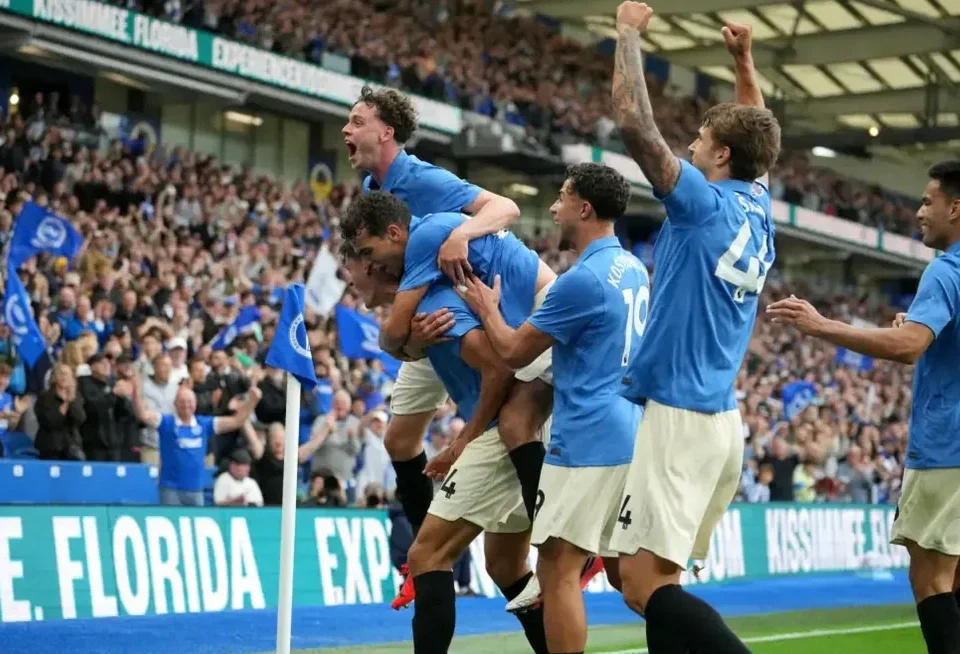
The Amex Stadium greeted that result as more than another big afternoon. Arsenal, the reigning English champions, were beaten decisively, and Brighton supporters watched the goals arrive with the disbelief of a fanbase that remembers a very different era. There was even a pointed chant aimed at the visitors: “Are you Tottenham in disguise?” It captured the confidence around a club whose recent rise has altered both its sporting standing and the atmosphere of the city around it.
Brighton, a coastal city of around 150,000 people often called “London by the Sea”, has become a destination for more than its beach and nightlife. The club’s progress under owner Tony Bloom has tied matchdays closely to the wider Sussex economy, while the stage production offers visitors a reminder of the precarious journey that preceded the current celebrations.
From exile to a European return
Brighton left the deteriorating Goldstone Ground in 1997 and endured a nomadic period that took them to Gillingham, 70 miles away, before a spell at the Withdean athletics stadium. The contrast with the modern Amex could scarcely be greater. Bloom’s purchase of the club changed its direction, with the businessman applying the data-led methods developed through his Jamestown Analytics operation to recruitment and player assessment.
Known in gambling circles as “The Lizard” for his mathematical expertise, Bloom has overseen a model built on identifying players with immediate potential, developing them and selling at increased value when the market allows. The process is also used across his other clubs, Belgian side Union Saint-Gilloise and Scotland’s Hearts, with scouting and statistical analysis shared across a broad international search.
That approach has brought in players such as Greek youngster Kostoulas, promising centre-back Luka Vuskovic and Chema Andrés, the Spanish midfielder formerly of Real Madrid and Stuttgart. Brighton’s recruitment record has also produced substantial sales: Jan Paul van Hecke joined Tottenham for £52 million, Carlos Baleba moved to Manchester United for £65 million, while Moisés Caicedo, Marc Cucurella, Robert Sánchez, João Pedro and, most recently last summer, Danny Welbeck in a move to Chelsea, all generated major returns.
Fabian Hürzeler, the German coach born in the United States, now leads a side whose attacking output has carried them behind only Manchester City and Arsenal in the table. Brighton have scored 16 league goals, the highest total in the division, and have become the first team since 2023 credited with defeating Arsenal while scoring more than three against the Gunners.
Europe is again part of the season’s landscape, with Conference League football accompanying domestic ambitions. Bloom’s next priority is the stadium itself. Work on the Amex’s south stand forms part of a £40 million modernisation programme, with the September international break used to advance improvements intended to sharpen the matchday experience and make the ground’s atmosphere more intense.
The consequences reach well beyond the turnstiles. An independent economic assessment puts Brighton & Hove Albion’s annual contribution to the Brighton and Sussex economy at £612 million. In an area that welcomes approximately five million tourists a year, football visitors have become an increasingly significant part of the local picture. Hotels, restaurants and shops are estimated to receive £26 million in spending from home supporters and travelling fans.
The club’s brand value has been assessed at £240 million through publicity and the growing international profile of both Brighton and the city. Players such as Japan’s Kaoru Mitoma have helped give that expansion a recognisable face abroad, while wins have made football tourism a larger part of the local calendar.
For the Arsenal match, the club’s blue-and-white flags were joined by a special turquoise-blue strip, designed as a tribute to the kit Brighton wore in their first Southern League Division Two campaign in 1901. The limited-edition shirt was sold for £150, a price that caused debate among supporters. After the 3-0 win, however, it quickly acquired the status of a souvenir from a moment few around the club would have imagined during the years recalled a few streets away at the Theatre Royal.