The 2026 rookie class has not waited around for a second look. From Opening Day callups to spring arrivals who forced their way into regular work, this group has supplied impact bats, premium defense and innings that already matter in September.
These are not players carrying rookie eligibility over from a brief earlier cameo. Every name here reached the Major Leagues for the first time this season, and the production has made the transition look far less intimidating than it usually is. Statistics are through Wednesday’s games.
Quick facts
- Joe Mack has erased 24 attempted basestealers, second most among MLB catchers.
- Kevin McGonigle’s 6.7 WAR trails only Mike Trout’s 2012 among rookies age 21 or younger, with Trout having debuted the prior year.
- Walbert Ureña owns the only complete game by a rookie pitcher in 2026.
- Spencer Miles has turned a Rule 5 opportunity into a 2.65 ERA over 91 2/3 innings.
Behind the plate, Miami’s Joe Mack has made the most of an opening created when Agustín Ramírez was sent back for a Minor League reset. Mack, 23, debuted May 4 and has posted a .682 OPS, with enough power flashes to suggest more offense may arrive. His calling card is defense: his Fielding Run Value sits in the 97th percentile, and only one catcher has thrown out more runners than his 24.
Colorado first baseman TJ Rumfield arrived March 27 and has quickly looked like a piece of the Rockies’ rebuild. He is batting .300/.392/.455, carries an .802 OPS outside Coors Field and has saved plays with 5 Outs Above Average. White Sox slugger Munetaka Murakami also had a strong case at first, but Rumfield’s glove separates him here.
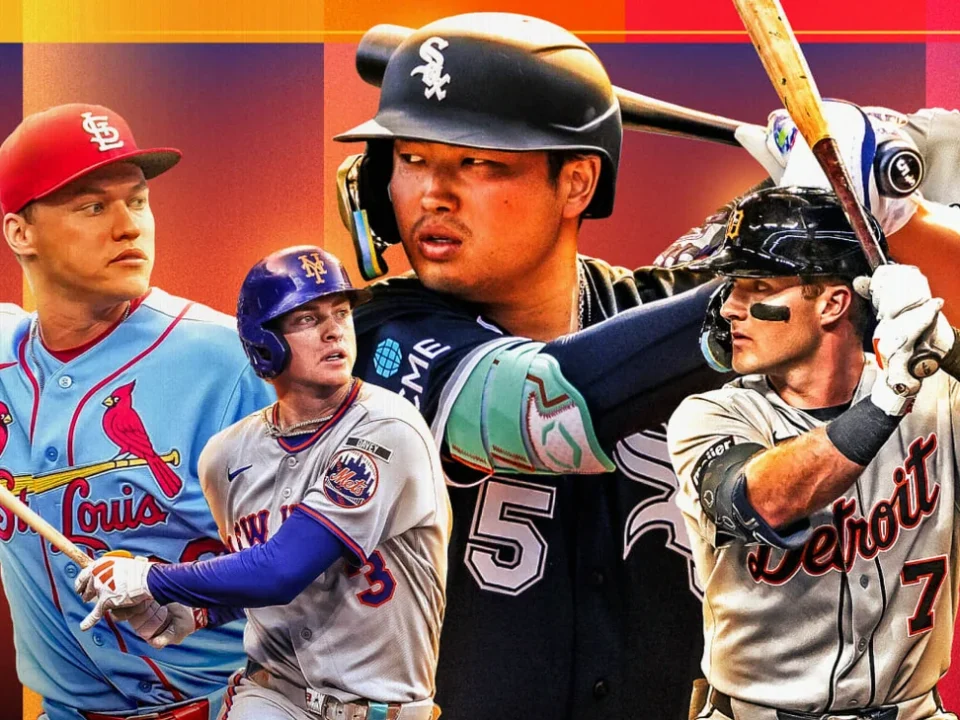
At second, Cardinals rookie JJ Wetherholt was in the National League Rookie of the Year conversation before a wrist injury interrupted his run just before September. He returned Wednesday after debuting with an Opening Day homer on March 26. The No. 7 selection in the 2024 Draft has a .240/.341/.368 line, 17 homers, 14 doubles and 14 steals.
Wetherholt’s work up the middle has been even louder. His 22 Outs Above Average lead all second basemen and rank third overall, behind Cubs center fielder Pete Crow-Armstrong at 26 and Royals shortstop Bobby Witt Jr. at 23. Cleveland’s Travis Bazzana, the No. 1 pick in that same 2024 Draft and an All-Star this season, has also made a strong first impression.
Tigers shortstop Kevin McGonigle made his debut March 26 at age 21 and opened with four hits, including two doubles. He has continued to play with the poise of somebody who has been around much longer, producing an OPS+ 24 percent above league average while showing sharp instincts on the bases.
Baseball-Reference credits McGonigle with 6.7 WAR. Among rookies 21 or younger, only Trout reached that mark in 2012, although Trout had appeared in the Majors in 2011. Ted Williams in 1939, Frank Robinson in 1956 and Albert Pujols in 2001 sit just behind McGonigle’s current total.
Blue Jays third baseman Kazuma Okamoto took a different route to rookie status. The 30-year-old, a six-time Nippon Professional Baseball All-Star, debuted March 27 after coming over from Japan and has endured some adjustment periods. His late surge has shown why Toronto believed the bat would play.
Okamoto’s 33rd home run established the single-season mark for a right-handed Japanese rookie, and he has been 10 percent better than league average offensively. The Jays have started to see more of the “Big Oak” who was such a decorated hitter overseas.
Chicago’s turnaround has received a meaningful lift from two debuting hitters. Left fielder Sam Antonacci, called up April 15 after earning praise around Team Italy for his contact skills during the World Baseball Classic, is hitting .271/.367/.392 with 23 doubles and 18 steals. He is still learning the outfield after spending most of his Minor League time on the infield dirt, but the offensive foundation is clear.
Murakami, meanwhile, has powered the White Sox into contention despite arriving amid a quiet offseason market. He debuted March 26 and has hit 31 homers with 14 doubles. He has served as designated hitter only sparingly, but the former NPB single-season home run record holder for a Japanese-born player is the natural choice for that spot; the strikeouts come with the damage.
Oakland center fielder Henry Bolte debuted May 13 in a deep group of young center fielders that includes the Mets’ A.J. Ewing, Toronto’s Brett Bateman and Detroit’s Max Clark. Bolte—pronounced BOL-tay—has paired quick hands and speed with a .275 average, .357 on-base percentage and 20 stolen bases. His defense adds another layer to the package.
Mets right fielder Carson Benge has been one of the bright spots in a lost New York season. Since debuting March 26, the former two-way player has batted .270/.333/.413 while collecting 18 homers, 19 doubles, three triples and 22 steals. He brings a powerful throwing arm, disciplined strike-zone work, athleticism and the kind of all-around game a club can build around.
The rotation gets a rookie with both durability and a little historical novelty. Angels right-hander Walbert Ureña, who debuted March 26, is the first player named Walbert in Major League history. More importantly, he has logged a 2.88 ERA, a 141 ERA+ and 131 strikeouts across 137 1/3 innings.
Ureña has issued too many walks, but he gets ground balls and has delivered the season’s only rookie complete game. For an Angels club trying to create some fresh momentum, those innings have carried real weight.
Toronto reliever Spencer Miles is the bullpen selection and a reminder of what a Rule 5 pick can become. A fourth-round Giants selection in 2022, Miles was limited to 14 2/3 innings by injuries before the Blue Jays selected him in the Rule 5 Draft and kept him on the roster out of camp.
Miles has answered that gamble with a 2.65 ERA, 1.09 WHIP and a 3.6 strikeout-to-walk ratio over 91 2/3 innings, mostly out of the bullpen. His varied arsenal has kept hitters from squaring him up, turning a low-mileage arm into a valuable Toronto weapon.
There will be time for awards voting and postseason accounting. For now, this is the more immediate takeaway: the 2026 class did not merely arrive. It took the field, claimed regular jobs and gave the season a set of new faces worth remembering.