Vegas enters 2026-27 with the numbers of a club that lives at the blue paint, owns the puck, and still has a late-game gear when the rink tightens up. The Golden Knights are coming off their third Stanley Cup Final trip in nine seasons, and their underlying profile points to another heavy push.
Vegas Golden Knights 2026-27 notebook: crease pressure, PP control and Eichel’s engine
SEO Title: Vegas Golden Knights 2026-27 preview: EDGE numbers to watch
SEO Description: A rink-side look at the Vegas Golden Knights’ 2026-27 outlook, from high-danger dominance and power-play zone time to Jack Eichel’s skating and shooting metrics.
Quick facts
- Vegas allowed an NHL-low 522 high-danger shots last regular season and generated 718, fourth-most in the League.
- The Golden Knights posted the NHL’s best high-danger shot differential at plus-196.
- Vegas led the 2026 playoffs with 179 high-danger shots and 43 high-danger goals.
- Mitch Marner topped the postseason scoring race with 29 points in his first Vegas campaign.
- Jack Eichel recorded 370 bursts above 20 mph last season, fourth-most in the NHL.
The Golden Knights were built to win the dangerous ice. They surrendered fewer high-danger looks than anyone, scored 146 high-danger goals, third in the League, and finished plus-196 in that shot category.
Vegas also outshot opponents in 62 games, trailing only Carolina’s 65 and Colorado’s 64. That pressure carried into the playoffs, where the Golden Knights finished first in both high-danger shots on goal and high-danger scoring.
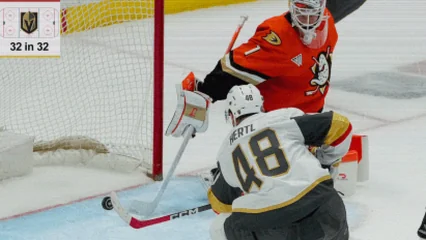
Tomas Hertl drove much of the crease work during the regular season. His 113 high-danger shots led Vegas and ranked fourth NHL-wide, while captain Mark Stone scored 22 times from high-danger territory, tied for 10th in the League.
In the postseason, Hertl placed third with 23 high-danger shots. Stone had 21, tied for fourth, and Brett Howden’s 19 were tied for 10th; Howden shared the playoff lead with eight high-danger goals, while Stone’s six were tied for fourth.
Marner’s first playoff run in Vegas changed the club’s attack another notch. He led all postseason skaters with 10 goals and 19 assists, becoming only the fourth player in the modern era, beginning in 1944, to lead the NHL playoff scoring race in his first season with a new franchise.
Ryan O’Reilly did it with St. Louis in 2019, Frank Mahovlich with Montreal in 1971, and Bill Goldsworthy with Minnesota in 1968. Marner also scored six high-danger goals, tied for fourth in the 2026 playoffs, after producing just one across his prior four postseasons in the player-tracking era.
His 21 high-danger playoff shots were tied for fourth and represented a major jump. Over the preceding two playoff years, he had only six such shots across 20 games.
Power play owns the zone
Vegas finished fourth in offensive-zone time percentage at 42.3 percent and sixth in 5-on-5 shot-attempt share at 52.3 percent. The power play was equally forceful, ranking sixth with 58 goals and a 24.6 percent conversion rate.
The Golden Knights led the NHL in power-play offensive-zone time at 63.6 percent. Their top unit often used five forwards, and all five regular pieces ranked among the League’s top 10 in that measure.
Stone ranked second at 66.5 percent, followed by Pavel Dorofeyev at 65.4 percent, Hertl at 65.3, Marner at 64.9 and Eichel at 64.6. Dorofeyev’s offseason move to the New York Rangers removes one option, but Shea Theodore has a track record of helping hold the zone on the man advantage.
Theodore led Vegas and ranked seventh in the NHL at 65.9 percent in power-play offensive-zone time during 2024-25. He could return to the first unit.
Vegas won 39 regular-season games, making it one of only two playoff clubs below 40 victories; Los Angeles had 35. Still, the Golden Knights led the NHL at plus-47 in third-period goal differential and plus-206 in third-period shots on goal differential.
That third-period edge showed up in the spring. Vegas posted an NHL-best seven comeback victories in the playoffs, including four rallies completed in the final frame.
Eichel remains the pace-setter
Eichel’s first seven NHL seasons ended without a playoff appearance. Since arriving in Vegas, he has helped send the club to four consecutive postseasons, two Stanley Cup Finals and the franchise’s 2023 championship.
The 29-year-old remains one of the League’s most explosive centers. He had 370 skating bursts above 20 mph last season, fourth in the NHL, and tied for seventh among forwards with 10 shot attempts clocked at 90 mph or faster.
His 26 bursts above 22 mph placed him in the 98th percentile among forwards. Eichel’s hardest shot reached 94.62 mph, in the 96th percentile, while his average shot velocity of 61.45 mph ranked in the 93rd percentile.
During the playoffs, Eichel led all players with 105 bursts above 20 mph in 22 games. His top skating speed of 23.14 mph rated in the 95th percentile among forwards, and his five bursts over 22 mph also landed in the 95th percentile.
Eichel owns both 90-point seasons in Golden Knights history: 94 in 2024-25 and 90 last season. His broader tracking file remained strong, including 257.04 total miles skated, 37.58 power-play miles, 14 high-danger goals, 95 mid-range shots, nine mid-range goals and a 45.2 percent offensive-zone time share.
Those marks placed him at or above the 87th percentile among forwards in each category. With Eichel driving the pace and Marner adding another top-end playmaker to the attack, Vegas again has the profile of a club built for deep spring hockey.