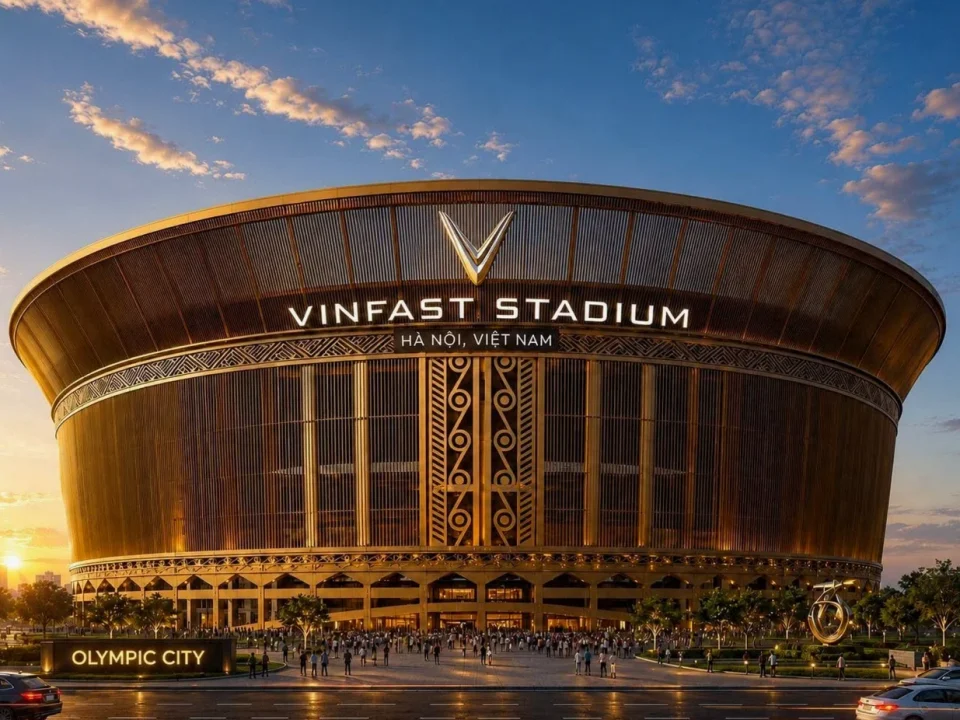
From Hanoi to the scrubland east of Casablanca, football’s biggest stages are being redrawn. Vietnam’s VinFast Stadium and Morocco’s Grand Stade Hassan II are set to move ahead of Pyongyang’s Rungrado 1st of May Stadium, bringing two new 100,000-plus arenas into a hierarchy long dominated by older landmarks.
Two new giants on the way
VinFast Stadium, formerly known as Trong Dong, is planned for Hanoi with 135,000 seats. It would become not only the world’s largest football stadium but also exceed the 132,000-capacity Narendra Modi Stadium in India, currently the largest venue across all sports and principally used for cricket.
The Vietnamese venue is part of the Hung Vuong International Sports Complex. Its proposed gold-coloured dome takes its form from the trong dong, a traditional Vietnamese bronze drum with major cultural significance.
Morocco’s Grand Stade Hassan II, in Benslimane Province, is designed for roughly 115,000 spectators. Announced in 2023, it is the centrepiece of the country’s stadium programme for the 2030 World Cup, which Morocco will co-host with Spain and Portugal. The ground is among the candidates to stage the final.
Its design draws on the tents used at moussems, Morocco’s traditional cultural festivals. The project has been recognised by Architizer, while its expected cost is above 11 billion Moroccan dirhams, or more than R$5 billion.
- Work on the Hanoi stadium began last December, with completion now targeted for July 2027 rather than the initially projected August 2028.
- Construction at the Hassan II stadium is also advancing, with delivery expected between late 2027 and the middle of 2028.
- Once both projects are completed, Rungrado 1st of May Stadium is expected to lose its position as football’s largest venue.
The projected top 10 largest football stadiums
| Rank | Stadium | Location | Capacity |
|---|---|---|---|
| 1 | VinFast Stadium | Hanoi, Vietnam | 135,000 |
| 2 | Grand Stade Hassan II | Benslimane Province, Morocco | 115,000 |
| 3 | Rungrado 1st of May Stadium | Pyongyang, North Korea | 114,000 |
| 4 | Camp Nou | Barcelona, Spain | 105,000 |
| 5 | Estadio Monumental de Núñez | Buenos Aires, Argentina | 101,000 |
| 6 | FNB Stadium | Johannesburg, South Africa | 94,736 |
| 7 | Misr Stadium | New Administrative Capital, Egypt | 93,940 |
| 8 | Wembley Stadium | London, England | 90,000 |
| 9 | Estadio Azteca | Mexico City, Mexico | About 87,500 |
| 10 | Bukit Jalil National Stadium | Kuala Lumpur, Malaysia | 87,411 |
The established landmarks beneath them
Rungrado 1st of May Stadium remains the present leader among football grounds, with room for 114,000. Its name combines Rungra Island, where it stands, with its opening date of 1 May 1989. North Korea built it amid the rivalry with South Korea after Seoul was awarded the 1988 Olympics, accelerating public works to host the 13th World Festival of Youth and Students.
Barcelona’s Camp Nou is heading towards a capacity of 105,000 as its redevelopment continues. Opened in 1957, the stadium entered a major rebuilding programme in 2023 and resumed operations with restricted attendance at the end of 2025. The final stage will require a complete closure of at least six months from mid-2027.
In Buenos Aires, River Plate’s Monumental is expected to reach 101,000 by 2029. Club president Stefano Di Carlo has outlined a full 360-degree stand ring that would add 16,000 seats, alongside a complete roof. River intend to continue playing home fixtures there during the work.
Johannesburg’s FNB Stadium, once commonly called Soccer City, holds 94,736. It hosted Nelson Mandela’s first public address after his 1990 release, following 27 years in prison. Refurbished for the 2010 World Cup, it staged both ceremonies and the final.
Egypt’s Misr Stadium opened in March 2024 inside the International Olympic City in the New Administrative Capital, east of Cairo. Its futuristic elliptical, rippling roof references Queen Nefertiti’s headdress and necklace. The 93,940-seat ground was built to replace Cairo International Stadium and supports Egyptian ambitions to host an Olympic Games and a World Cup.
Wembley, with 90,000 seats, reopened in 2007 after the demolition of the original stadium. Built at a cost of about £750 million, it is identified by its 133-metre arch. Its retractable roof does not fully close above the pitch, but every seat is covered from rain, making it the largest fully sheltered stadium of its kind.
Mexico City’s Estadio Azteca has hosted more World Cup matches than any other stadium, with 24. It is the only venue to have been used at three editions of the tournament: 1970, 1986 and 2026. Brazil secured its third world title there in 1970; Italy and West Germany contested the celebrated “Game of the Century”; and Diego Maradona scored his “Hand of God” goal at the ground in 1986.
Bukit Jalil National Stadium serves as Malaysia’s national-team home and as a state-owned multi-purpose centre. It took over from older domestic venues as the country’s principal setting for cup finals, has staged youth international events and has welcomed touring European clubs, including Liverpool in 2011 and 2015.