Zinedine Zidane’s Juventus years began in uncertainty and ended with the largest transfer fee football had yet seen, but the road between those points was anything but smooth. In Turin, the young Frenchman became a champion, a World Cup winner and Ballon d’Or recipient, while also collecting the difficult lessons that accompanied his rise.
A slow beginning in Turin
When Zidane arrived from Bordeaux in the summer of 1996, he wore Juventus’s number 21 shirt and struggled to settle. His first months brought criticism from the Italian press, and the comparisons with Michel Platini quickly faded as his influence remained limited.
Marcello Lippi found the change that unlocked him on 20 October 1996, in the Derby d’Italia against Inter. Moved from the right into a more central attacking role, Zidane scored the winning goal with a left-footed strike from outside the area. It was a decisive moment in his adaptation to Serie A and the beginning of his authority in the Juventus side.
Just over a month later, on 26 November, Juventus travelled to Tokyo as reigning European champions to meet River Plate in the Intercontinental Cup final. Alessandro Del Piero settled the contest, but Zidane celebrated the first trophy of his Juventus career.
European brilliance and painful finals
Zidane’s growing importance was evident in the Champions League semi-final of 23 April 1997. Juventus beat their Dutch opponents 4-1, with the Frenchman producing two assists and a goal in a commanding display. The campaign nevertheless ended in disappointment in Munich, where Borussia Dortmund won the final 3-1.
That was not the first European final defeat Zidane had known. Before joining Juventus, he had lost a UEFA Cup final with Bordeaux. A further setback followed on 20 May 1998, when Juventus faced Real Madrid in the Champions League final. Zidane started but could not shape the match, and Predrag Mijatovic’s second-half goal gave the Spanish club the trophy.
It was his third losing European final, a sequence that stood in sharp contrast to the international triumph waiting later that summer.
Temperament alongside talent
There was always another side to Zidane’s competitive edge. In Parma on 5 January, he was sent off after punching Enrico Chiesa during a midfield incident. Carlo Ancelotti’s Parma won 1-0.
He would also be dismissed against Inter in October and against Roma the following year. In his final season before leaving Juventus, he received two red cards in four Champions League matches, disciplinary episodes that may have damaged his chances of adding a second Ballon d’Or.
Yet the 1997-98 season confirmed his stature. Across league and cup competitions, Zidane finished with 11 goals and 16 assists for Juventus, arriving at the 1998 World Cup as one of the defining figures in French football.
France changes the scale of his career
France’s route to the 1998 World Cup included a quarter-final against Italy, settled only after 120 goalless minutes. Zidane took and scored France’s first penalty in the shoot-out, helping remove the Azzurri from the tournament before France went on to beat Brazil in the final.
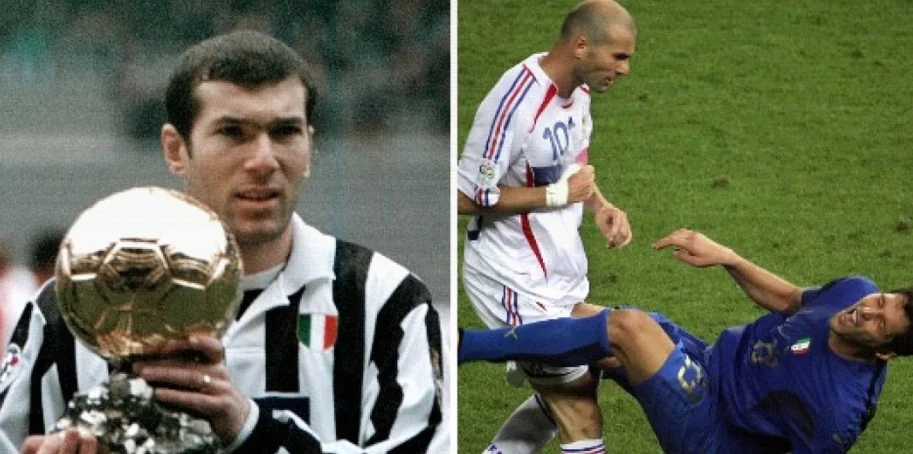
That victory brought France its first World Cup, turned Zidane into a national symbol and led to his image appearing on the Arc de Triomphe. He won the Ballon d’Or while still a Juventus player.
Two years later, he led France to the European Championship. The final was decided by David Trezeguet’s golden goal, giving Les Bleus another major international title.
The record departure and a final meeting with Italy
Zidane left Juventus in the summer of 2001 for Real Madrid in a €75 million deal, a world-record transfer at the time. His five years in Turin had taken him from a questioned newcomer to one of the game’s central figures.
His final match as a player, on 9 July 2006 in Berlin, brought him back against Italy in the World Cup final. Zidane put France ahead from the penalty spot, but Gianluigi Buffon denied him a second goal and Marco Materazzi equalised.
In extra time, Zidane headbutted Materazzi and was sent off. France lost the final, and one of football’s most extraordinary careers ended with Zidane walking away from the pitch, leaving the World Cup and the game itself behind.