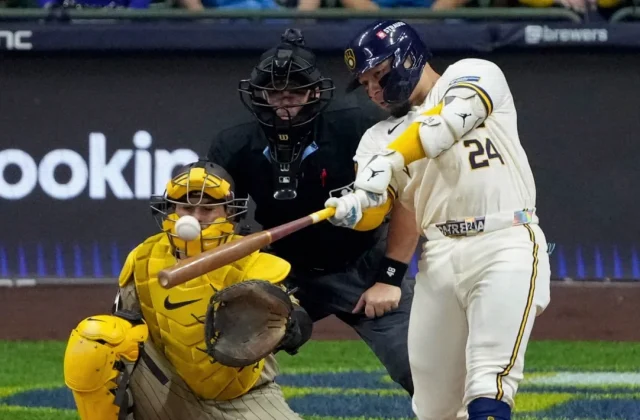
Milwaukee’s roof turned into the loudest defender on the field in Game 1 of the 2026 National League Division Series. With the Padres down a run in the ninth, Ty France sent a high fly toward left that carried enough drama to make American Family Field hold its breath. Instead, the ball struck the roof in fair territory, dropped back into play and settled into Jackson Chourio’s glove for the second out.
France had a runner aboard and San Diego trailing, 3-2, when he lifted the ball at a 49-degree launch angle. It initially carried the look of a possible go-ahead homer, and a ball over the wall would have put the Padres ahead by a run. But Milwaukee’s ground rules treat a fair ball off the roof as live, and replay upheld the out after Chourio handled the carom. The Brewers closed out the victory soon afterward.
The oddity fit the building, though the batted-ball data suggests France’s shot was an unlikely home run even without the roof. Since Statcast tracking began in 2015, only 10 balls hit at an angle at least that steep have cleared the fence for homers. Still, October has a way of making even low-probability plays feel like they are hanging over the season.
October has always had room for the strange one
Milwaukee had already authored another postseason oddity the previous fall. In Game 1 of the 2025 NL Championship Series against the Dodgers, Max Muncy drove a ball toward the wall with the bases loaded. Sal Frelick leaped in center field and got leather on it, but the ball popped free, touched the wall and was recovered by Frelick. That wall contact changed the situation: Teoscar Hernández, who had started from third, was required to run home rather than return and tag.
Hernández retreated before recognizing the force situation, and Milwaukee made him pay. Frelick relayed to Joey Ortiz, who fired home to William Contreras. Contreras kept a foot on the plate for the force at home, then moved up the third-base line and recorded another force on the runner there. The 8-6-2 double play was the first of its kind in postseason history. Muncy’s 404-foot drive was entered in the box score as a ground-ball double play, an especially cruel description for a ball that had nearly been a grand slam.
Fenway Park delivered its own ruling-driven twist in Game 3 of the 2021 AL Division Series. Tampa Bay and Boston were tied in both the game and series during the 13th inning when Kevin Kiermaier hammered a two-out ball into the right-center gap. It kicked off the top of the wall, then struck Red Sox right fielder Hunter Renfroe and bounded over the fence. Yandy Díaz, running from first, appeared set to score easily with the go-ahead run.
Instead, Díaz was sent back to third. Because the ball was no longer in flight when it was deflected out of play, the rule awarded two bases from the runners’ positions at the pitch. The next Rays hitter struck out, Boston won in the bottom half, and the Red Sox wrapped up the series the following night.
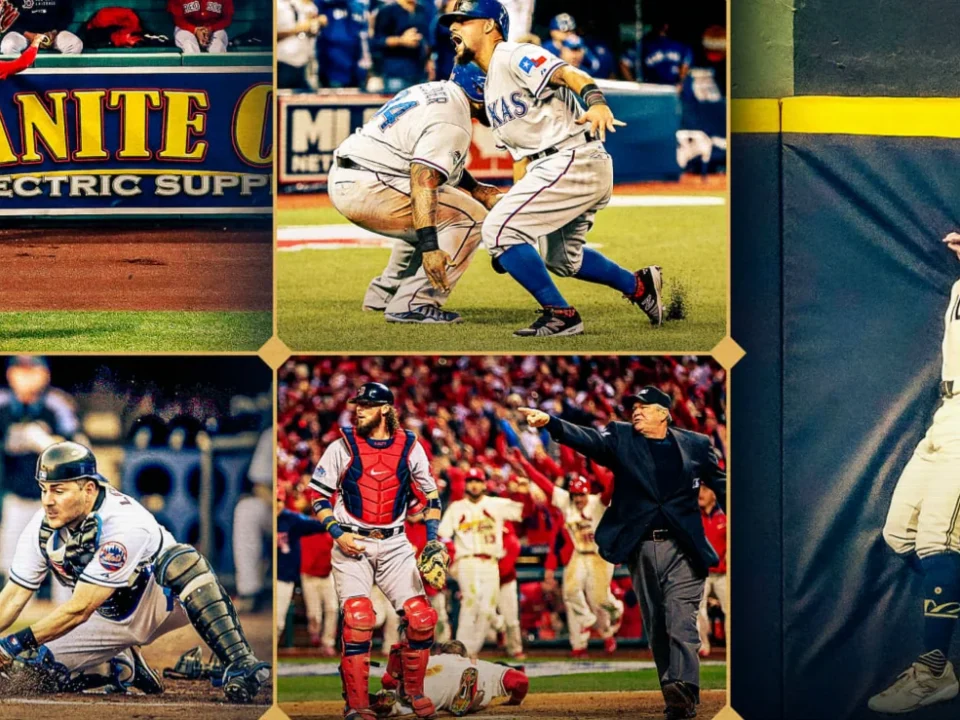
One of the wildest October innings came in Toronto during Game 5 of the 2015 ALDS. The Rangers and Blue Jays were tied in the seventh with Rougned Odor on third and two outs when Toronto catcher Russell Martin threw the ball back toward the mound. The throw clipped Shin-Soo Choo’s bat as he held it out, and the ball rolled away long enough for Odor to score.
The run stood after more than 10 minutes of confusion. For a moment, it threatened to define Toronto’s season in the worst way. Then the Rangers committed three straight errors to begin the bottom of the inning, opening the door for José Bautista’s three-run homer and the bat flip that became an October landmark.
The 2013 World Series supplied perhaps the most consequential version of the game’s strange-rule theater. Game 3 was tied in the ninth at St. Louis, with Cardinals runners on second and third and one out. Boston second baseman Dustin Pedroia made a diving stop and cut down the runner trying to score. Catcher Jarrod Saltalamacchia then attempted to get Allen Craig, the trailing runner, at third.
Saltalamacchia’s throw sailed wide. As Red Sox third baseman Will Middlebrooks tried to rise after the play, Craig stumbled over his legs on the way home. Craig was retired at the plate, but Middlebrooks was called for obstruction, awarding the Cardinals the winning run in a World Series walk-off. Boston protested, without success, before recovering to win each of the next three games and claim the championship.
The Dodgers had endured a similarly unusual home-plate sequence years earlier. In Game 1 of the 2006 NLDS, Mets catcher Paul Lo Duca erased a Los Angeles rally in the second inning by tagging two runners in rapid order after an outfield relay reached the plate. It was the sort of alert double tag usually reserved for a replay loop, reminiscent of Carlton Fisk’s comparable play against the Yankees in 1985. Los Angeles managed only one run that inning, lost 6-5, and then dropped the next two games to complete the sweep.
France’s fly ball now belongs in that October file: a shot hit high enough to find the roof, a replay rule that made it an out, and a game that turned on a ballpark feature no visiting hitter can carry with him into the batter’s box.