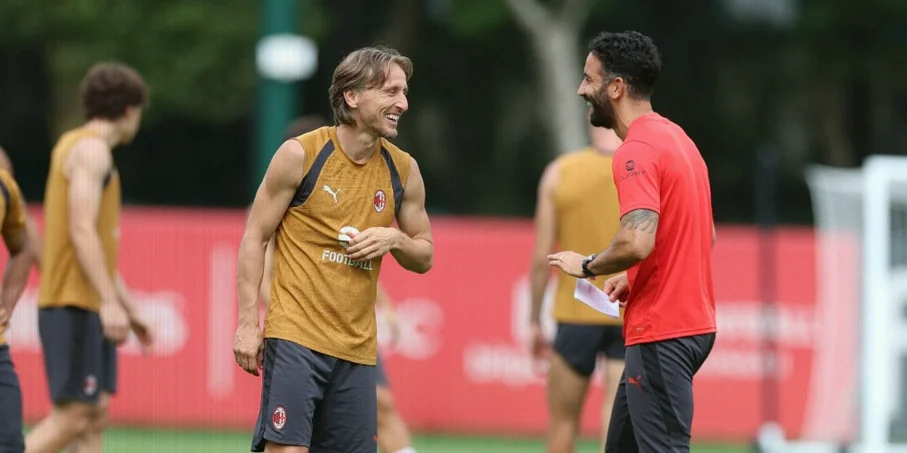
Luka Modric’s first weeks at Milan have already brought a familiar question into focus: not whether he can still shape matches, but how often a 41-year-old midfielder can be asked to do so across a season on three fronts. Ruben Amorim has made it clear that the answer will depend on the opponent, the rhythm of the fixture and Modric’s physical condition rather than reputation alone.
A managed role in a demanding Milan season
By the end of September, it appeared increasingly unlikely that Modric would again approach 3,000 minutes over the campaign, as he had done in each of the previous two seasons. Milan’s calendar, his age and Amorim’s markedly different approach from last year all point towards a more selective use of the Croatian.
The club’s commitments in three competitions will require rotation, while the coach sees some matches as more suitable for Modric than others. In games built around transitions and sustained running, Amorim has suggested that the demands can become too severe for him.
- Modric has started four of his five Milan appearances so far.
- He remained an unused substitute for the entire match against Benfica.
- Amorim is expected to assess both the opposition and Modric’s athletic condition before deciding whether he starts.
- Fixtures against deep defensive blocks are considered more favourable for Modric’s qualities than open, transition-heavy contests.
The distinction could make a tangible difference over the season. A match such as Lecce may offer a clearer route into the starting side than one against Como, if Amorim judges the latter to demand more running and more defensive recovery work.
Amorim’s message to Modric and the squad
Amorim has sought to handle the situation openly. The Portuguese coach has said that he does not reserve difficult messages for public press conferences, insisting that he has already repeated them directly to the players concerned.
That approach has so far helped avoid any apparent tension around Modric’s status. Amorim has described the midfielder as “a very good lad” who understands the situation, adding that opportunities will sometimes fall to him and sometimes to another player.
The coach’s public explanation has been equally direct:
- “He is ready to play every match when we need him.”
- “When we face low blocks, we can use Modric a lot. In the other games, we will see.”
- “I have to rotate, especially with a 41-year-old player.”
For Milan, it is a question of preserving influence rather than diminishing it. Modric remains a player Amorim trusts, but his place will be shaped by the specific character of each Sunday afternoon and each European night.
Croatia duty adds another concern
The immediate issue is what Modric will bring back to Milanello ahead of Sassuolo on Sunday 11 October. Croatia face a demanding Nations League sequence against the Czech Republic, Spain twice and England, leaving little room for a quiet international break.
Modric was also a doubt for the first meeting with the Czechs in Prague on Saturday evening after suffering from a fever. Croatia coach Bilic said that Modric had been ill on Thursday and that his condition would be checked again on Saturday morning.
The international decision carries added weight because Modric has reversed the retirement plan that had seemed set after the World Cup. Encouraged by Bilic’s attempts to keep him involved, he chose to continue representing Croatia rather than merely remain around the squad.
That commitment means Milan must manage not only a veteran central to their own ambitions, but a player still determined to have a meaningful role for his country. The season’s balance will therefore be decided fixture by fixture: minutes earned through suitability, not granted through standing.