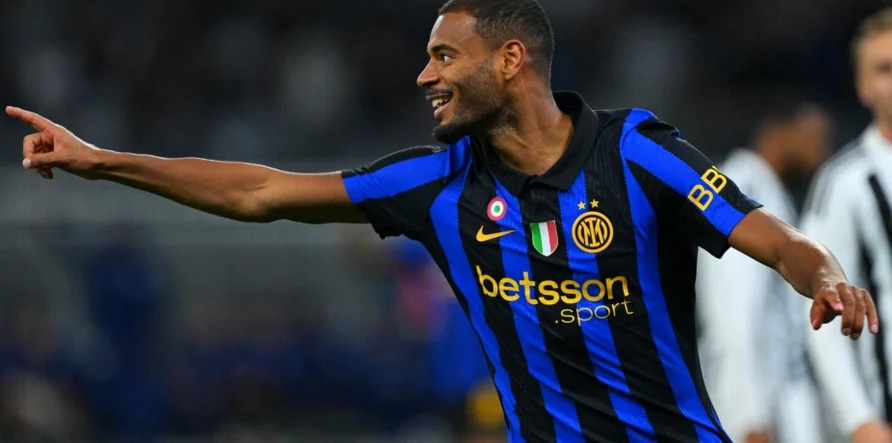
Andy Diouf’s route to Serie A began far from the usual football postcards, on the pitches around Nanterre, west of Paris, where the towers of La Défense replaced the open horizons of a childhood dream.
Before professional football, Diouf would run by the lake with friends from his neighbourhood and speak confidently about playing at the highest level one day. At Garenne-Colombes, where he spent three years from 2009 to 2012, that promise quickly looked less like a child’s ambition and more like an early certainty.
Sebastien Pendola, now the technical director at the club, first saw him at the age of nine. The memory has remained clear: a left-footed volley driven into the top corner. “It caught my attention immediately,” Pendola recalled. “Football was already in his blood. His father and older brothers had played, and Andy stood out even against older boys.”
Diouf was not tied to one position in those years. Midfield was where he appeared most comfortable, but his energy took him across the pitch. He could be seen defending, carrying the ball forward and arriving near goal in the same move. His coach’s instruction was often simple: slow down, hold the middle of the field and give the team balance.
Yet Diouf’s instinct was to chase the game. Pendola remembered a difficult match against a strong side from the Paris area, when his young team had been overwhelmed and many of the children were exhausted. With five minutes left, Diouf was still pressing and covering every part of the pitch. He finished with tears in his eyes, brought on by effort rather than disappointment.
That refusal to stop was evident from the beginning. Pendola said Diouf possessed a natural ability to push beyond fatigue, while also reading situations earlier than his opponents and playing with a determination to win. Even at that age, he had the pace to recover possession and turn defence into attack in seconds.
The environment around him mattered as well. Pendola regularly spoke with Diouf’s father after matches and described a family that was modest and grounded despite recognising the boy’s talent. There was no sense of pressure or excess, only the support required to let a gifted player develop.
Diouf has since been used in wider areas, a role Pendola considers a good fit even if it was not his original position. He believes the player can continue to grow there, bringing his running power and ability to affect games from different zones.
The prospect of using him at full-back, an idea associated with Zidane, also interests his former coach. In Pendola’s view, Diouf has the qualities demanded of a modern wide defender: quick acceleration, sharp transitions and technical assurance.
For those who knew him in Garenne-Colombes, however, the defining image is not simply the player’s versatility or physical capacity. It is the smile he carried into training and matches, and the optimism he passed on to teammates. Seeing him reach Serie A and international football, Pendola said, brings enormous pride. In the Paris suburbs, they had their own Forrest Gump: a boy who kept running, and did not stop when the road became longer.