Atlético de Madrid’s Champions League meeting with Manchester United was shaped by two major VAR decisions: Johnny Cardoso’s first-half goal, which would have made it 2-0 in the 44th minute, was ruled out, while United were later reduced to 10 men following Yoro’s dismissal.
What the night decided
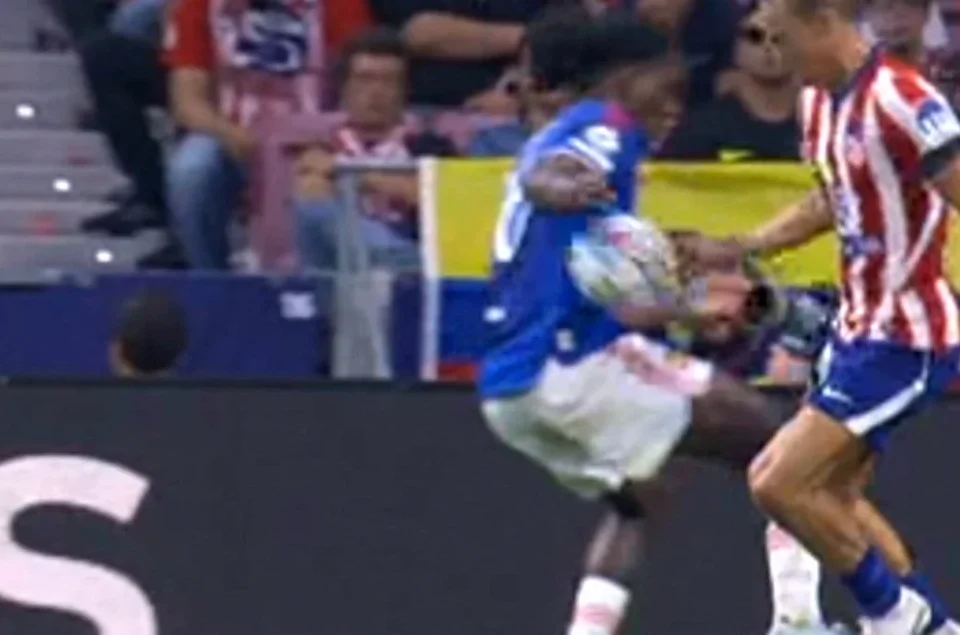
Cardoso found the net after being supplied by Barrios, but Swedish referee Glenn Nyberg was sent to the monitor after a VAR intervention. He judged that Marcos Llorente had handled the ball in an unnatural position during the build-up and disallowed the goal.
Former international referee Antonio Mateu Lahoz strongly disagreed with that interpretation during the broadcast. He argued that Llorente could not realistically have kept his arms fixed to his body, saying it was “madness” to treat that position as unnatural.
Mateu Lahoz went further, describing the ruling as an affront to the laws of the game. In his view, the handball was not deliberate and could only have led to an intervention if it had occurred immediately before the goal or if Llorente himself had scored. Neither condition, he said, applied to Atlético’s move.
Controversy also surrounded Yoro’s red card
The former referee also criticised the decision to send off Yoro, a dismissal that left Manchester United a man down against Atlético.
Mateu Lahoz questioned the VAR review process, arguing that the first replay shown was the only angle capable of making the incident appear more serious than it was. He said the game had to be assessed in its wider context rather than through one selected image.
“To give a direct free-kick and a red card for that contact is too much,” he said, adding that VAR had not been introduced for decisions of that kind.
He concluded that such incidents should not occur in Europe’s leading club competition, with Atlético left to reflect on a night in which a potential two-goal advantage was removed and Manchester United’s numerical disadvantage became another flashpoint.