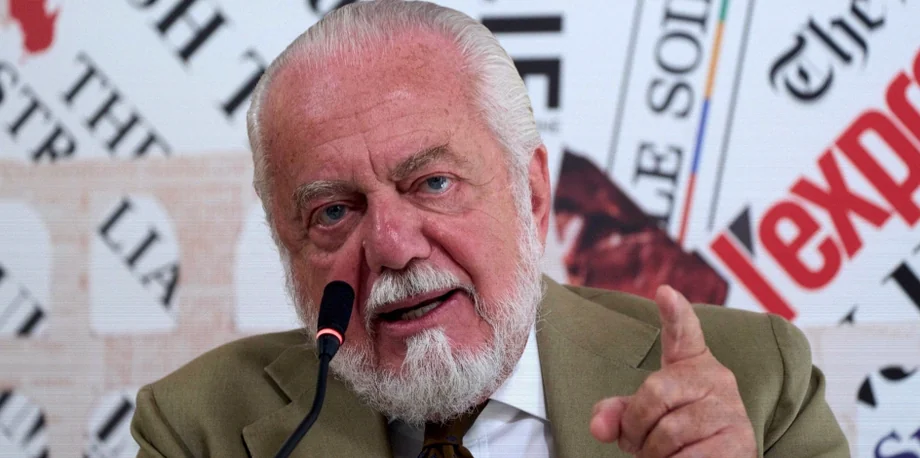
Napoli’s future is being sketched on two separate sites: a new training centre at Qualiano and a privately funded stadium project in the eastern part of the city. Aurelio De Laurentiis used an appearance in Rome, after receiving the Foreign Press Association in Italy’s Career Sports Award, to set out ambitions that would reshape the club beyond the present Maradona debate.
The president said the search for land for the new sporting base had been difficult, with earlier checks on a chosen area uncovering complications. Napoli have now identified 17.5 hectares at Qualiano, where the club intends to build a facility for both the senior side and academy.
Quick facts
- Napoli plan ten football pitches at the proposed Qualiano training complex.
- The site would include 7,500 square metres of offices and changing-room areas.
- De Laurentiis says he has signed a letter of intent with Q8 for 38 hectares in Napoli Est.
- His stadium concept has a capacity of 70,000, 120 sky boxes, restaurants and an interactive museum.
- He believes construction of a new ground could take 24 months and be financed entirely by him.
The Qualiano project is intended to bring the first team and youth sector under one roof. For a club accustomed to managing the demands of a long campaign while sharing public infrastructure, it would represent a more controlled sporting base.
De Laurentiis’ larger argument concerns the stadium. He remains apart from the municipal plan to upgrade the Stadio Diego Armando Maradona for Euro 2032, preferring a ground owned by Napoli rather than another renovation of the existing venue.
He said the agreement in principle with Q8 was signed a month ago and concerns land in Napoli Est. The proposed 70,000-seat stadium would have no athletics track, with the president arguing that football should be played in a venue designed around football rather than multi-sport use.
The concept also includes 120 premium boxes, hospitality spaces and restaurants. De Laurentiis described plans for an interactive museum, developed with his Los Angeles representative, in which visitors could virtually play alongside figures from Napoli history such as Diego Maradona, Edinson Cavani and Gonzalo Higuain.
He acknowledged that the project would require both time and substantial investment in dollars. Still, he presented it as a necessary break from the limitations he sees at the Maradona, where summer concerts have repeatedly affected the playing surface.
De Laurentiis pointed to Real Madrid’s stadium as an example of a venue able to protect its pitch while hosting other events. He said Napoli are required to relay the grass after concerts at the Maradona and claimed that the irrigation system was nearly damaged this year.
His verdict on the public renovation proposal was equally firm. The Campania Region is expected to put forward €150 million and the city council €50 million, but De Laurentiis argued that €200 million would make only a limited difference to the present stadium.
He said Napoli would continue playing at the Maradona until the new stadium is ready, before calling for the current structure to be demolished and rebuilt. The president said the replacement ground would not depend on public financing.
The stadium question is therefore becoming part of a wider tension between club ownership and civic planning. Napoli’s immediate football calendar remains tied to the Maradona, but De Laurentiis is framing the next phase as one in which the club controls its own facilities, revenue spaces and matchday environment.
He also turned his attention to football ownership models, criticising the role of investment funds. Recalling a dinner with Milan owner Gerry Cardinale three years ago, De Laurentiis said Cardinale had approached the game as a financier rather than as an entrepreneur running a club for its own sporting and business identity.
In De Laurentiis’ view, funds invest with the expectation of delivering returns to their backers; without a profit after a period of time, he questioned what value had been created. His comments placed Napoli’s proposed self-financed stadium alongside his broader preference for direct ownership and long-term control.
He also looked back on his own record since taking charge of Napoli. De Laurentiis said his experience in the difficult Italian film industry had prepared him for football, and cited two Serie A titles, five cups and 22 years at the club, including its long run of European participation.
He referred to having lived through Calciopoli and insisted that his achievements had come without cheating, a principle he described as essential. Looking ahead, he said he would prefer a squad made up entirely of young players.
Asked about Luciano Spalletti, De Laurentiis declined to discuss the former Napoli coach directly, instead referring to the television dramatisation involving Francesco Totti and Spalletti. He then made his position on the hierarchy clear: coaches, he said, are collaborators appointed to conduct the group of players, but remain employees of the club.
For Napoli, the conversation is no longer solely about the next match or the next transfer window. The president’s plans point toward a longer chapter: a new training home, a possible new stadium, and an insistence that the club’s direction should remain in the hands of its owner.