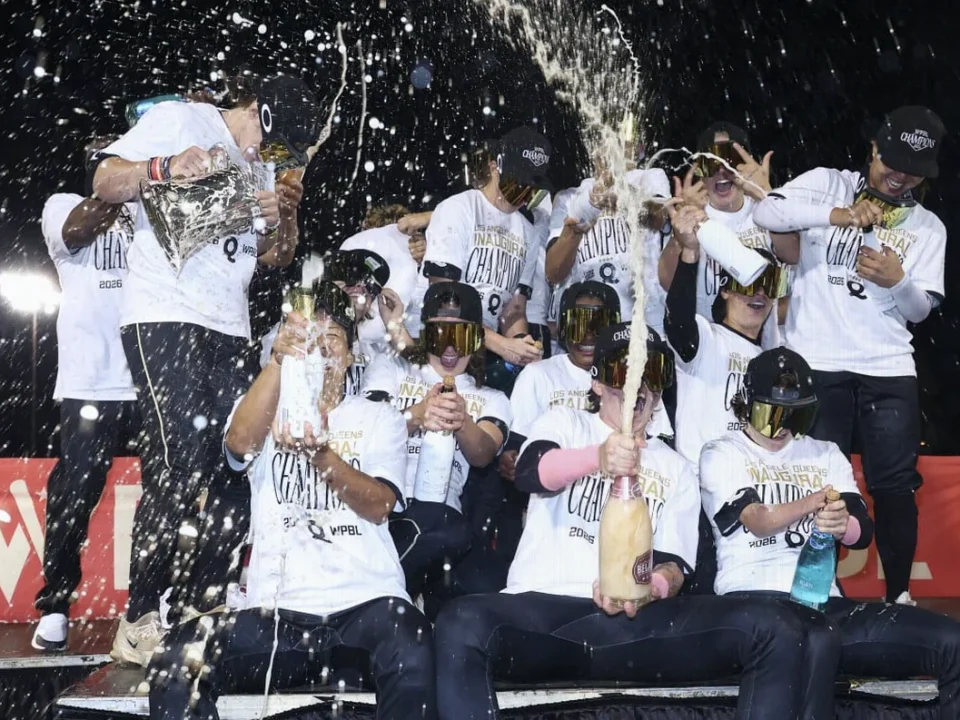
Ayami Sato’s season had carried frustration as well as promise, but the Los Angeles Queens got the version of their ace they had waited for when the championship was on the line. The Japanese right-hander threw the first complete game in Women’s Professional Baseball League history Tuesday night, blanking the San Francisco Firebells 2-0 and delivering the inaugural title to Los Angeles in Springfield, Illinois.
Sato owns the clincher
Selected No. 2 overall by the Queens in the first WPBL Draft, Sato entered the year with a résumé few in women’s baseball could touch. The Kagoshima native has won three Women’s Baseball World Cup MVP awards, more than any other pitcher, and held several records in Japan’s women’s league before that circuit closed in 2021. Last season, she also became the first woman to play for a men’s professional club in Canada, joining the Toronto Maple Leafs of the Intercounty Baseball League.
Her first Queens campaign did not always follow that decorated script. Sato posted a 6.09 ERA in the regular season and sometimes shared her disappointment with her own performances on Instagram. Still, the ingredients were evident: a fastball in the mid-to-upper 70s that could beat hitters at the top of the zone, plus a sharp curveball learned from former Seibu Lions pitcher Hiroshi Shintani.
Against San Francisco’s highest-scoring lineup, Sato put it all together. The Firebells had erupted for 17 runs Sunday and scored 27 over two games while climbing out of a 0-2 series hole. On Tuesday, though, they could not crack the Queens starter.
- Sato went the distance in a 2-0 shutout, the first complete game recorded in WPBL play.
- She was named championship MVP and lifted the silver trophy after the final out.
- Queens closer Meggie Meidlinger did not need to warm up for late-inning duty.
- Manager Eric Young Sr. recalled Sato telling the club in its first meeting that she wanted to become a champion. By night’s end, he said, she had done exactly that.
Speaking through her partner and translator, Mayo Hirano, Sato said the game seemed to move slowly because she wanted to absorb every moment. She said she hoped to enjoy baseball with “the best teammates in the world,” and felt her thoughts and her pitching were in sync.
After accepting her award, Sato said she was relieved and thanked teammates and fans for the energy they gave her each time she stepped onto the mound. Her closing message to the crowd was simple: “Enjoy baseball.”
Meidlinger called the outing a door-slammer and said she was thrilled for Sato both as a pitcher and as a person.
Two runs were enough for Los Angeles
The Firebells, regular-season leaders at 10-5, handed the ball to Jill Albayati after the ace had missed several weeks with a hamstring injury. Albayati was tough from the outset, allowing only one hit through 4 2/3 innings. But that hit came at the wrong time.
A walk and an error put traffic on the bases before former Little League standout Mo’ne Davis drove in the first Queens run with a single. Two hitters later, with another San Francisco error extending the inning, Queens captain Ashton Lansdell hit a hard ground ball to shortstop. Joely Leguizamon made the play and got the force at third, but another Los Angeles runner crossed the plate.
With Sato controlling the game, that two-run sequence settled the championship.
Heartbreak for the Firebells, pride in the season
San Francisco’s comeback had given the deciding game its edge, and the loss left the Firebells hurting. Second baseman Amanda Gianelloni said the first feeling was heartbreak, though she took pride in a team that pursued a title while building closeness, playing for one another, and representing San Francisco throughout the summer.
Manager Matt Williams described the ending as painful, likening it to racing at full speed before everything suddenly stops. Still, he said the club had the camaraderie and the qualities any manager would seek, even if it did not win the last game.
First overall Draft pick Kelsie Whitmore urged teammates to see more than the final score. The season, she said, mattered because women had their own professional league in which to compete, and any first-time viewer on championship night saw strong baseball.
A season larger than one trophy
The title game closed a two-month stretch in which more than 60 players gathered in Springfield for the first women’s professional baseball league in the United States since the All-American Girls Professional Baseball League. For many, it was an opportunity they had wanted for years without expecting it would arrive during their playing lives.
- New York Heights slugger Denae Benites, who shared the regular-season home run crown with Whitmore, had played in men’s recreational leagues to keep her baseball career going.
- Leguizamon, named Player of the Game in Game 3, said baseball was the only thing she had ever wanted to do and that she was living the dream by continuing to chase it.
- Firebells pitcher Niki Eckert, an employee of the New York City Department of Education, normally could only participate on weekends and flew back and forth each week. Remote-work permission for the playoffs allowed her to remain with the club and retire the Queens during their fifth-inning threat.
- Gianelloni, expecting a baby with her partner in a few months, set aside her business, work, baby showers, and everyday responsibilities for two months to play the sport she loved as a child.
For years, many of the players had found spots on men’s teams or been told to switch to softball. In Springfield, they trained daily with big league coaches and managers instead of waiting for scattered tournament at-bats on weekends. The league even had a roaming mascot modeled after longtime women’s baseball figure Maybelle Blair.
Lansdell said players know the feeling of being the lone girl on a field, an experience difficult for others to fully understand. Having an entire field filled with women, she said, was surreal and felt like what they had been waiting for.
Whitmore had written earlier in the season that years of trying to fit in as the only woman on a roster had taken away some of her joy in the game. In the WPBL, she said, the photos showed her feeling like a kid on a baseball field again, laughing and enjoying the sport more than she ever had in her career.
Meidlinger said she paused even on Opening Day to recognize that the league was fulfilling a dream players had carried since they were 4 or 5 years old: the chance to play professional baseball. At the end of the season, she said, they could finally take in what that meant.
Before the trophy ceremony, commissioner Justine Siegal dedicated the moment to those who had fought for women in the game on and off the field, including players from the All-American Girls Professional Baseball League and women who played in the Negro Leagues. She said the championship trophy belonged to the fans, girls who dream big, and the L.A. Queens.
Lansdell offered the clubhouse version of the league’s larger statement: women can play some very good baseball.