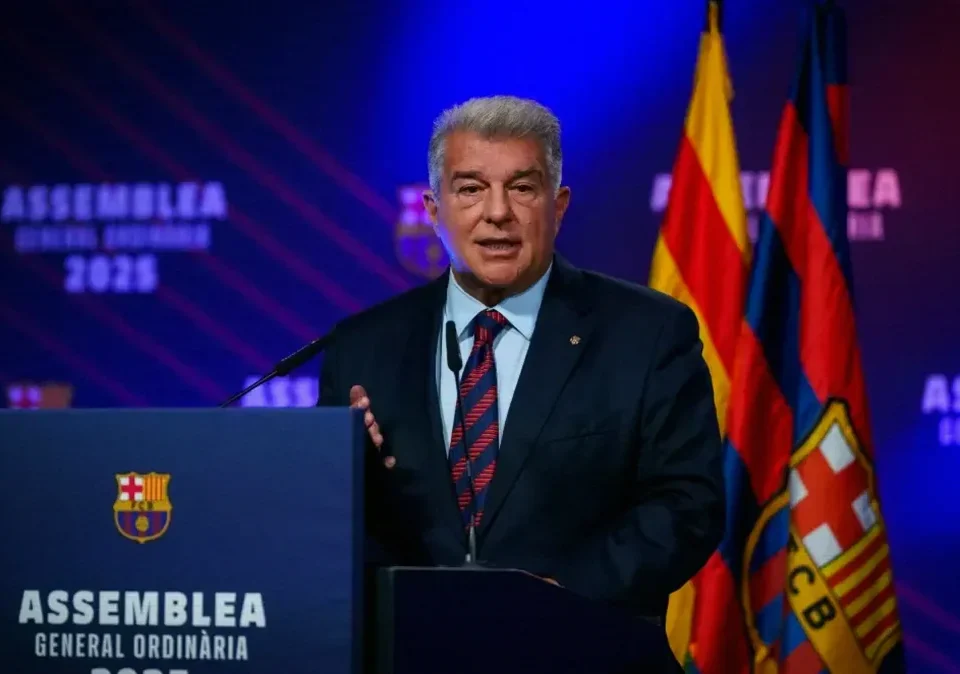
Barcelona’s Auditori 1899 became the meeting point for a club looking beyond the next match and towards a much longer horizon. FC Barcelona’s ordinary general assembly opened with 415 delegate members present, while others joined remotely, to consider the accounts for 2025-26, the budget for 2026-27 and a set of commercial and financing measures tied to the transformation of the Spotify Camp Nou and the wider Espai Barça project.
Joan Laporta told the gathering that members were being asked to make decisions affecting both the immediate position and the future direction of the institution. He said the board wanted authorisation to complete the stadium works while preserving Barcelona’s ability to field a competitive team, describing the club’s recent recovery from difficult years as a collective effort. “The club is moving in the right direction,” Laporta said, adding that he believed Barcelona supporters were in an optimistic mood.
The session began after a minute’s silence for members who have died over the past year. Secretary Josep Cubells warned that the programme could run for around eight hours, with a lunch break scheduled for 15:00. Before the detailed business began, the assembly was shown a film revisiting the club’s trophies and major moments of the past year, including Laporta’s victory in the March elections.
Camp Nou financing at the centre of the day
The defining vote concerns additional funding for Espai Barça, the redevelopment intended to turn the Camp Nou district into a year-round destination rather than solely a matchday venue. Members are due to decide whether to extend the Goldman Sachs credit facility by as much as €300 million, alongside a proposed €210 million issue of Media Notes secured against additional FC Barcelona audiovisual rights.
Those two operations sit beside the approval of the 2025-26 financial settlement and the proposed 2026-27 budget. The agenda also includes the confirmation of appointments to the board of directors and the club’s economic commission, a report from the members’ ombudsman, motions brought by members and an open floor for interventions.
For Barcelona, the funding debate reaches beyond construction bills. The club is attempting to finish its home’s remaking while building income streams that can travel far beyond Catalonia, from the Gulf to the family-entertainment market around the stadium itself.
Commercial links from the Emirates to Catalonia
One agreement put before the delegates is with Ohana Real Estate Development. The partnership covers a Barcelona-linked residential development in the United Arab Emirates through to 2055, as well as a sponsorship arrangement promoting both the project and the Ohana name until 2030.
The arrangement is expected to bring roughly €10 million per year during its first three years. Afterwards, Ohana would move into a licensing role, paying slightly more than €1 million annually across almost three decades of Barcelona branding at the Emirati complex. Ohana is also set to become a global sponsor, with its logo due to appear on the back of Barcelona shirts in domestic competitions for three seasons, from 2027-28 through 2029-30.
A separate proposal concerns Babylon Park Spain. It would grant a 25-year licence to create and operate an indoor family entertainment venue carrying the FC Barcelona identity at the Spotify Camp Nou. The planned attraction is intended to combine football-themed immersion with family leisure and provide recurring long-term revenue within Espai Barça.
The Babylon Park relationship also envisages a gradual rollout of Barcelona-branded entertainment centres elsewhere in Catalonia. Together with the Ohana project, it illustrates the scope of the choices facing the assembly: the club is not only weighing another stadium-finance package, but considering how the Barcelona name may be used across new places and industries for decades to come.