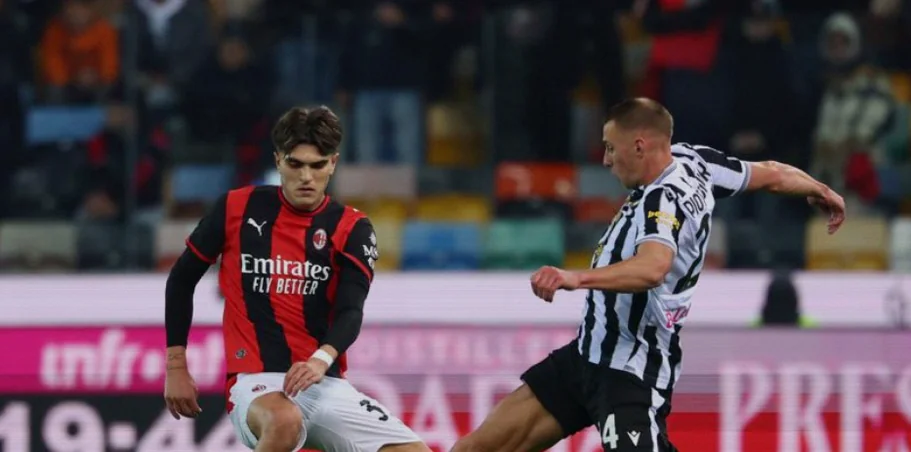
Davide Bartesaghi left Udine without the goal that might have crowned his afternoon, but with a new role to consider in Milan’s season. The young player came within a touch of finishing Fikayo Tomori’s inviting cross, only for Christian Pulisic to arrive at the same moment and deny him with an unintended intervention from his own side.
Bartesaghi said he had called for the ball before Tomori received it, while Pulisic later explained in the dressing room that he had not heard him. There was no dispute between the pair, merely a missed chance in a performance that offered Ruben Amorim another option during a period shaped by injuries.
An unfamiliar position brings an answer
The starting line-up at the Bluenergy Stadium raised immediate questions. Tomori, De Winter, Pavlovic, Diawara and Bartesaghi were all selected, with Bartesaghi’s inclusion the most unexpected element of the XI.
Amorim used him higher up the left side, at times close to Ramos, rather than asking him to cover the full flank as a conventional wing-back. With a defender behind him, Bartesaghi was able to attack with greater freedom: he carried the ball forward, supplied crosses, took a shot and kept Vojvoda occupied in deeper areas.
The adjustment reflected circumstance as much as theory. Amorim acknowledged that Milan would probably not have fielded that particular side without so many simultaneous absences. Yet necessity gave Bartesaghi the platform to show that his crossing and running can be more valuable when his defensive responsibilities are reduced.
“I felt very comfortable in this position,” Bartesaghi said after the match.
Amorim’s message remains direct
Amorim did not disguise the limits of the display. He judged Bartesaghi stronger going forward than in defensive work, adding that the player must improve without the ball. It was not a criticism delivered only for public consumption: the coach had already addressed the point directly with the player inside the stadium.
That approach has become a feature of Amorim’s management. He has repeatedly made clear that any message voiced publicly has already been put to the players privately on several occasions.
Bartesaghi’s chance to develop arrives after a complicated campaign. Under Massimiliano Allegri, he had enjoyed a more settled place, whereas Amorim’s ideas have often favoured quicker, more assertive wide players such as Moreira. Estupinan, meanwhile, has remained important enough for Milan to resist interest in the market.
There is also competition closer to the back line. Bartesaghi can operate as the left-sided third central defender, but Pavlovic is firmly established in that area and Diawara also impressed in Udine.
Bologna may offer another test
It remains uncertain whether Amorim will repeat the experiment against Bologna on Wednesday. Once the injury list shortens, Bartesaghi’s advanced role may become harder to accommodate from the start.
Still, Amorim has shown little interest in giving opposing coaches fixed reference points. In Bartesaghi, Milan may have found a situational solution rather than a permanent conversion: a left-sided player whose attacking contribution can be amplified when the match and the available personnel allow it.
For now, the missed finish is a minor footnote. Udine gave Bartesaghi something more significant: evidence that he can contribute to Milan’s changing picture in another shirt.