St. Louis finished last season outside the playoff field, but the club’s closing surge and a young core pushing into larger roles give the Blues a credible path back into the Western Conference wild-card race in 2026-27. Joel Hofer’s work in net, new forward options Mason McTavish and Connor McMichael, and an attack that creates from the middle of the ice are the main threads running through the club’s offseason picture.
St. Louis Blues 2026-27 notebook: Hofer takes the crease, youth drives the push
The Blues were the NHL’s best team from March 1 through the end of the regular season, collecting 35 points on a 16-4-3 run. Their .761 points percentage led the League over those 23 games, even though the late charge did not carry them into the Stanley Cup Playoffs.
Hofer was at the center of that finish. He tied for the NHL lead in wins over the stretch with 11 and matched the League high with two shutouts. His .932 save percentage ranked second among goaltenders who played at least 10 games in that period, trailing only Scott Wedgewood’s .946 mark. For the full season, Hofer posted six shutouts, one fewer than Ilya Sorokin, and his .910 save percentage ranked fifth among goalies with at least 40 appearances.
That performance put Hofer ahead of longtime No. 1 Jordan Binnington, the goaltender who backstopped St. Louis to the 2019 Stanley Cup, as the club’s leading option. The underlying numbers support the shift. Hofer stopped .984 of long-range shots, tied for fourth in the League, while his 311 saves from that distance ranked seventh. He was also tied for ninth with a .906 save percentage on mid-range attempts.
His quality-start rate was another encouraging indicator. Hofer delivered a save percentage above .900 in 60.5 percent of his starts, sixth among goaltenders with at least 40 starts. If his workload grows into a true starter’s assignment, the Blues have reason to believe there is another level available.
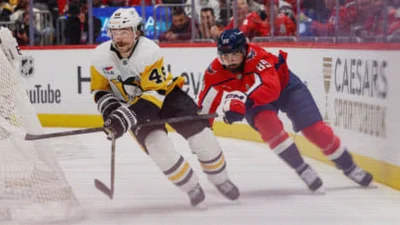
Up front, the departure of Jordan Kyrou has changed the conversation around the top six. McMichael arrived from the Washington Capitals in the June 23 deal that sent Kyrou out, while McTavish joined the Blues from the Anaheim Ducks on June 26. Both newcomers bring traits that fit a roster that has become increasingly fast and direct through the neutral zone.
McTavish, 23, has shown the shot profile of a player capable of breaking out with a larger opportunity. Last season, he ranked in the 91st percentile among NHL forwards with 70 attempts clocked between 70 and 80 mph, and his 25 tries in the 80-to-90 mph range placed him in the 88th percentile. In 2024-25, he reached the 91st percentile with 70 mid-range shots on goal and ranked in the 86th percentile with 61 high-danger shots on goal.
McMichael offers more than one look for the Blues’ top-nine group. He recorded 174 skating bursts above 20 mph last season, good for the 91st percentile among forwards. His hardest shot measured 91.40 mph, placing him in the 89th percentile, and his top skating speed of 23.01 mph ranked in the 85th percentile. He generated 63 high-danger shots on goal, an 87th-percentile total, but converted those chances at 17.5 percent, below the NHL forward average of 19.6 percent. A better finish rate could make him a more productive scorer in St. Louis.
The Blues’ offense already showed a clear strength from the mid-range areas last season. Their average shot speed of 58.72 mph ranked 10th in the NHL, and they were tied for third with 94 mid-range goals. St. Louis also placed sixth with 701 mid-range shots on goal.
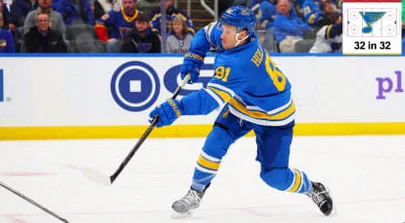
Dylan Holloway was one of the club’s most dangerous shooters in that profile. His hardest shot came in at 93.05 mph, ranking in the 92nd percentile among forwards, and his 59.02 mph average shot speed sat in the 89th percentile. He scored 14 times from mid-range territory, a 97th-percentile figure among NHL forwards.
Jimmy Snuggerud found a fit beside Holloway and Robert Thomas on the top line late last season, and his tracking numbers mirrored Holloway’s. The rookie registered a 95.56 mph top shot, placing in the 97th percentile, along with a 59.96 mph average shot speed that ranked in the 90th percentile. He produced 74 mid-range shots on goal, in the 93rd percentile, and scored eight mid-range goals, an 86th-percentile result.
Kyrou leaves behind a meaningful share of that production. He had 82 mid-range shots on goal last season, a 95th-percentile total, and nine goals from that area, ranking in the 89th percentile. In 2024-25, his 16 mid-range goals were tied for seventh in the NHL. McTavish, McMichael or Dalibor Dvorsky could take the opening created in the Blues’ top-six mix.
Dvorsky, 21, was selected 10th overall in the 2023 NHL Draft and showed scoring touch despite limited usage as a rookie. Five of his 12 goals came on the power play. His hardest shot reached 89.81 mph, placing him in the 83rd percentile among forwards, and he scored four goals from the mid-range zone, a 65th-percentile mark.
On the blue line, Philip Broberg gives the Blues another young player with room to grow. The 25-year-old ranked in the 98th percentile among defensemen in both top skating speed, at 23.46 mph, and 20-plus mph bursts, with 158. He also produced 35 mid-range shots on goal, ranking in the 93rd percentile at his position.
With Hofer, Holloway, Snuggerud, Dvorsky and Broberg all 26 or younger, St. Louis has a developing group spread through the lineup rather than concentrated in one area. The next step is turning last spring’s strong finish into a full-season push, beginning with Hofer’s opportunity to hold the crease and the reshaped forward group’s ability to replace Kyrou’s offense.
SEO Title: St. Louis Blues 2026-27 Notebook: Joel Hofer, McTavish and McMichael
SEO Description: Joel Hofer’s rise, St. Louis’ mid-range scoring strength and the arrivals of Mason McTavish and Connor McMichael shape the Blues’ 2026-27 outlook.