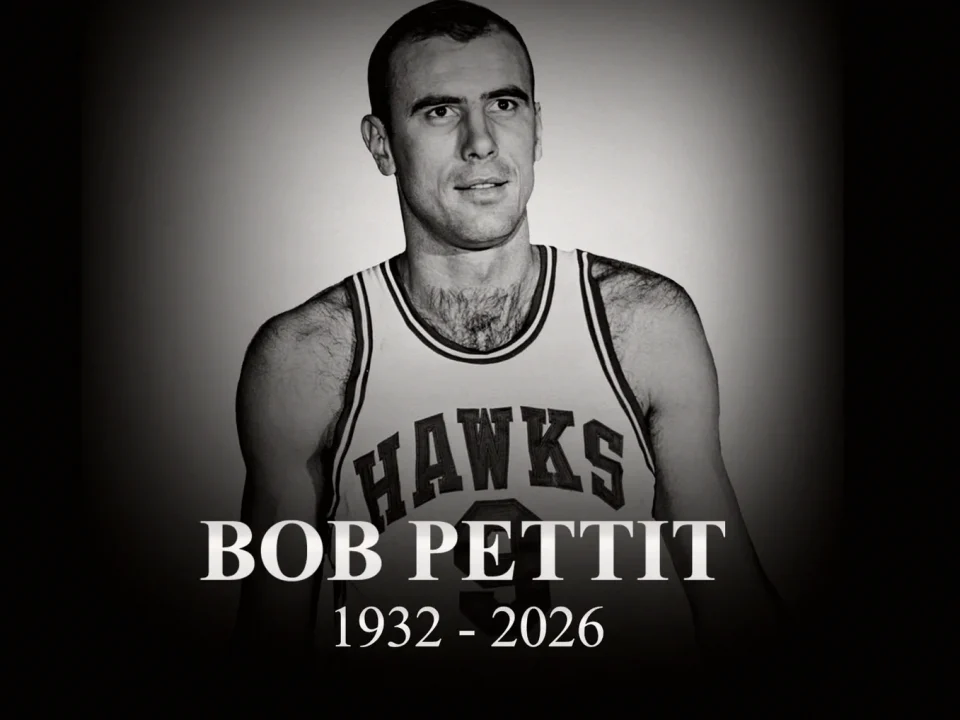
Bob Pettit, the St. Louis Hawks cornerstone who set the NBA’s original MVP standard and powered the franchise to its only championship, has died at 93. LSU, his alma mater, said Thursday that Pettit died Wednesday; no cause was announced.
| Career marker | Figure |
|---|---|
| NBA seasons | 11, all with Hawks |
| Career scoring average | 26.4 points per game |
| Career rebounding average | 16.2 rebounds per game |
| Career points | 20,880 |
| Career rebounds | 12,849 |
| 1956 scoring average | 25.7 points per game |
| 1959 scoring average | 29.2 points per game |
Pettit arrived before the league’s television boom, a star in St. Louis whose national profile never quite matched the size of his production. At 6-foot-9 and 205 pounds, he was an early prototype of the modern power forward: a big man comfortable facing the rim, scoring away from the block, working the glass and taking occasional center minutes.
He was the NBA’s Rookie of the Year in 1955, when the Hawks were completing their final season in Milwaukee, then became the league’s first Most Valuable Player the following year. Pettit won another MVP in 1959, made the All-Star team in every one of his 11 NBA campaigns and collected four All-Star Game MVP awards. Kobe Bryant is the only other player to match that total.
NBA commissioner Adam Silver said Pettit “set a new standard of excellence” as the league’s inaugural MVP, first 20,000-point scorer and first four-time All-Star Game MVP. Silver also noted that Pettit’s 50-point Game 6 in the 1958 Finals delivered the title to St. Louis and said Pettit helped reshape the power forward job.
The 1958 title still stands alone
Pettit’s defining postseason came against the Bill Russell-led Boston Celtics. He scored 50 points in Game 6 of the 1958 NBA Finals to close out the series and give the Hawks their lone NBA championship.
Boston was the central obstacle of Pettit’s era, with the Hawks reaching the Finals four times against the Celtics. St. Louis lost a double-overtime Game 7 in 1957, broke through in 1958, then fell in seven games in 1960 and in five games in 1961. The 1958 result interrupted a Celtics stretch that produced nine championships in 10 seasons.
Pettit held his own in a league that also featured Wilt Chamberlain, Russell, Oscar Robertson and Elgin Baylor. He seldom sat out, and when he retired following the 1964-65 season, he was the NBA’s all-time points leader and ranked second in total rebounds.
The Naismith Memorial Basketball Hall of Fame inducted him in 1970. Its profile described Pettit as a lean, polished and well-conditioned frontcourt player whose willingness to outwork opponents separated him from his peers.
Baton Rouge roots and LSU stature
Robert Lee Pettit Jr. was born Dec. 12, 1932, in Baton Rouge, Louisiana. His father worked in law enforcement and served as sheriff of East Baton Rouge Parish. Pettit did not make Baton Rouge High School’s varsity team until his junior year, then led the school to a state championship as a senior and received more than a dozen college offers.
He stayed home for LSU, entering the varsity as a sophomore under the eligibility rules of the time. Pettit led the Southeastern Conference in scoring in each of his three LSU seasons.
| LSU season | Points per game |
|---|---|
| Sophomore | 25.5 |
| Junior | 24.9 |
| Senior | 31.4 |
Pettit is one of three LSU players in the Hall of Fame, alongside Pete Maravich and Shaquille O’Neal. LSU retired his No. 50, and statues of Pettit and O’Neal stand outside the Pete Maravich Assembly Center. The Hawks retired Pettit’s No. 9.
After his playing career, Pettit returned to Baton Rouge and worked in banking and financial consulting. In recent years, he remained a familiar presence at LSU games and New Orleans Pelicans home dates.