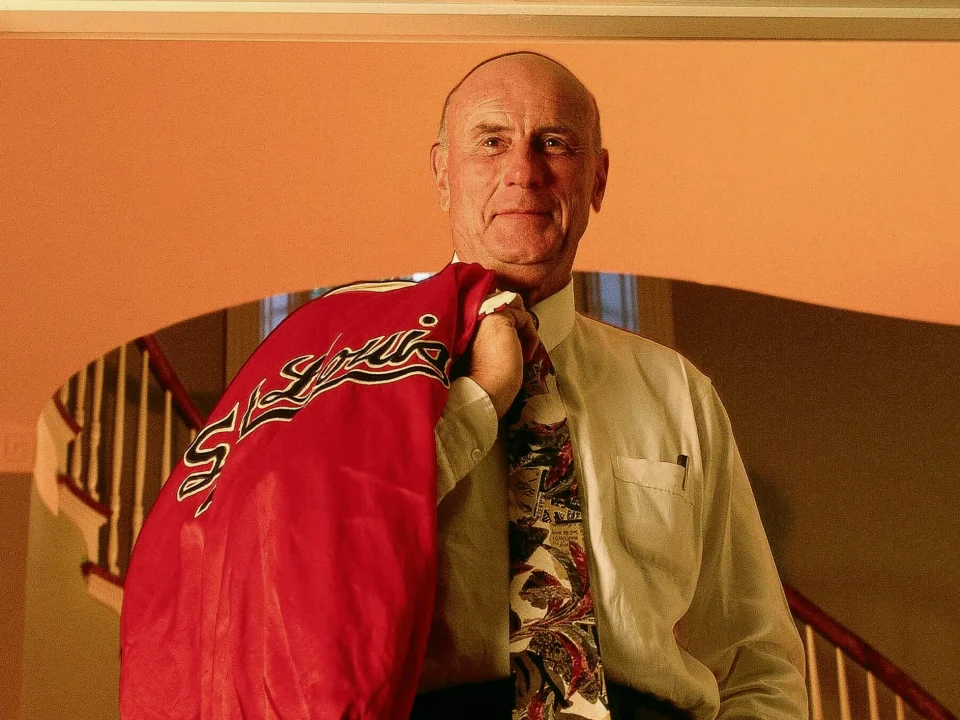
Bob Pettit’s place in the NBA’s early architecture is easy to spot in the numbers, but the clearest marker came on a spring night in 1958. The St. Louis Hawks forward put 50 points on Boston in Game 6 of the Finals, closing out the franchise’s only championship and handing Bill Russell the lone Finals loss of his 12 championship-series appearances.
| Bob Pettit career snapshot | Figure |
|---|---|
| NBA seasons | 11 |
| Teams | Milwaukee/St. Louis Hawks |
| Career scoring average | 26.4 points per game |
| Career rebounding average | 16.2 rebounds per game |
| NBA Finals appearances | 4 |
| MVP awards | 2 |
| All-NBA First Team selections | 10 |
| All-Star selections | 11 |
Pettit was a 6-foot-9 forward listed at 205 pounds, yet he played with the force of a much bigger frontcourt player. Long before “power forward” became standard NBA language, he was doing its work: scoring from the midrange, owning the paint and treating every missed shot as a new possession to win.
The 1958 breakthrough
The Hawks had already come painfully close against Boston a year earlier. In the 1957 Finals, Pettit forced overtime in Game 7 by making two free throws with six seconds remaining. In the final moments of overtime, his tip attempt circled the rim and fell away as the Celtics survived.
One year later, Pettit and the Hawks got another shot at Russell. Boston’s center was not fully healthy, but Pettit’s series-clinching Game 6 still stands as one of the defining individual Finals performances. His 50 points remained the most in a championship-winning closeout game until Giannis Antetokounmpo matched it for Milwaukee in 2021.
Tommy Heinsohn spent much of that matchup trying to check Pettit. Red Auerbach kept the result alive for years, needling Heinsohn with the idea that Boston might have won 10 consecutive titles if Pettit had been limited to 48.
Russell later described what made Pettit such a problem: his repeated effort. Russell said Pettit made the idea of a “second effort” part of the sport’s vocabulary, always working for post position, fighting on the glass and delivering when the pressure climbed.
A nightly double-double standard
| Season point | Points | Rebounds |
|---|---|---|
| Rookie season | 20.4 per game | 13.8 per game |
| Final season | 22.5 per game | 12.4 per game |
| Career | 26.4 per game | 16.2 per game |
That 1958 explosion was not a one-off in Pettit’s ledger. He averaged at least 20 points in every NBA season and never finished outside the top seven in the league scoring race. He became the first NBA player to reach 20,000 points and, when he retired in 1965, stood second on the league’s all-time rebounding list.
Oscar Robertson called Pettit’s durability and production nearly impossible to find in the modern game. The numbers held from the moment Pettit entered the league through his last season, an unusual run for a high-usage scorer who also did the heavy work near the rim.
Pettit believed offensive rebounds made a direct difference on the scoreboard, estimating that they produced eight to 12 points a night for him. At a time when fewer players consistently hunted second chances, he made that pursuit central to his game.
His own explanation was blunt: every teammate shot was an opportunity to go get the ball. Pettit said he never used a possession to rest, never decided to stay back and watch, and kept attacking the offensive glass because the accumulated extra work paid off.
Built before the position had a name
Pettit’s basketball path began in Baton Rouge, Louisiana. He developed his perimeter shot in high school and helped win a state championship after initially being cut from the team. By the time he reached LSU, he had grown five inches and brought an unusual skill package for a big man: he could score from roughly 15 feet as well as around the basket.
That combination transferred immediately to the professional game. The Hawks were still in Milwaukee during Pettit’s rookie season, and he helped turn them into a contender before the franchise relocated to St. Louis. In an era when many centers and forwards were not asked to carry an offense, Pettit became the focal point.
His rebounding technique was as much about the man in front of him as the ball in the air. Pettit said he watched the defender trying to seal him out, fought around that body and worked into the space where he expected the rebound to land. Much of his game, he said, was the pushing and shoving beneath the backboard.
The league would eventually place a premium on forwards who could stretch defenses, score from different spots and still control the paint. Pettit was playing that role decades before the terminology caught up.
Respect inside the Hawks locker room
Lenny Wilkens joined Pettit in St. Louis during the forward’s final seasons and saw the routine up close. The young point guard said Pettit arrived ready every night, did not make excuses and could be counted on to produce when the ball reached his preferred areas.
Pettit’s resume included the NBA’s first MVP award in 1956, another MVP in 1959, four All-Star Game MVPs, 10 All-NBA First Team nods and 11 All-Star selections. He was later named to the NBA’s 25th, 35th, 50th and 75th anniversary teams, along with his Hall of Fame induction.
For Wilkens, the longer evaluation needed little decoration: Pettit was one hell of a player. The record backs it up—an original high-volume forward, a relentless rebounder and the man who interrupted Russell’s championship run before Boston took control of the next decade.