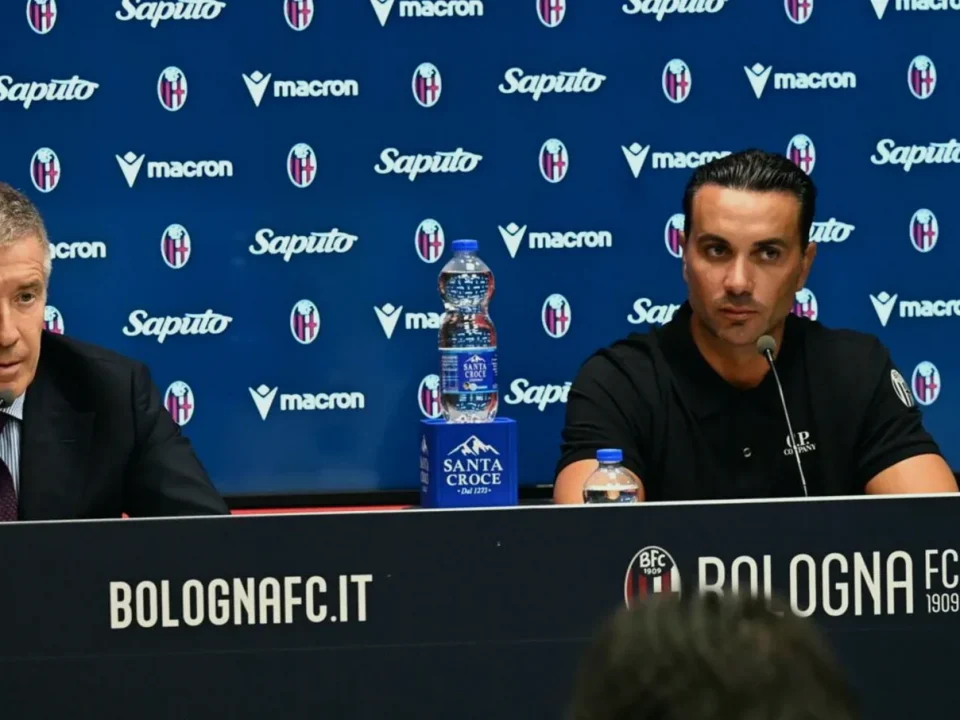
Bologna have chosen a decisive change of direction after only four league matches, dismissing Tedesco and placing Raffaele Palladino at the centre of a longer-term plan. The new coach arrives with Saturday’s home match against Torino already in view, but the club see the coming three-week break as the first real opportunity to build a new cycle.
Key takeaways
- Bologna dismissed Tedesco after four Serie A rounds, judging that the team had struggled to apply his ideas on the pitch.
- Palladino has signed a three-year contract, the first such deal Bologna have given to a coach.
- The new manager considers a back three his preferred reference point, while believing the squad can also operate with four defenders.
- Riccardo Orsolini returned to partial team training and will be assessed ahead of Saturday’s meeting with Torino.
- Chief executive Claudio Fenucci said Bologna want to regain European contention and reproduce major nights such as the Coppa Italia final win over Milan in Rome.
A rapid dismissal and a longer appointment
Fenucci acknowledged that Bologna had acted in a manner unusual for the club. Tedesco’s spell was brief, yet the board concluded that waiting through the approaching international break would not solve their concerns.
The chief executive explained that, after reviewing training methods, the coach’s footballing proposal and its effect on the side’s performances with Giovanni Sartori and Marco Di Vaio, the club felt his influence had fallen short of expectations. The issue, he stressed, was not intended as a verdict on Tedesco’s professional methods, which had worked before and could do so again.
Instead, Bologna believed the players were not managing to translate the coach’s requests into matches. The club thanked Tedesco for the months shared together and for what Fenucci described as a strong human relationship, but felt compelled to intervene while a long pause in the calendar remained available.
Palladino was contacted quickly and accepted the prospect of a substantial project. Fenucci said Bologna moved swiftly partly because they did not want to lose a coach with whom they had already been in contact. The resulting three-year agreement is a notable commitment from a club that want stability after a sudden change.
The executive said the ambitions are shared: Bologna want to put themselves back in the conversation for Europe and return to occasions that carry the weight of their Coppa Italia triumph over Milan in Rome. Financial backing, he said, will be available from the club, while the squad must be prepared to stretch beyond its perceived limits.
Palladino’s first task: restore conviction
Palladino said he had not accepted Bologna merely to occupy a vacant bench. He felt trust from the club during the discussions and said the agreement came together rapidly because the move felt like the right place to grow and begin a fresh professional chapter.
His route has already taken him from Monza, where he established himself at the highest level, to Fiorentina, which he described as an important year of development, and then through a Champions League campaign that gave him further experience. His attention, however, is now entirely on Bologna.
He has inherited a group he believes has a sound base, but one that must recover the energy around the club. Palladino recalled that Bologna were difficult opponents when he visited the Dall’Ara as a player. His intention is to restore that sense of resistance while asking the side to play on the front foot rather than surrender initiative.
“Everyone must give everything for this shirt, the supporters and the club,” Palladino said. “We have to bring something back to the fans and to Bologna. The enthusiasm has to return.”
On the tactical side, Palladino made clear that he has adjusted systems during his coaching career and will do so again if the players require it. He believes the current squad was assembled mainly with a four-man defence in mind, but sees enough quality in the wide areas to use three at the back as well. His usual framework is based on a three-defender line, though he wants Bologna to become adaptable rather than fixed.
He also outlined demands without the ball: the team should press opponents high and seek quick recoveries, with forwards contributing as the first defenders. In possession, he wants clarity and quality players placed in conditions where they can decide matches. Every player, he said, must defend collectively when possession is lost.
Orsolini’s return to partial training offers an early selection question. Palladino said the winger had responded positively but that his availability against Torino would be decided later. He described Orsolini and Federico Bernardeschi as a potentially formidable pairing and indicated that he would look to field as much technical talent as possible.
The immediate preparation is compressed. Palladino had watched Bologna’s match against Lazio in person before taking the job, looking for new coaching principles and ideas. Although the result had been disappointing, he saw an attempt by the team to impose its own football.
Now he wants as much contact as possible with the players, both to work and to understand their feelings. Three days can bring progress, he said, but they are also limited when a Saturday fixture is so close. Every available minute matters.
Torino are therefore the first test, one Palladino called highly important. After that, the three-week break should resemble a training camp, with work aimed at lifting physical condition and adapting the group to greater intensity. He has asked for patience, describing the process as one that began only recently, but he does not want Bologna to set narrow limits on what can be achieved.
For now, the message is to avoid studying the table and concentrate on the work. Bologna have made an early correction; Palladino’s task is to make it the start of a season that regains direction rather than another interruption.