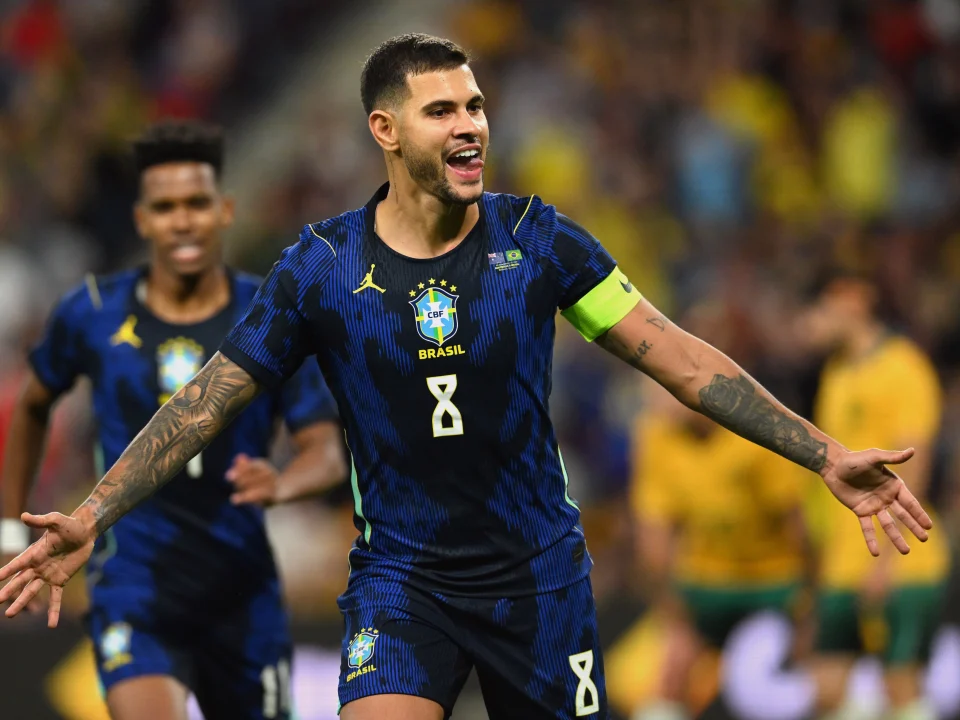
In Brisbane, Brazil found a more convincing route through Australia: a fuller midfield, an early goal and enough attacking weight to turn a six-goal friendly in their favour. Carlo Ancelotti’s side were tested in transition and by high deliveries into the box, but their second match after the World Cup ended with a comeback victory that offered clearer attacking answers than their previous outing in Townsville.
A midfield platform in Brisbane
Brazil returned to a 4-3-3, placing Danilo, Bruno Guimarães and Gabriel Bontempo across the centre of the pitch. The adjustment gave the visitors more bodies around the ball in advanced areas, better connections down both flanks and a notably higher attacking output.
The midfield triangle also changed the first phase of possession. One holding player could drop alongside the defenders to create a three-man build-up, while two teammates remained available ahead of him. That gave Brazil routes forward through combinations, third-man movements and support from the full-backs.
- Vanderson put Brazil ahead in the third minute with a first-time finish. Bruno Guimarães helped begin the move from deep, Bontempo supported Vanderson’s progression, Rayan stretched the defence with a run in behind, and Bontempo then arrived in the area to supply the assist.
- Brazil began with intensity and caused Australia problems with their high press, controlling much of the opening 20 minutes.
- As the visitors committed more players forward, Australia found counter-attacking space. Brazil had difficulty recovering while running back towards their own goal, with their first defensive line occasionally left exposed.
- Raphinha did not return for the second half, and Endrick was introduced to threaten the space behind Australia’s final line. Brazil also looked more often for Vinícius Júnior in depth.
- Australia continued to pose a threat, particularly from aerial balls, but Brazil’s volume of attacks kept growing.
- Bruno Guimarães scored Brazil’s third after another move built from the back, involving the midfielders before the finish.
- Vinícius converted a penalty to complete the scoring and seal the Brazilian win.
Numbers underline the change
Australia managed seven attempts, the same total they had produced in Friday’s match in Townsville. Brazil, however, created far more than they had in that earlier game, recording 18 shots rather than six.
| Brazil attacking measure | Brisbane | Previous match |
|---|---|---|
| Total shots | 18 | 6 |
| Shots from inside the penalty area | 13 | 8 |
| Actions inside the penalty area | 30 | 18 |
| Duels won | 54 | 39 |
Work still to do without the ball
The Brisbane display was not without its concerns. Brazil’s aggressive positioning and greater attacking presence left them vulnerable when Australia broke quickly, and the timing of the midfielders’ forward movement remains an area requiring refinement.
Yet the friendly showed a broader offensive repertoire than Brazil had displayed on Friday. With Danilo, Bruno Guimarães and Bontempo supplying a stronger central base, Ancelotti’s team carried more authority in possession and produced the goals needed to come through a demanding evening on Australia’s east coast.