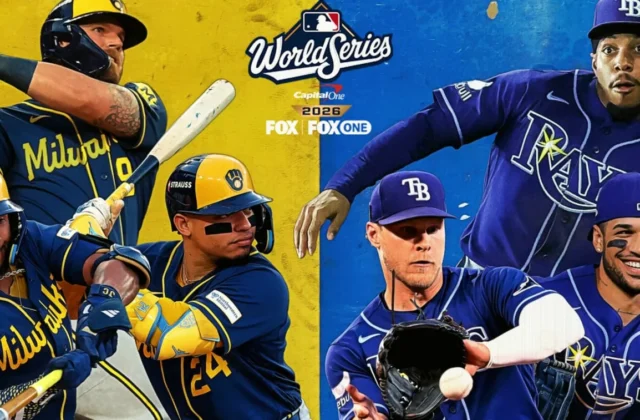
Milwaukee and Tampa Bay arrive at Game 1 with the same kind of October identity: quick runners, hard-nosed defense, contact-heavy at-bats and rotations built to keep a game from getting away. The Brewers own home field and carry a rested bullpen into the World Series opener tonight at 8 p.m. ET, while the Rays bring a lineup led by Junior Caminero and a staff with enough depth to make this a long, uncomfortable series for either clubhouse.
World Series snapshot
| Category | Milwaukee Brewers | Tampa Bay Rays |
|---|---|---|
| League seed | No. 1 in the National League | No. 1 in the American League |
| Top-three starters, postseason ERA | 1.87 combined | |
| Bullpen postseason work | 6 earned runs in 40 2/3 innings | Closer Bryan Baker’s velocity is a question after heavy ALCS usage |
| Average bullpen fastball | 98.0 mph | 93.2 mph |
| Game 1 | Tonight, 8 p.m. ET | |
This is only the sixth No. 1 seed versus No. 1 seed World Series in the last three decades. It also brings together two franchises still hunting their first championship, something that has happened only once since 1980, when the Royals met the Phillies, and only twice over more than a century.
The clubs have a few shared roots. Tampa Bay starters Drew Rasmussen and Freddy Peralta were Brewers teammates in 2020 and 2021. Rays corner infielder Jake Bauers debuted with Tampa Bay in 2018 before becoming Milwaukee’s NLCS MVP. Brewers president of baseball operations Matt Arnold also spent nine years in the Rays’ front office.
On the field, they are built in similar fashion. Tampa Bay struck out less often than any club in the majors. Both teams finished among the top five in steals, ranked in the bottom 10 in home runs and led the sport in bunt-hit production, with the Rays first and Brewers second. Neither side plans to wait around for a three-run homer.
Position-player edges
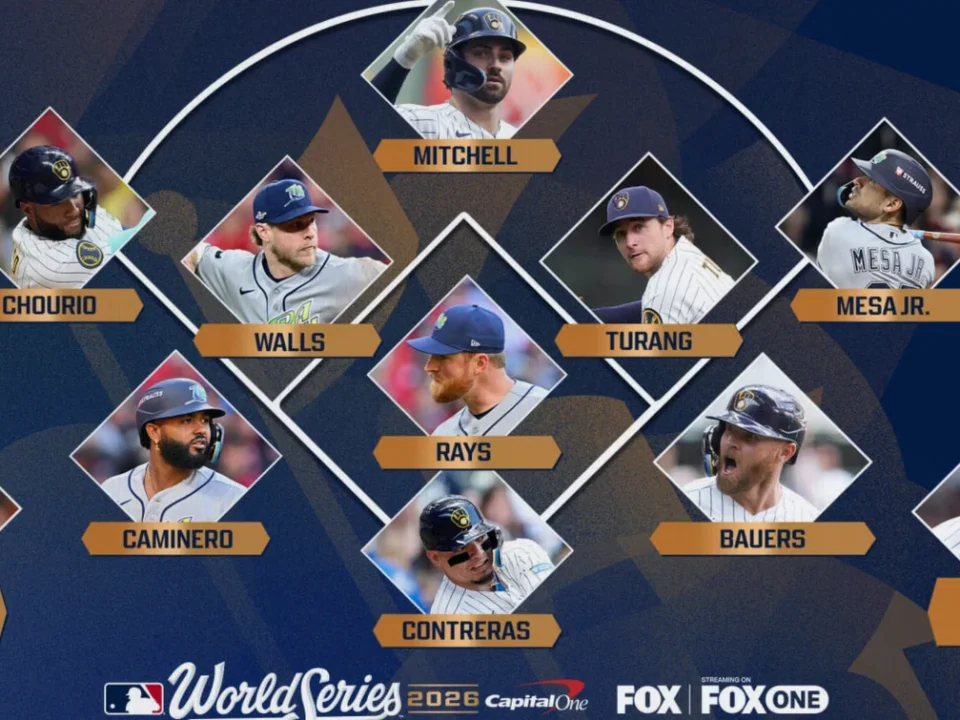
Milwaukee has the clearer advantage behind the plate. William Contreras has been one of the National League’s most complete catchers over the last five seasons, and his October line has been loud: a 1.157 OPS and three home runs in eight games. His regular-season offense has dipped from a 129 OPS+ peak across 2022-24 to 110 over the last two years, but that remains dependable production.
Tampa Bay made a helpful midseason addition in Liam Hicks, who posted a 129 OPS+ in 41 games and gave the lineup more length. Hicks has not found much at the plate this postseason, though, and Contreras’ larger body of work gives Milwaukee the nod.
At first base, the Rays have the feel-good breakthrough in Jonathan Aranda, who reached this level a decade after signing with Tampa Bay as an amateur free agent. Bauers, however, has offered more power, reached base more consistently and outplayed Aranda during the regular season and in October. Neither is carrying the matchup with his glove, making Bauers the stronger choice.
Second base is Milwaukee’s biggest mismatch. Brice Turang paired standout defense with 21 home runs and 100 RBIs, putting himself in the conversation as baseball’s best all-around second baseman. Richie Palacios and Ben Williamson have supplied Tampa Bay with useful work at the position, but it is not the same level of impact.
The shortstop decision is less straightforward. Taylor Walls remains in Tampa Bay’s everyday lineup for his defense despite a .381 OPS this month and a long record of limited offense. Cooper Pratt, Milwaukee’s rookie, has produced around league-average offense and relied largely on singles in the postseason. Pratt projects as a fine defender, but several October mistakes give the steadier Walls the edge.
Caminero changes the tone at third. The Rays star produced a second straight season of more than 40 home runs and is likely headed for a prominent finish in AL MVP voting. His bat was quiet early in the postseason before his ALCS Game 6 homer, though he has faced premium pitching, including fastballs averaging 96.8 mph. Milwaukee can counter with speed and defense from David Hamilton and Joey Ortiz, but Caminero’s offensive ceiling makes this one-sided.
In right field, Jackson Chourio brings the bigger package. At 22, he is the first player in history with three 20-homer, 20-steal seasons by that age, combining power with premium defense. Tampa Bay’s Chandler Simpson, 25, has elite contact and speed, while his improved defense helped earn Gold Glove finalist recognition for both players. But with both able to run and defend, Chourio’s power separates him.
Center field is nearly even. Garrett Mitchell gets on base more often than Jonny DeLuca, posting an on-base percentage 54 points higher despite striking out more. Mitchell’s walk rate was three times DeLuca’s, and he has delivered major postseason moments. DeLuca likely owns the slightly better glove, and Cedric Mullins remains another capable defensive option for Tampa Bay, but Mitchell’s ability to reach base gives Milwaukee a narrow advantage.
Left field belongs to Tampa Bay. Sal Frelick had a difficult regular season, finishing with a career-low 70 OPS+, and has only three singles plus a handful of walks in the playoffs. He can still help in other areas. Victor Mesa Jr., though, has emerged as a Rays difference-maker after joining the club for good only in late May. He posted a 127 OPS+ in roughly half a season, supplied exceptional defense and owns a throwing arm that can alter an inning.
At designated hitter, Tampa Bay has the more dangerous bat. Yandy Díaz, now in his eighth Rays season, outperformed Milwaukee captain Christian Yelich, 124 OPS+ to 91, and has maintained that edge into October. Yelich has sat against some tough left-handers, with Andrew Vaughn taking those turns. Díaz does not play much defense anymore, nor does Yelich, so the assignment is simple: deliver offense. Díaz has done more of it.
The rotation test
The Brewers will lean on Jacob Misiorowski, Logan Henderson and Robert Gasser. Tampa Bay’s principal trio is Rasmussen, Peralta and Nick Martinez. Together, those six starters have posted a 1.87 ERA in the postseason, aided by strong defense and relief work even as their strikeout rate has been merely average.
Misiorowski, the likely NL Cy Young winner, is the biggest individual arm in the series and has been the sport’s most dominant pitcher on a per-hitter basis. Yet he owns the highest postseason ERA among the six. Rasmussen has pitched like an ace himself, and Peralta has become a notably different pitcher since his move to Tampa Bay from New York before the Trade Deadline.
Tampa Bay’s edge is depth. No Milwaukee starter has worked beyond five innings this postseason, creating repeated demand for the relief corps. The Rays also have Griffin Jax and Ian Seymour behind their first three, a stronger fallback than Milwaukee’s Shane Drohan and Dustin May. Tampa Bay’s contact-oriented lineup may also try to extend Misiorowski’s at-bats and push his pitch count, something opponents have managed this month.
Milwaukee’s hard-throwing relief advantage
If the Brewers’ rotation has often handed over the ball early, the bullpen has carried the load. Milwaukee relievers have allowed six earned runs across 40 2/3 postseason innings. Closer Trevor Megill and Aaron Ashby draw much of the attention, but JoJo Romero has struck out 47% of his hitters this month.
Abner Uribe, Antonio Senzatela, Megill and Ashby have each averaged better than 98 mph with their fastballs in October. Milwaukee’s relief unit has averaged 98 mph overall, the second hardest-throwing bullpen since pitch tracking began in 2008 and the fastest one in that span without Mason Miller.
The Rays bullpen is still a strength, just a different kind. Its 93.2 mph average fastball sits well behind Milwaukee’s. Baker, Tampa Bay’s All-Star closer, becomes the key health-and-rest question. His regular-season fastball averaged 96.3 mph, but it dropped below 93 mph in ALCS Game 6 after a heavy workload against Cleveland. He remained effective, and three days before the World Series should help, but the Brewers have the deeper and fresher relief group.
Small margins, big October stakes
Milwaukee’s lineup depth could be the series tiebreaker. No team received more second-half production from the sixth through ninth spots than the Brewers. Their middle infield was the third most productive in baseball, while Tampa Bay’s ranked third from the bottom.
The Rays have the series’ biggest position-player star in Caminero. Milwaukee has Misiorowski, home field, a more powerful bullpen and a lineup that can keep pressure on an opponent without living on the long ball. Tampa Bay’s defense, speed, rotation depth and opportunistic style should make every game uncomfortable.
It has the shape of a tight seven-game fight between clubs that recognize themselves in the other dugout. Still, Milwaukee owns enough narrow advantages to enter as the choice to bring the city its second World Series championship and the Brewers franchise its first.