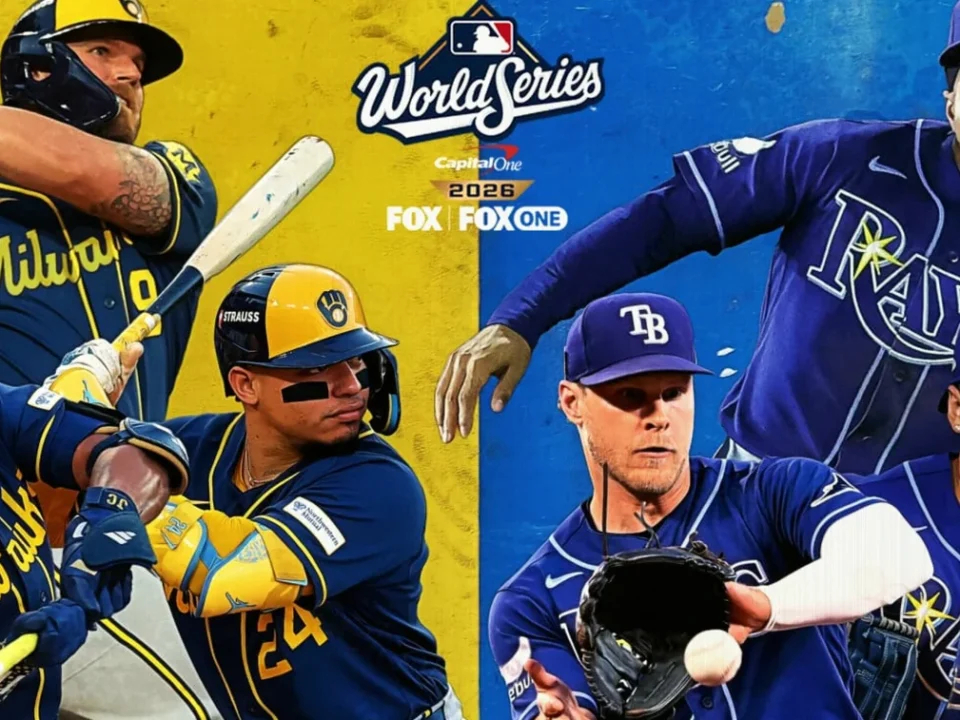
The World Series will put a familiar Milwaukee question on the biggest stage: what kind of offense are the Brewers going to be tonight? Pat Murphy’s club can bunt, run, take the other way and make an opposing defense work from first pitch to last. It can also turn a game into a walk-strikeout-homer affair, as the Dodgers discovered during Milwaukee’s NLCS win over the two-time reigning champions. Against Tampa Bay, the Brewers’ ability to reshape itself runs into a defense built to turn loud contact into quiet outs.
Milwaukee brings more than the small-ball tag
The Brewers do not fit neatly into the usual offensive labels. Their relatively modest home-run total has helped attach the small-ball description, and there is truth in it: they use the whole field, move well on the bases and are comfortable laying down a bunt. But their route through the NLCS showed another version of the lineup. Over that seven-game series, Milwaukee produced the most homer-walk-strikeout-heavy offensive mix recorded by any club in a seven-game postseason matchup.
That flexibility is rooted in hard contact. Milwaukee owns the fifth-fastest bats in the Majors and ranks seventh in hard-hit rate, even without being among baseball’s biggest home-run clubs.
- A hard-hit ball is tracked at 95 mph or harder off the bat.
- Across the Statcast era, beginning in 2015, those balls have produced a .512 batting average and a 1.020 slugging percentage.
- About 97% of all home runs come on hard-hit contact.
- Softly struck balls, by comparison, have generated only a .222 average and .265 slugging percentage.
Murphy made clear in early September that Milwaukee is not trying to manufacture weak contact. “We are absolutely trying to hit home runs,” he said. “We are not shortening up just to put ground balls in play.”
Infielder Joey Ortiz described the hitter’s version of that approach this month: “I concentrate on hitting the ball hard, putting together quality swings and swinging at the right pitches.”
Over the past two seasons, no offense outside Colorado has been better than Milwaukee at turning hard-hit balls into hits. That is not simply a matter of seeing-eye singles. The Brewers create difficult decisions for defenses by driving the ball to areas where conventional alignment does not always hold up. No offense faces a lower estimated defensive success rate than Milwaukee’s, a reflection of how hard the club is to position against.
Tampa Bay has made hard contact survivable
The Rays arrive with a remarkable counterpunch. No team in the Statcast era has done a better job of converting hard-hit balls into outs than Tampa Bay’s 2026 club.
Take home runs out of the equation and focus only on hard-hit balls that remain playable by the defense. Over the last 11 seasons, those balls have carried a .440 batting average on balls in play. The Rays have held opponents to a .379 mark in that category this season. More than 60% of the hard-hit, non-homer balls permitted by Tampa Bay pitchers have become outs, the best result among 330 full team seasons since 2015.
That work has helped a Rays pitching staff that has been good rather than overpowering on paper post the Majors’ seventh-lowest ERA at 3.70, even while several ERA estimators viewed its underlying work as closer to league average. Tampa Bay also owns baseball’s lowest walk rate, a sign that its pitchers can challenge hitters with confidence in the gloves behind them.
Speed outside, positioning inside
The outfield has been the most visible part of Tampa Bay’s formula. Chandler Simpson, Victor Mesa Jr., Johnny DeLuca and Cedric Mullins have formed an exceptional defensive group, one that has converted batted balls into outs at a rate unmatched by any Statcast-era outfield.
The Rays are not relying only on outfield range, however. On hard-hit ground balls, they rank tied for third-best—not first—among those 330 team seasons. The broader success comes from a club-wide commitment to athleticism, first-step reads and positioning.
- Tampa Bay’s infield recorded the highest estimated success rate of any team over the past six seasons.
- Shortstop Taylor Walls has been baseball’s most effective infielder at turning opportunities into outs over that same six-year span.
- In Game 2 of the ALCS, Walls was positioned perfectly for Travis Bazzana’s 107.1 mph liner up the middle, turning what looked like a clean hit into an out.
This is not a new Tampa Bay identity. Defense was a defining feature of the Rays’ previous World Series trip in 2020, and the current roster has pushed that emphasis to an even higher level.
A postseason shaped by gloves and velocity
The Brewers-Rays matchup lands in a postseason environment that has made hard contact less rewarding than ever. The value of a hard-hit ball that stays in the park has declined across the sport, particularly in October, when elite defenders and well-prepared staffs are more likely to take away the gaps.
Major League hitters have produced a .214/.295/.338 line in this postseason, the lowest playoff slash line in more than four decades. Power arms are part of the story: the average postseason fastball has reached 96.1 mph. Yet strikeouts alone do not explain the offensive downturn. This year’s playoff strikeout rate, 24.3%, is essentially the same as it was in 2015.
The difference is what happens when hitters do put the ball in play. Defenses are covering more ground, arriving in better spots and converting batted balls that once would have found grass. If there is a case for a renewed place for small-ball tactics, it starts there.
The World Series hinge point
There are other obvious strength-on-strength battles in this series. Tampa Bay owns the Major Leagues’ most difficult offense to strike out, while Milwaukee’s staff carries baseball’s highest strikeout rate. Speed will be everywhere as well, from the bases to the gaps.
But the central tug-of-war may come after the Brewers make contact. Milwaukee has been one of the sport’s best clubs at turning hard-hit balls into hits. Tampa Bay has been better than anyone at denying exactly those hits.
The Brewers can win with bunts, baserunning, opposite-field liners or a barrage of walks and homers. The Rays can let hitters square the ball up and still trust their defense to finish the inning. In a World Series full of velocity and athleticism, that collision between Milwaukee contact and Tampa Bay coverage could decide more than any single matchup on the lineup card.