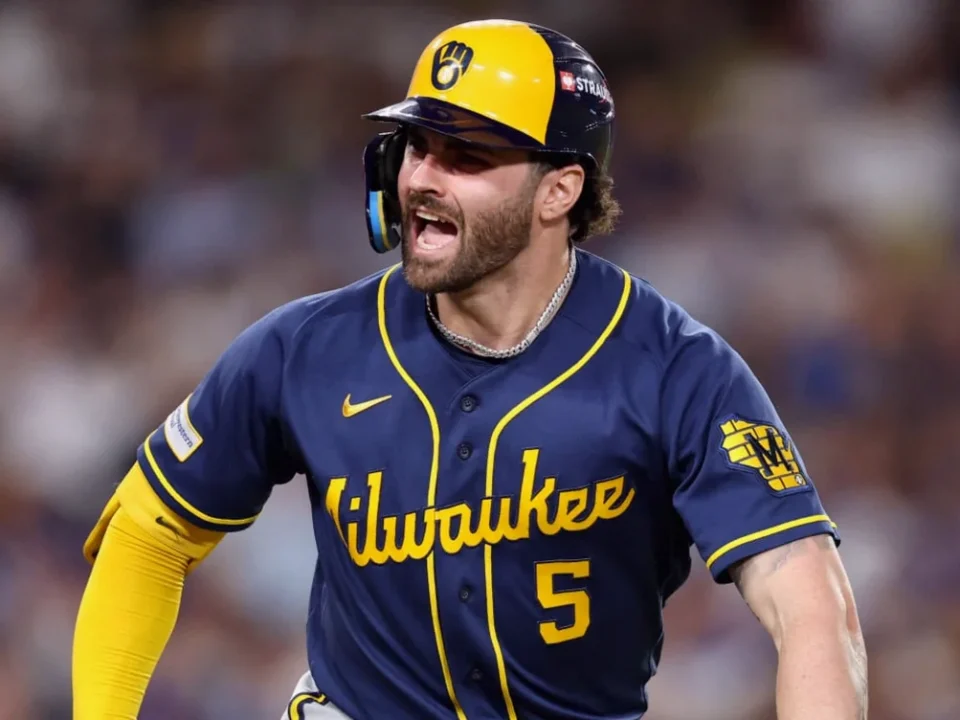
Milwaukee has spent this October proving that there is more than one way to put a club on the brink of the World Series. The Brewers carry a 3-0 National League Championship Series lead over the Dodgers into Thursday night’s Game 4, with first pitch scheduled for 8 p.m. ET, 7 p.m. CT and 5 p.m. PT on FS1, FOX Deportes and FOX One. Their pitching has been outstanding, but the lineup has supplied its share of the damage in a manner that does not neatly fit the small-market, small-ball image attached to this club.
The Brewers won a franchise-best 103 games in the regular season and claimed their fifth NL Central title in six years by refusing to be pinned to one offensive identity. They finished 29th in the Majors in home runs yet ranked second in runs scored. That usually meant finding room for an opposite-field hit, taking an extra base, exploiting a matchup or squeezing value from details other clubs might overlook. Milwaukee is not even an especially low-strikeout club; it was roughly league average in punchouts during the season.
But three games against Los Angeles have given the Brewers a different October look. They have struck out more often than the Dodgers in every game of the series and hold a 31% strikeout rate, compared with Los Angeles at 23%. They have also out-homered the Dodgers 5-0. After tying for the Major League lead with a 10.6% regular-season walk rate, Milwaukee has pushed that number to 14.7% in the NLCS.
Put it together, and nearly half of the Brewers’ plate appearances in the first three games have ended in one of baseball’s so-called three true outcomes: a walk, a strikeout or a home run. Among the 228 clubs to play in a League Championship Series since the format began in 1969, no team has carried a higher rate of those outcomes through an LCS than these Brewers.
Milwaukee has found a new October shape
That approach has little in common with the contact-heavy caricature often applied to Milwaukee, even if the roster remains lighter on imposing sluggers than the Yankees, Dodgers and other power-built contenders. The Brewers have not tried to match Los Angeles player for player or payroll for payroll. Instead, they have used the tools available to them, and right now those tools are producing walks, big swings and an unusual amount of empty air.
The contrast is especially sharp because the Dodgers swept Milwaukee out of the postseason a year ago in a four-game defeat. This time, the Brewers have controlled the series so completely that Los Angeles has yet to hit a home run. Milwaukee’s arms deserve much of the credit, but the offense has made sure the Dodgers have had no room to settle in.
The phrase “three true outcomes,” coined by Christina Kahrl years before she became sports editor of the San Francisco Chronicle, describes plate appearances that finish without a ball being put in play. It is generally associated with baseball’s move toward power, patience and strikeouts. A fitting historical connection sits in Milwaukee’s own record book: former Brewers slugger Rob Deer was one of the early symbols of that profile.
Deer led the Majors in strikeouts twice during his five Milwaukee seasons from 1986 through 1990. He remains among the Brewers’ top 15 all-time home run hitters and ranks eighth in franchise strikeouts. His 48% three-true-outcomes rate with Milwaukee was second-highest in the Majors across that stretch, essentially matching what the current Brewers have done against the Dodgers. For three games, Milwaukee has gone full Deer, and it has worked beautifully.
That style is neither a guarantee of success nor a flaw. This season’s leaders in three-true-outcomes rate included playoff teams such as the Yankees and White Sox, along with disappointing Reds and Orioles clubs. At the lower end were the Rays, who had an excellent season, but also the Blue Jays and Royals, who did not. The Brewers themselves ranked 10th in the regular season, slightly above average despite their shortage of home runs. Players such as Munetaka Murakami, Nick Kurtz and Kyle Schwarber show how dominant the high-outcome style can be, while Luis Arraez and Chandler Simpson illustrate that there remains value at the opposite end.
The real Milwaukee identity is flexibility. The Brewers laid down two sacrifice bunts in Game 1, including one that helped create a run, and there would be no surprise if they call on that play again. They can pressure defenses with their legs, move a runner when the moment asks for it, accept a walk, live with a strikeout or wait for a ball to leave the yard. The old lesson behind the Moneyball idea was never that one tactic was sacred. It was that a good club finds the edge available on a given night.
With one win needed to reach the World Series, Milwaukee has shown it can win with its familiar resourcefulness and with a far louder brand of offense than anyone expected.