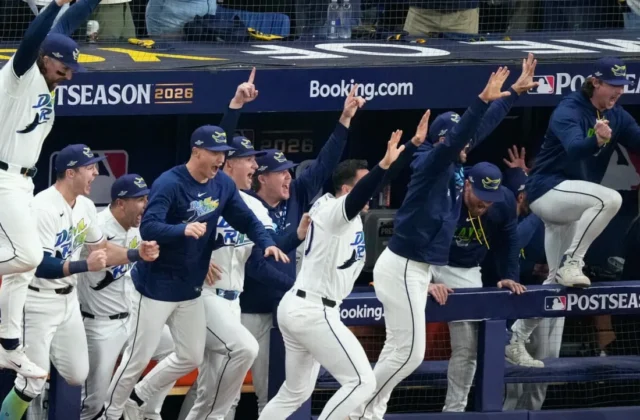

Junior Caminero finally got the October swing he had been chasing, and it sent Tampa Bay straight into the World Series. His seventh-inning, two-run shot in Game 6 of the AL Championship Series struck the left-field foul pole at Tropicana Field, turning a tense night into a Rays celebration.
The 23-year-old had hit 42 homers during the regular season, a total topped by only three Major Leaguers. But he arrived at that moment without a postseason long ball in 36 plate appearances, following a stretch in which Cleveland had repeatedly tied him up with elevated fastballs.
Quick facts
- Caminero’s foul-pole homer in Game 6 of the ALCS clinched Tampa Bay’s World Series berth.
- The Rays open the World Series against the 103-win Brewers on Friday at 8 p.m. ET.
- Caminero struck out 11 times while going 4-for-20 over the first five ALCS games.
- He finished the regular season with 42 home runs and a .641 slugging percentage against four-seam fastballs.
- His Game 6 homer came on Cade Smith’s first-pitch splitter; Smith had thrown 880 career splitters without allowing a homer.
“We were all waiting for it,” Rays closer Bryan Baker said after the clincher.
Caminero’s postseason has already included some rough edges. He went 3-for-10 with two strikeouts against the Yankees in the AL Division Series, then endured the five-game stretch against Cleveland in which he went 4-for-20 and struck out 11 times. Before this October, he had never posted more than eight strikeouts over any five-game span in his big league career.
The Guardians were not subtle about the assignment. They kept coming with four-seam fastballs, throwing them 37.8 percent of the time in the ALCS and using them on 30.4 percent of their pitches to Caminero. Cleveland had built its season around that kind of attack; only the Dodgers and Pirates used four-seamers more often during the regular season.
It also targeted a Tampa Bay weakness. Rays hitters as a group carried baseball’s lowest expected weighted on-base average against four-seam fastballs in 2026.
High heat, then an adjustment
Caminero, however, is not the typical Rays hitter against velocity. Among batters with at least 100 plate appearances ending on four-seamers, he ranked among the top 10 with a .641 slugging percentage and a .652 expected slugging mark. No individual pitch type produced a higher slugging percentage for him.
His compact, level path is built for fastballs near the top of the zone. On four-seamers at mid-zone height or above, Caminero batted .368 and slugged .882 in the regular season. Only Yankees hitter Ben Rice did more damage against those elevated pitches.
Cleveland pushed the fastballs even higher. Of 53 postseason hitters who had seen at least 25 four-seamers, only three had faced them at a greater average height than Caminero. The pitches he saw were higher than those he had encountered in any month of his career with that sample size, following a September in which opponents had worked him lower than at any other point.
The plan worked early because Caminero chased. Across the six-game ALCS, he saw 26 four-seamers outside the strike zone and offered at 13, a 50 percent chase rate that stood as the highest monthly figure of his MLB career against that pitch.
Those chased pitches averaged 3.70 feet off the ground. Seven of the 13 swings missed, part of a postseason out-of-zone whiff rate that climbed to 53.5 percent after sitting at 37.5 percent in the regular season.
That was a notable change for a hitter who can normally spoil difficult pitches and sometimes punish them. Caminero produced 17 extra-base hits on pitches beyond the zone during the regular season, tied with San Diego’s Jackson Merrill for the Major League lead.
His issue was getting underneath the fastball. During the regular season, he swung under half the four-seamers on which he took a cut. In the playoffs, he had been underneath 17 of 24, a 71 percent rate.
“My whole approach with the swing is, I just want to stay as level as possible,” Caminero said in May. “Because if I feel like I’m getting under the baseball, I’m just gonna miss it.”
Daniel Espino was especially effective in that department. Five of Caminero’s nine largest misses under the ball came on Espino fastballs. Among postseason pitchers, only Dodgers left-hander Tanner Scott had induced more swings beneath four-seamers than Espino’s 74 percent rate.
Gavin Williams also leaned into the formula. His four-seamer had created swings under the pitch at better than a 60 percent rate during the regular season, and he used it heavily in October. The approach reached its peak in ALCS Game 3, when Caminero struck out four times, including three chase strikeouts on high fastballs.
Then Caminero began to close the gap. In Games 4 through 6, he chased only five four-seamers out of the zone and put the bat on all five. He made contact twice with two strikes, and each of his three balls in play in those situations left the bat at 106 mph or harder.
One of those swings produced a key RBI double that gave Tampa Bay the lead in Game 4. Against Espino, Caminero used an extremely flat 19-degree swing path, generated 81.8 mph of bat speed and met the ball 16 inches in front of home plate, pulling it down the left-field line.
By Game 6, the answer came against a different pitch. Cade Smith opened Caminero’s decisive at-bat with a splitter, and Caminero drove it into the foul pole. It was the first homer Smith had allowed on a splitter in 881 career offerings.
Milwaukee’s next move
The Brewers will not simply duplicate Cleveland’s formula. Milwaukee has used the fewest four-seam fastballs of any club this postseason, throwing them 24.1 percent of the time and recording only 10 strikeouts with the pitch. That is a sharp contrast to a regular season in which its rotation set the pitch-tracking-era record for four-seamer strikeouts by starters.
Jacob Misiorowski is the clearest candidate to test Caminero upstairs. He throws more four-seam fastballs than any starting pitcher, although his heater has posted only a 16.1 percent whiff rate in the postseason. Right-handed hitters have also been more successful at avoiding swings underneath his fastball this October.
Still, Misiorowski’s power gives Milwaukee a familiar route against Caminero. The rest of the bullpen and rotation present different looks. Abner Uribe and Aaron Ashby lean on two-seam fastballs, while Trevor Megill’s rising four-seamer is often thrown through the heart of the zone, daring hitters to catch up.
Logan Henderson, expected to start Game 2, may have another lane with his changeup. Henderson uses it confidently against hitters on the same side of the plate, and the changeup was Caminero’s least productive pitch type in the regular season. His .328 slugging percentage against changeups was his lowest against any individual offering.
Caminero did not finish the regular season with a negative run value against any pitch type, but he did not build positive value against changeups either. That gives Milwaukee a possible alternative to the Guardians’ elevated-fastball barrage.
The World Series will put that chess match under a brighter light. Caminero has already shown the Brewers both sides of the file: the hitter who can be tempted by high velocity, and the one who can make a series-changing adjustment before the next pitch arrives.