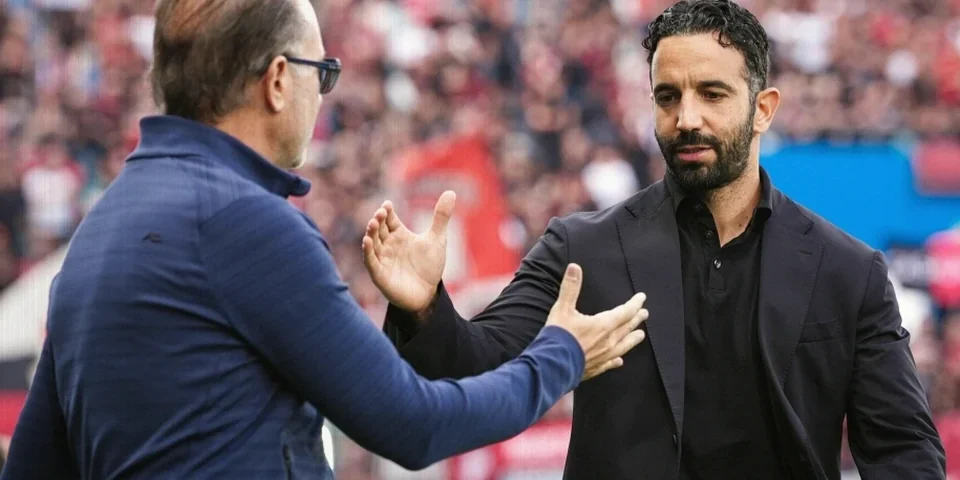
Milan left Reggio Emilia still unbeaten in Serie A, yet the feeling around the club was not one of a side satisfied with its work. Gerry Cardinale’s swift departure from the Mapei Stadium reflected an evening in which the result preserved the league record but did little to settle the questions gathering around Ruben Amorim’s early months in charge.
There is a generous reading of Milan’s start: a team still learning its manager’s demands has continued to take points every weekend. The less forgiving view is that the side’s most persuasive display remains the opening match against Torino, with even the summer friendly against Manchester United still standing out in the memory. The course has not yet turned clearly upwards, and the match with Sassuolo exposed familiar shortcomings.
Amorim’s first concern was the concession from a corner. “We cannot concede goals like that from set pieces,” he said afterwards. More broadly, Milan lost command after taking the lead. In the following five minutes, Sassuolo found three opportunities on the break as the visitors became stretched, behaving like a team chasing the game rather than protecting an advantage.
The coach was not asking his players to retreat into a low block. His idea was more in keeping with his own football: retain possession after scoring, remove the opponent’s momentum and close down the match through control. “We needed to keep the ball after our goal, control the game and stop Sassuolo’s reaction,” he explained. Luka Modric was on the pitch to give Milan precisely that kind of authority, but the match slipped away from them instead.
Experience remains part of Milan’s unfinished work
Amorim rejected the suggestion that a lack of leaders was behind the lapse. For him, it is a matter of experience rather than mentality. The squad contains several young players, while others are still adjusting to Serie A and its changing demands. Diego Moreira impressed in the first half before fading after the interval; Gonçalo Ramos is discovering the difficulty of finding space in Italian football; and Pervis Estupinan, withdrawn at half-time in part because he had been booked, has at times looked caught out by the rhythm of events.
The substitutes Cisse and Hutchinson are only 41 years old between them. It was telling, then, that Milan’s goal was created by two players who have lived through every kind of major occasion: Modric, from Zadar, supplied Adrien Rabiot, raised in Paris. Time, more than any quick correction, may be the only route to turning a young group into a more composed one.
There is also a problem at the other end. Before this round, Milan ranked 13th in Serie A for shots attempted and last for attempts from outside the area. They have had plenty of the ball, but have not converted that possession into enough efforts on goal. So far, an excellent conversion rate has covered part of the issue: when Milan do shoot, they score more frequently than most. Eight attempts in Reggio Emilia, however, offered little evidence of a lasting solution.
Ramos often works hard in isolation but receives too few chances in the penalty area. Christian Pulisic had only one decisive burst of influence, threading the late pass for Samuel Chukwueze. Amorim did not accept that a scarcity of long-range efforts was at the heart of the problem. “Ninety per cent of goals are scored inside the box,” he said. “You can shoot often, but the aim is to bring the ball closer to goal.”
The manager instead pointed to Milan’s need for sharper combinations and better delivery from wide areas. Space existed on the flanks against Sassuolo, but Milan did not make enough of it. Chukwueze has shown since the start of the season that he can provide quality from the right, while Davide Bartesaghi could offer another answer on the left through his ability to cross on the move, including first-time deliveries.
Amorim’s Milan are also still searching for a recognisable balance. The side that initially appeared determined to press high and push the tempo has at times chosen a slower, more measured control of possession. The 3-4-2-1 used earlier in the campaign has recently given way to a back four, before returning after the interval in Reggio Emilia.
Rabiot described the process plainly: “We adapt to our opponents. During the week, we prepare differently depending on the match.” Such flexibility can be valuable over a long campaign, but it carries a cost for a team whose habits are not yet fully formed. Amorim said in September that victories would buy the group time. Milan remain unbeaten, so they still possess some of that credit, but their margin for uncertainty is narrowing.
The next test comes in Salzburg, where cold evening conditions and extensive rotation are expected. Amorim will not merely be asking Milan to adjust their approach; he is likely to alter much of the personnel as well. For a side still trying to establish its identity, it is another demanding turn in an already delicate opening chapter.