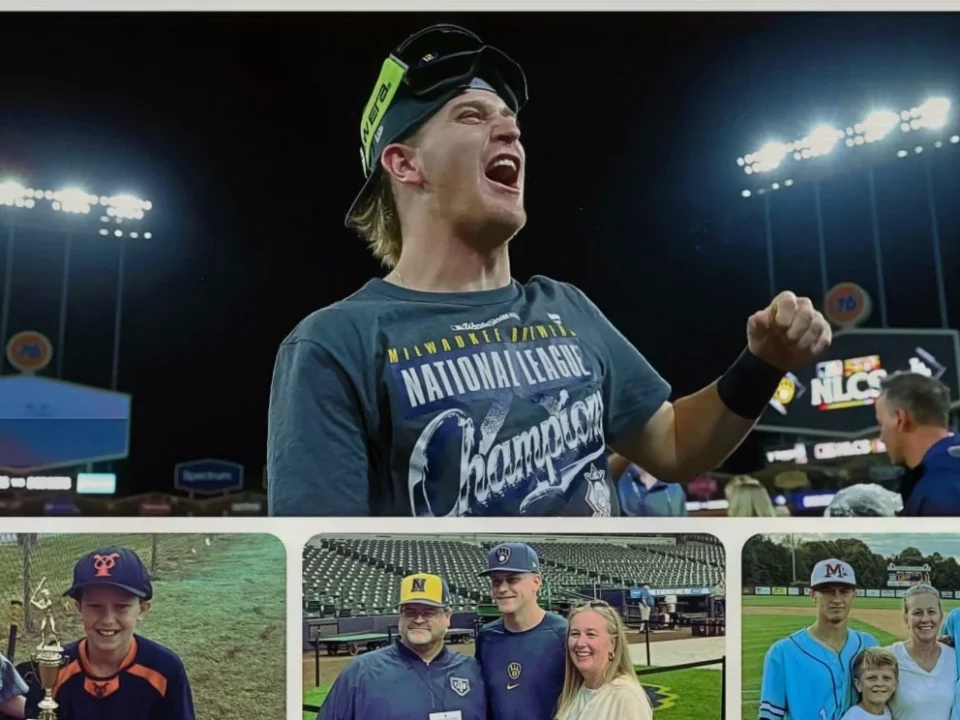
Cooper Pratt arrived in Milwaukee with the kind of baseball background that can make a rookie season look almost inevitable. The Brewers’ 22-year-old shortstop has spent his first 74 Major League games showing why the family name carried weight long before he reached the clubhouse, batting .281 with a .350 on-base percentage and a .368 slugging mark. In the postseason, he has pushed that line to .310 while bringing a little extra personality to the celebrations, happily downing orange soda and sparkling cider after wins.
Pratt has called it “frickin’ fun,” which is about as far as he takes the language. A member of the Church of Jesus Christ of Latter-day Saints, he neither drinks alcohol nor swears. But the joy has been unmistakable for a player who became the first in a deep baseball family to make the Majors.
His father, Russell, played at Utah. His uncles Trent, Scott, Paul and Kyle all played college baseball as well. Trent played at Arizona State under a young Pat Murphy, then transferred to Auburn and later reached Double-A in the Phillies’ system. Scott went from Auburn to Triple-A with Cleveland and Atlanta. Paul played at Air Force, and Kyle at Dixie State. Cooper’s older brother Ozzie played at Ole Miss, where Cooper might have enrolled had he not signed with Milwaukee. Younger brother Quincy is a catcher committed to Ole Miss and could be selected high in next year’s Draft, while Jett, still set to finish high school in 2027, is already drawing prospect attention.
The athletic roots run through both sides of the family. Cooper’s mother, Heidi, played softball at Nova Southeastern, earned a place in that school’s Hall of Fame and regularly threw batting practice to her sons before becoming a family physician. Another uncle, Mark, played football at Youngstown State. Still, baseball has always been the family’s daily language.
The work behind the rookie season
That language was not always easy for Cooper to hear. Russell runs the Yalobusha Giants youth baseball organization in northern Mississippi, and he built a demanding routine around his boys. Cooper and Ozzie went to hit virtually every night, including holidays, birthdays and days when they were sick. Pratt remembers working until his hands bled, passing on parties, dances and plenty of ordinary kid time.
“I hated it for the longest time,” Pratt said, though he is careful to say he always loved the game itself. There were many evenings when he wanted to be in the cage. There were others when he would have preferred video games or television, and he did not hide that frustration.
A growth spurt before his junior year at Magnolia Heights High School changed the picture. Pratt emerged as a legitimate prospect, and the Brewers selected him in the sixth round of the 2023 Draft, then signed him for an above-slot bonus. The everyday rhythm that can overwhelm players fresh out of high school was already familiar territory. Professional baseball asks players to report, prepare and perform through long stretches with few breaks; Pratt had lived a version of that grind for years.
Brewers infield coach Matt Erickson sees that early structure in Pratt’s game, particularly in the steadiness of his defensive work. Erickson said Pratt’s consistency, instincts and attention to detail point toward a high defensive ceiling, perhaps one the shortstop himself had not fully recognized.
The connection between coach and player is more personal than it first appears. Erickson’s sister teaches at Magnolia Heights, as did his parents before her. Her children, including 2026 second-round pick Cole Prosek, grew up around the Pratt brothers through baseball. Cooper spent countless afternoons with the Prosek family, long before he met Erickson as a Brewers prospect.
Once Erickson got to know him, he said the family resemblance made sense, joking that Pratt was “an idiot, just like my nephews.” It was clubhouse teasing from a coach who values the player’s work habits as much as his ability.
Pratt now understands the purpose in all those long hitting sessions. He said his father loved the game, loved coaching his sons and loved the closeness baseball gave the family. Having his relatives present for his Major League debut brought that history into one moment.
“This has always been my dream,” Pratt said. “My dad, my uncles, they all played, and they never made it [to the Majors]. To be the first one is really cool.”
Russell described his son as remarkably composed on the day of that debut, a player who does not get carried away by either success or failure. Heidi chose a simpler word for the feeling of watching him reach the Majors: bliss.
For Cooper, the old routine no longer feels like something taken away. He knows more time with friends would have been enjoyable, but he also knows the nightly repetitions helped prepare him for this moment. The rookie shortstop has come to appreciate the standard that once wore him down: when the season asks for another day of work, he goes to hit.