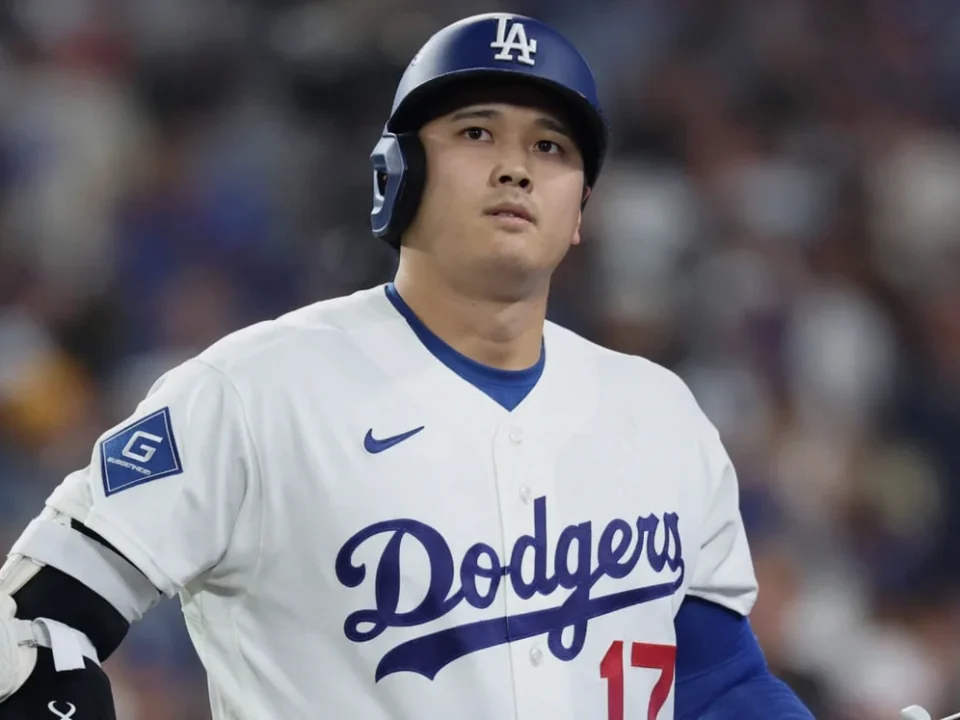
Shohei Ohtani’s October was supposed to be the payoff for all the caution the Dodgers preached during the summer. Instead, after rest on the injured list and the Wild Card Series bye, he reached the postseason still carrying the effects of a left knee problem and right biceps trouble.
The Dodgers were swept by the Brewers in the National League Championship Series, their season ending last Thursday. Ohtani finally homered in Game 4, his first long ball in nearly two months, but the late burst could not reverse the series.
Quick facts
- Ohtani’s final pitching appearance came July 3 after right biceps tightness surfaced.
- He posted a 0.74 ERA over his first 10 starts, then had a 4.38 ERA across his final four outings while dealing with the knee issue.
- Beginning Aug. 8, he batted .205 with a .666 OPS over his last 29 regular-season games.
- He went 3-for-20 without an extra-base hit in his first six postseason games.
- Ohtani intends to resume a full two-way workload in 2027.
Los Angeles had tried to protect its two-way star in stretches, separating mound days from hitting duties and occasionally giving him a full day off after a start. Still, the club did not skip starts or use the injured list until Ohtani’s physical limitations had become difficult to overlook.
That balancing act is particularly complicated with a player who has no real historical template. The Dodgers leaned on daily conversations with Ohtani, though president of baseball operations Andrew Friedman acknowledged that communication was not always the same as a complete medical picture.
“Our communication has been great,” Friedman said after Ohtani returned from the IL. “Whether he always shares exactly how he feels, maybe not quite as great.”
The first public sign of the season-long issue came June 11, a day after Ohtani pitched in Pittsburgh. He left with inflammation in his left knee. The initial belief was that he had aggravated it on a stolen-base try, although Ohtani later said his pitching mechanics may have contributed.
On July 3, he delivered what was ruled a quality start, then was lifted for a pinch-hitter because of biceps tightness. Ohtani said the arm had bothered him months earlier, and that outing became his final start of 2026.
His results had already turned. He carried a 0.74 ERA through 10 starts, but his final four came with the knee still bothering him and produced a 4.38 ERA. The Dodgers scratched him from a scheduled July 10 start, then hoped an Orthovisc injection would allow him to return after the All-Star break.
That plan did not hold. By July 19, the club had removed him from the rotation without a timetable because the knee irritation continued. Three days after a full bullpen in Philadelphia that appeared to catch some within the organization off guard, Ohtani was shut down from throwing on July 25 after the knee regressed.
He resumed playing catch Aug. 8 following more than two weeks without throwing. The progression moved to a bullpen on Aug. 14 and live hitters on Aug. 23, but his work at the plate began fading during that same stretch.
The Dodgers had considered using him for an inning in a game as early as Aug. 30. A bullpen session on Aug. 28 changed the calculation, and the pitching comeback was delayed again.
By Sept. 3, after a game in which Ohtani appeared notably compromised at the plate, the Dodgers began resting him. He missed four consecutive games, while the club debated whether an IL move was necessary. General manager Brandon Gomes said that day the idea had not even been discussed.
When Ohtani returned Sept. 7, he said he would hit only for the balance of the year, finally settling the question of whether he would pitch again. Four days later, after missing six of seven games, he went on the 15-day IL.
Manager Dave Roberts later said he would have preferred an earlier IL decision in hindsight. Ohtani served the minimum stay and came back for the Dodgers’ final five regular-season games, but the postseason did not bring the version of Ohtani the club had been trying to preserve.
After six October games, Dodgers decision-makers even discussed holding him out of NLCS Game 3. Ohtani told them he felt well enough to play, and he did look sharper in Games 3 and 4. The improvement was brief, and Milwaukee completed the sweep.
Ohtani said he has not yet settled on the full lesson from the season. “I haven’t really been able to process what I learned from the year,” he said through interpreter Will Ireton. “I’ll go back to the drawing board with treatment and my training program, and figure out what I can do for next season.”
For the Dodgers and Ohtani, the 2027 two-way return will require more than hopeful check-ins and late adjustments. The hard lesson from 2026 is that the path to October may have needed a firmer stop sign much earlier.