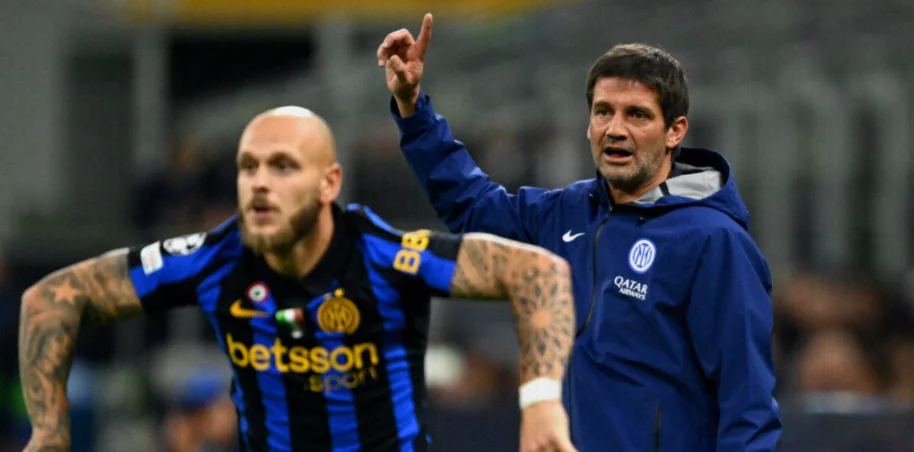
Inter’s latest European night again turned on the bench, with Cristian Chivu finding a way to alter the course of the match through his substitutions. It has become a recurring feature of this season: the Nerazzurri may not always begin with their sharpest rhythm, but the coach has repeatedly shown the capacity to change the picture as the game develops.
The coach and the club
The debate around Chivu is not simply whether he selects the wrong starting eleven before rescuing the situation later. His work suggests a broader calculation, one that considers the condition of players, the need to protect confidence and the importance of keeping a large squad involved across a demanding campaign.
Josep Martinez offers the clearest example. The goalkeeper has endured moments of uncertainty, including errors that drew attention, yet Chivu continued to back him rather than immediately turning to Provedel. It would have been the safer public decision to remove Martinez and shield himself from criticism. Instead, the coach maintained his trust in the player, and that faith was rewarded in Inter’s third, significant Champions League fixture.
That choice helps explain Chivu’s wider selection policy. A team cannot be managed only through the form table of a single Sunday or Wednesday. Leaving out established figures can have consequences beyond one match, particularly at a club where competition for places is constant and expectations are high.
Federico Dimarco remains one of Inter’s added values even within an already strong side. On recent evidence, it might appear straightforward to give a fresher teammate a place in the starting team. Yet the fact that Chivu has not automatically taken that route does not mean he has overlooked the possibility. It points instead to a manager considering the season as a whole rather than treating every fixture as an isolated test.
The same applies to the newer members of the group, including the three English arrivals. They must be introduced or reintroduced, even if there is some rust in their performances. Chivu’s approach differs markedly from that of Simone Inzaghi: he appears determined to keep as many players as possible engaged, rather than allowing members of the squad to drift away from the main project.
Changes that carry weight
Wednesday’s Champions League match reinforced Chivu’s reputation for making useful interventions. Henrikh Mkhitaryan’s introduction proved decisive, although there may have been a case for using Pio Esposito instead. With Inter down to ten men, Esposito could have offered a target for longer passes and helped the side retain the ball higher up the pitch.
Chivu chose Mkhitaryan, however, and the decision delivered the required response. It also underlined why the Armenian midfielder need not start every match to remain important. At his stage of his career, he may be far more effective over half an hour than across a full 90 minutes. The value of a player is not always measured by starts alone, especially in a squad competing on several fronts.
Inter’s substitutions have therefore done more than repair individual matches. They have reflected a coach attempting to distribute responsibility, restore players and correct decisions made with longer-term priorities in mind. That does not mean every initial selection has been beyond debate, but it does make the idea of simple mistakes too narrow.
The unresolved question
The concern for Chivu is not his ability to use the bench. It is why Inter have too often needed a jolt before fully coming alive: two goals conceded, or a dismissal, have sometimes been required to force a sharper reaction. The coach has found answers during matches, but the next stage of his work is to ensure that his side begins with the same urgency it has shown after adversity.