In Copenhagen, Portugal’s uneasy transition from Cristiano Ronaldo’s era of automatic selection to a more conditional role has reached its sharpest point yet. The 41-year-old captain has left the national-team camp after remaining unused against Norway and Denmark, a rupture with new coach Jorge Jesus that has placed his international future under fresh doubt.
Ronaldo started Jesus’s first match in charge, a win over Wales, but was kept on the bench for the following two fixtures. He warmed up during the second half against Norway without being introduced, then watched Gonçalo Ramos score the winner away to Denmark after again beginning among the substitutes.
At full time in Denmark, Ronaldo left the pitch immediately, visibly frustrated. He did not take part in Tuesday’s training session, prompting intense scrutiny around the Portugal camp. The president of the Portuguese Football Federation travelled to the squad’s base on Wednesday and met both player and coach in an effort to calm the situation; the discussion was understood to have gone well.
Yet the mood shifted again after Jesus faced the media. Ronaldo departed Parken Stadium before training began and announced on social media that he would leave the camp, adding that he would address the episode later.
Jesus insists selection belongs to the coach
Jesus rejected suggestions of a personal dispute, saying he had expected to use Ronaldo for between 20 and 30 minutes in Norway before the course of the game changed his plans. He said his own mistake had been asking the forward to warm up shortly after half-time.
But the coach also made clear that Ronaldo’s stature cannot determine Portugal’s team sheet. Even with the captain’s exceptional standing, he said, decisions on every player’s involvement remain the manager’s responsibility.
Jesus had already signalled that position at his unveiling after replacing Roberto Martínez following the 2026 World Cup. Asked about Ronaldo, he recalled having managed Neymar and Ronaldo, two of the three players he considers the world’s greatest, with Lionel Messi the remaining one. He said he had once told Neymar, “You are finished,” and stressed that he would always do what he believed was right for Portugal.
His approach to the current camp was shaped by Ronaldo’s physical condition, Jesus said, drawing on their time together at Al-Nassr. Before Denmark, he confirmed that he had planned not to use the forward against either Norway or Denmark, while also indicating that Ramos would start again.
Jesus has since softened the message without retreating from his authority, saying he would not apologise to Ronaldo but that the captain could return whenever he wished.
A tension building since Qatar
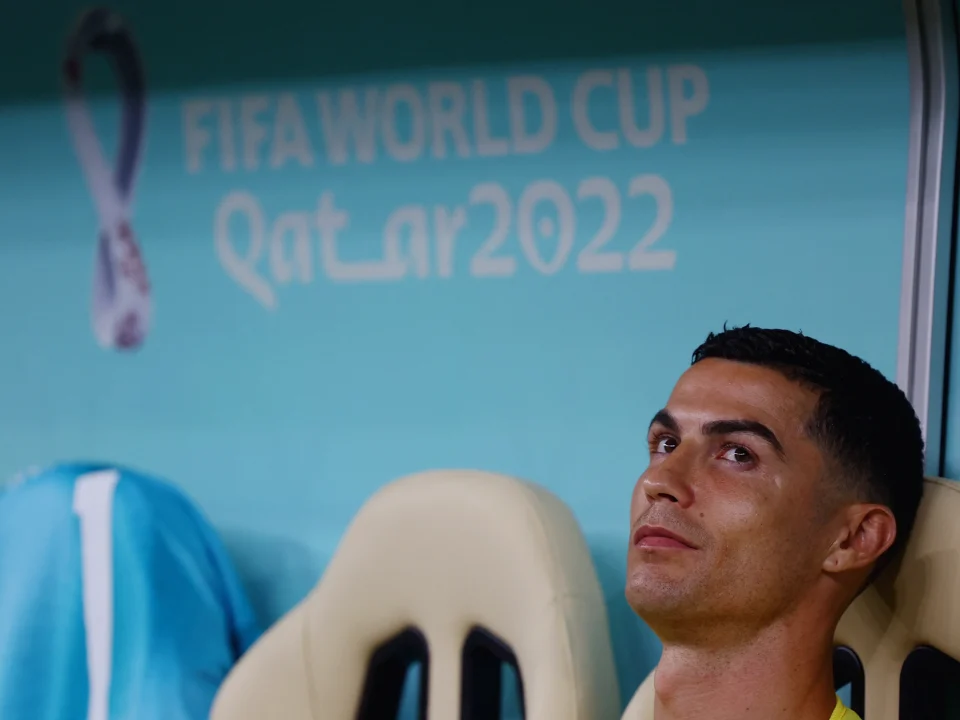
The current dispute is the latest chapter in a four-year reassessment of Ronaldo’s place with Portugal. It began conspicuously at the 2022 World Cup, after he reacted angrily when Fernando Santos substituted him during the 2-1 group-stage defeat to South Korea.
A public poll conducted in Portugal after that match found 70% in favour of dropping him. Santos did so for the round-of-16 meeting with Switzerland, Ronaldo’s first World Cup match as a substitute. Ramos took the opening, scoring a hat-trick in Portugal’s 6-1 victory.
Ronaldo also started from the bench in the subsequent quarter-final defeat to Morocco. Santos later pointed to a difficult second half of 2022: the death of one of Ronaldo’s newborn twins, the lack of a pre-season, two months away from training, and a limited role after returning to Manchester United.
His Manchester United spell had already unravelled shortly before the tournament. In an interview with Piers Morgan, Ronaldo criticised the club hierarchy and Erik ten Hag, following an earlier disciplinary episode in which he had refused to come on in a Premier League match. He later joined Al-Nassr.
From Martínez revival to another tournament setback
Martínez restored Ronaldo to an undisputed starting role after taking over in 2023, and the early results were emphatic. Ronaldo scored 10 goals in nine Euro qualifying appearances, finishing as UEFA’s leading scorer in the campaign despite being 39.
Questions returned at Euro 2024. Portugal arrived with an exceptionally deep generation that included Bruno Fernandes, Nuno Mendes, Vitinha, João Neves, Bernardo Silva and Rafael Leão, yet the team’s displays drew considerable criticism. Ronaldo started every match, failed to score and Portugal went out to France on penalties in the quarter-finals.
His emotional response to missing an extra-time penalty against Slovenia in the last 16 became one of the tournament’s defining images. Portugal repeatedly delivered the ball towards him in that match, attempting 39 crosses, of which only 11 found a teammate, despite the midfield talent available. Even then, a separate public survey showed 54% still wanted Ronaldo retained in the starting line-up.
Martínez kept faith, and Ronaldo answered with numbers before the next World Cup: 13 goals and one assist across 16 matches, as Portugal won the Nations League. He scored in the quarter-final, semi-final and final against Spain.
Portugal nevertheless disappointed again at the 2026 World Cup, taking two draws and one win from the group stage. Ronaldo scored twice against Uzbekistan, added another in the second-round victory over Croatia, then did not score as Spain eliminated Portugal in the last 16.
When challenged over his decision not to substitute Ronaldo in that Spain match, Martínez offered a simple defence: “When you need a goal, you cannot take him off.”
Jesus is now confronting the same central question from a different direction. Ramos’s winner in Denmark showed Portugal again have alternatives at centre-forward; Ronaldo’s departure has shown how difficult it remains to redefine the captain’s role without consequence.