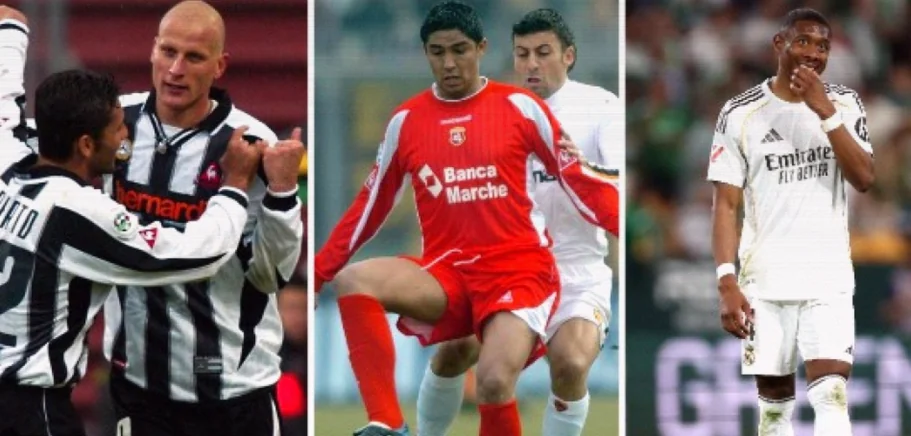
David Alaba’s arrival at Udinese is another reminder that Serie A’s smaller stages can still attract players shaped by football’s grandest arenas. While the club unveiled its 2026/27 third kit at Milan Fashion Week, its directors were completing the formalities for a far more consequential presentation: the former Bayern Munich and Real Madrid defender has passed his medical examinations and is set for his first Italian championship chapter.
The coach and the club
Udinese have not merely added a famous name. Alaba arrives with a body of work built at two of Europe’s defining clubs, but also with a personal test ahead of him. His fitness will be watched closely by Kosta Runjaic, who must decide how and when to introduce a player whose experience is beyond question but whose physical condition will need managing.
The move reflects a familiar logic for clubs outside Serie A’s traditional elite. A veteran of major finals can offer leadership in the dressing room, commercial attention beyond the region and a reliable reference point for a group that needs filling out with proven personalities. The calculation is always delicate: prestige does not guarantee availability, and a celebrated career cannot settle a difficult Sunday afternoon on its own.
Udinese have seen that tension before. In 2002, Carsten Jancker arrived from Bayern Munich for around €2.5 million, bringing a Champions League medal and four Bundesliga titles. At 28, he spoke confidently about eclipsing Oliver Bierhoff’s legacy in Friuli, insisting he was not intimidated by the comparison. Luciano Spalletti initially placed his faith in the German striker, but Jancker soon slipped behind Vincenzo Iaquinta. He scored once in his first season and twice in his second before his contract was terminated in 2004.
Alaba’s task is different, but the wider question is not. For Runjaic and Udinese, the value of the signing will be measured in training-ground influence, fitness, authority and points rather than in the scale of the announcement.
A recent pattern of famous arrivals
Serie A has repeatedly offered established names a place to restart, to lead, or simply to find a final competitive chapter. The outcomes have ranged from revival to relegation, from a single appearance to a lasting relationship with the club.
Vardy’s brief spell in Cremona
Jamie Vardy’s season at Cremonese ended with seven league goals and two assists, although the club were relegated to Serie B. During the campaign, some supporters had preferred Federico Bonazzoli’s shirt to that of Leicester City’s former hero, but Vardy’s reputation and story still made him a cherished figure around the Zini.
The former Sheffield factory worker, who rose to England duty, became a favourite with the grigiorossi supporters. Oasis songs could be heard outside the stadium, while the dressing-room fridge was once again stocked with Red Bull. His contribution could not prevent relegation, but his shirt became one of the more distinctive symbols of that difficult season.
World champions in survival fights
Diego Godín joined Cagliari in 2020/21 after only one season at Inter. The former Atlético Madrid captain, known for his uncompromising defending, spent a year and a half in Sardinia and made 40 appearances in all competitions before moving to Atlético Mineiro in Brazil. Cagliari supporters witnessed his unusually direct way of preparing for contact, including deliberately taking balls to the stomach to test his resistance.
Jérôme Boateng followed a similar road in February 2024, swapping a recent Lyon departure for Salernitana’s fight against relegation. The German had spent 11 seasons at Bayern Munich, won two Champions Leagues and lifted the 2014 World Cup with Germany. Salernitana hoped his experience and personality could help preserve their Serie A place. Instead, Boateng made seven league appearances in a short spell that ended with relegation.
Samuel Umtiti’s year at Lecce was more restorative. A World Cup winner with France in 2018 and formerly a central figure at Barcelona, he had lost continuity because of recurring injuries. He joined Lecce on loan in the summer of 2022 and found a less pressurised setting in which to play regularly again. His 25 league appearances did not erase the physical difficulties of previous years, but they revived a career that had appeared to be fading too early.
Como’s different answer
Raphaël Varane chose Como in 2024/25 after a career that included four Champions League wins with Real Madrid, where he formed a celebrated partnership with Sergio Ramos. Thierry Henry’s advice was among the factors behind his decision.
His playing spell lasted only one match, a Coppa Italia appearance, before injury forced him to reconsider his future. Varane has since remained at Como as a member of the club committee responsible for youth development, education and innovation. From the stands, alongside president Mirwan Suwarso, he now watches the project built by Cesc Fàbregas. Como, no longer easily described as a small club, have turned a curtailed signing into a continuing institutional connection.
When the name was not enough
There have also been arrivals in which reputation proved impossible to convert into a successful Serie A stay.
-
Samuel Eto’o joined Sampdoria from Everton in January 2015 without a transfer fee, with the deal structured around bonuses linked to the team’s results. He brought 19 career trophies, including three Champions Leagues and two trebles, achieved with Barcelona and Inter. In Genoa, however, he struggled for a consistent role under Sinisa Mihajlovic, with Eder frequently ahead of him in the attacking hierarchy. Eto’o scored twice in 18 appearances.
-
Nani arrived at Venezia with the aim of leading a side whose survival prospects had become increasingly bleak. Away from his Manchester United partnership with Cristiano Ronaldo, the Portuguese winger was looking for a relaunch. Venezia went down, and Nani recorded 10 appearances and one assist across six months in the 2021/22 season before later joining Melbourne Victory in Australia.
-
Benevento recruited Bacary Sagna in January 2018 after his Manchester City departure. The 34-year-old former Arsenal, City and France defender played 13 times and scored once, but could not save the Campanian side. In the same transfer window, Brazil midfielder Sandro arrived after spells with Tottenham and QPR and previous international recognition. He made 14 appearances and scored once as Benevento’s survival attempt failed.
-
Mario Jardel reached Ancona on 19 January 2004 with two European Golden Shoes and a formidable scoring record for Porto, Galatasaray and Sporting Lisbon. His unveiling was memorable for the wrong reason: confused by the colours, he greeted Perugia supporters rather than Ancona’s own fans. By then, the forward was far removed from his peak and dealing with personal problems and a profound crisis he would later discuss publicly. He played only three times, debuting in a 5-0 defeat to Milan at San Siro. Ancona, already bottom and without a win, used 46 players over the season and continued towards collapse.
Older chapters in the provincial game
Long before the modern cycle of late-career signings, Serie A’s provincial clubs could still pull major European names into their orbit.
Hagi and Brescia
Gheorghe Hagi arrived at Brescia in 1992 at the age of 27, already a trophy winner in Romania with spells at Steaua Bucharest and Real Madrid behind him. The player known as the “Maradona of the Carpathians” reunited with Mircea Lucescu, his Romania coach, and scored 15 goals over two seasons.
His time in Lombardy came before the 1994 World Cup that established him on an even larger international stage. That summer, Brescia president Luigi Corioni agreed to sell him to Barcelona rather than allow Napoli to take the club’s leading player.
Verona’s Barcelona connection
Verona added Rafa Márquez and Javier Saviola in 2014/15, giving Mandorlini’s side two players with substantial Barcelona histories. Márquez, signed from León, became a regular in defence and made 26 Serie A appearances.
Saviola arrived after Olympiacos and managed 15 league matches and one league goal, adding another in the Coppa Italia. Verona stayed up, while the Argentine later regretted not sharing more time on the pitch with Luca Toni. In training, he enjoyed attacking the spaces created by the Italian World Cup winner, but he never developed a close relationship with Mandorlini.
Brescia, Siena and the quieter value of experience
Pep Guardiola’s two spells at Brescia, beginning in 2001 after his departure from Barcelona, produced 24 appearances and three goals in total. The numbers were modest compared with his Catalan career, but the experience mattered beyond statistics. Under Carlo Mazzone, Guardiola formed a relationship that endured, played alongside Roberto Baggio and discovered a football world less exposed to the spotlight. He would later describe Brescia as a second home.
Siena supporters found their own cult figure in Tore André Flo. The former Chelsea forward scored 15 goals across two seasons when Coppa Italia matches are included. His decisive goal against Fiorentina in the 2004/05 derby elevated his standing still further among a support that regularly sang about seeing him score.
These stories explain why Alaba’s move to Udinese belongs to a familiar Serie A tradition. The division’s smaller clubs can offer a different kind of football life: less ceremony, greater responsibility and, sometimes, the chance for a renowned player to become part of a local season rather than simply a footnote in a larger career.