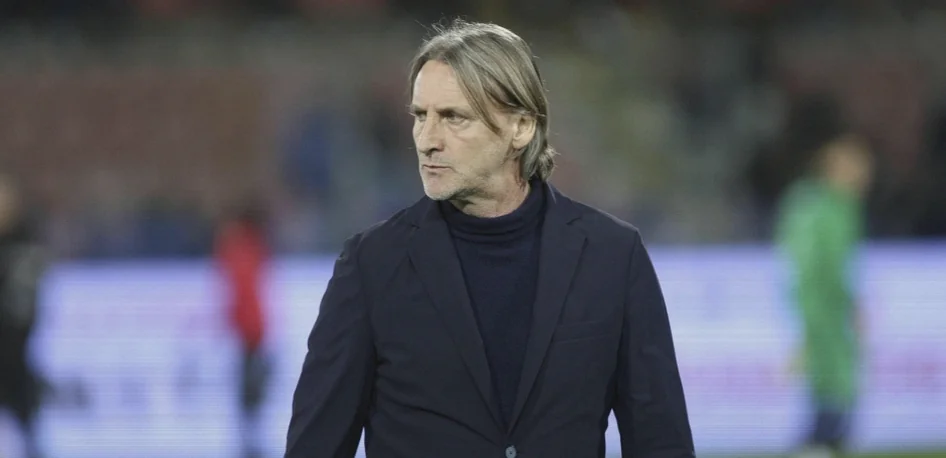
Venezia have handed Davide Nicola another survival fight, and the new coach has arrived with the familiar refusal to treat the task as an act of magic. After six defeats from their opening six league matches, the lagoon club have replaced Giovanni Stroppa with a manager whose previous escapes at Crotone and Salernitana remain among Serie A’s most striking relegation recoveries.
A new coach, and a difficult opening road
Nicola has signed a two-year contract and will take charge for the first time on Sunday, when Venezia welcome Napoli to the Penzo at 15:00. It is the beginning of a demanding sequence for the arancioneroverdi, who then travel to Genoa, host Inter and face Como.
Yet Nicola made clear that the fixture list will not dictate his immediate thinking. He compared the job to a climb in which the focus must remain on the next piton, rather than the summit. For him, the essential work is built week by week: assess what has worked, correct what has not, and begin again.
- Venezia have lost each of their first six Serie A matches.
- Nicola succeeds Stroppa after the club’s winless start.
- The former Crotone and Salernitana coach has agreed a two-season deal.
- His first four scheduled league tests are Napoli, Genoa, Inter and Como.
“I am not a magician,” Nicola said. “I am a coach who prepares, sets targets and works towards them. Venezia have qualities, and they can show them. It will be a difficult journey, but reaching the target brings an enormous satisfaction.”
Stroppa’s promotion work recognised
Sporting director and general manager Filippo Antonelli stressed that the decision to dismiss Stroppa was taken only after careful consideration. The club’s leadership also sought to acknowledge the work that had taken Venezia to promotion, describing that campaign as one that will endure in the memory of the club.
Antonelli said the first five defeats had been followed by signs of improvement against Lazio, but that the performance at Atalanta represented a backward step. That prompted Venezia to make the change before the season could settle further into a damaging pattern.
Nicola was chosen not simply for a record containing several positive spells in the division, but for what the club believe his experience and competence can bring to the current group.
Balance before conclusions
The new coach has spent only two days with the squad, but he does not regard the short preparation period as an excuse. Nicola said the players’ willingness to work has allowed him to define several priorities immediately, beginning with greater balance both in and out of possession.
He has not dismissed what came before him. Nicola believes Venezia already had an identity, even if it did not produce points, and he intends to develop rather than simply discard the existing work. His early message has been direct: act with clarity, avoid overthinking, and improve the transition between the team’s two phases.
- Nicola described the squad as serious, polite and selected first for its human qualities as well as its footballing ability.
- He said a coaching change requires everyone involved to examine their own responsibility and consider how to improve.
- He sees the result as dependent on many factors, while performance can be judged through behaviour, positioning and attitude.
- He noted that the squad was assembled with two players for each role, often with differing profiles.
Nicola said it would be presumptuous to claim he already knows every detail of his squad, although his time away from the touchline had allowed him to study different teams closely.
Flexibility without losing the immediate objective
Stroppa had remained committed to a 3-5-2 structure, but Nicola suggested Venezia may need to be more adaptable. He pointed to the ability of Serie A sides to alter their interpretation of the game several times within one match, with a starting system supported by a limited range of alternatives suited to the opponent.
Time, he said, will help that process, but it should not prevent the group from making practical changes straight away.
Napoli arrive in Venice as opponents with greater resources and a well-established identity, even if they are themselves going through a difficult spell. Nicola’s attention, however, is fixed on his own side. He wants Venezia to discover their potential, define their identity and play a kind of football capable of bringing both enjoyment and results.