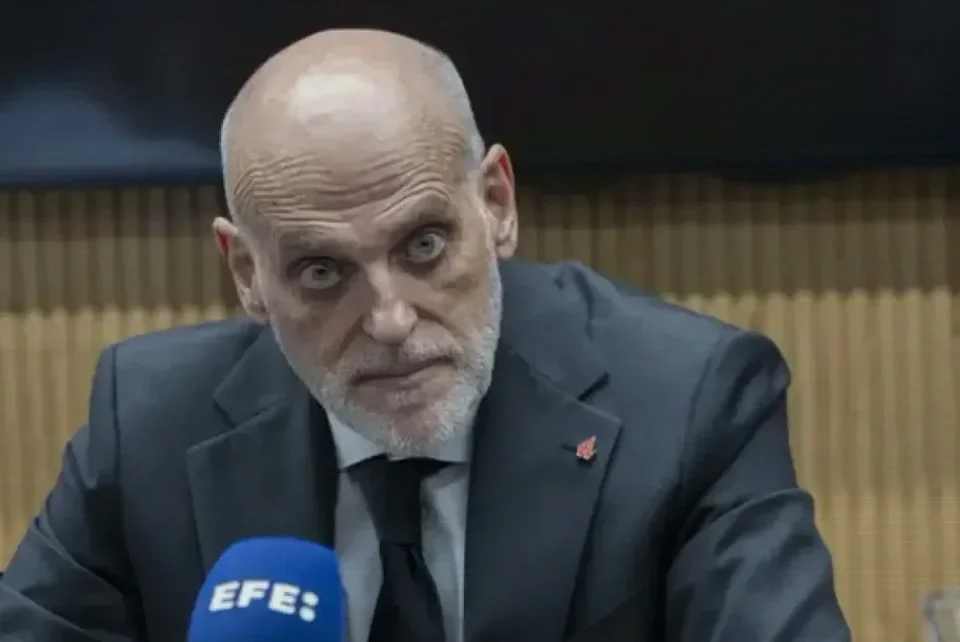
Madrid’s long-running institutional dispute has opened another front, with LaLiga president Javier Tebas answering Real Madrid’s demand for his resignation after his comparison of the club’s television channel with Nazi propaganda.
Real Madrid had issued an official statement condemning Tebas’s reference, which placed Real Madrid TV alongside the propaganda methods associated with Joseph Goebbels, Adolf Hitler’s minister during the Nazi regime. The club called for Tebas to step down, citing what it regards as repeated hostility from the LaLiga chief.
Quick facts
- Real Madrid requested Javier Tebas’s resignation following his comparison involving Real Madrid TV and Nazi propaganda.
- Tebas said Madrid officials have sought his removal or disqualification repeatedly over his 13 years in office.
- The LaLiga president challenged Madrid’s position on the Negreira case, refereeing claims, fixture scheduling and the European Super League.
- He accused the club’s leadership of trying to damage Spain’s domestic competition through its public narrative.
Writing on X, Tebas said he had “lost count” of the occasions on which Real Madrid’s leaders had called for him to go or attempted to bar him from office. He cited complaints to Spain’s Higher Sports Council, both directly and via third parties, as well as criminal proceedings.
“Today is simply another one,” Tebas wrote. “What still has not arrived are the answers.” He argued that Madrid confuse neutrality with independence, insisting that his role demands independence rather than silence when he believes LaLiga is being unfairly attacked.
Tebas took particular aim at Real Madrid TV and voices he described as its amplifiers, saying their criticism of the competition had been continuous, excessive and insulting. In his view, the LaLiga president has a duty to defend the championship, including against Real Madrid’s own executives.
The Negreira argument returns
The exchange also revisited the Negreira case, the investigation surrounding payments made by Barcelona to companies linked to former refereeing official José María Enríquez Negreira. Tebas rejected suggestions that LaLiga had stood aside, saying the league acted from the outset and that repeating the accusation did not make it true.
He then questioned Madrid’s own past conduct. Tebas noted that Florentino Pérez remained within the Spanish Football Federation’s governing structures for months, and said Pérez’s exit from the management committee was submitted on 30 October 2023, the same day as Joan Laporta’s.
Tebas also pointed to Real Madrid’s members’ assembly on 24 November 2024, where Pérez was asked whether relations with Barcelona should be cut. Pérez answered that Barcelona and Madrid “have to help each other,” adding: “Why would we be angry?”
For Tebas, those remarks raised questions about the timing of Madrid’s harder line. He asked why the escalation had coincided with Barcelona’s break from the Super League project, and whether Madrid’s changing stance reflected the seriousness of the allegations or its own interests.
He further asked where Real Madrid TV’s present indignation had been earlier in the case. Tebas said that if the club truly believed referees were still influenced by Negreira eight years after the payments ended, it should identify the evidence concerning each official and explain what individual complaints had been lodged with Spanish authorities, UEFA or FIFA.
Calling for Barcelona to be held responsible, he argued, was not enough to sustain allegations against every referee. “A video does not replace evidence,” Tebas said, warning that putting individuals in the public spotlight was profoundly serious and irresponsible.
Reform, fixtures and the Super League
Tebas said refereeing reform had moved forward, while accepting that further work remains. He would have preferred a faster and broader process, he added, but maintained that football’s institutions cannot be directed according to Real Madrid’s interests, sporting circumstances, mood or evolving relationship with Barcelona.
Any reform, he said, must involve other stakeholders and retain the support of most clubs. “Reform is not obedience,” was the essence of his response.
His conclusion was blunt: Tebas accused Real Madrid’s leadership of seeking to “destroy” the national competition. He claimed that what the club had not achieved through the Super League was now being pursued through what he called a distorted media narrative that harms the standing of the league in which Madrid compete.
The LaLiga president also demanded that Real Madrid publicly deny reported claims attributed to club sources if they were untrue, including a comparison between Tebas and Negreira and allegations that LaLiga disadvantages Madrid through match scheduling.
He challenged the club to publish the full record of its requests to alter kick-off dates and times, how many were granted, and how many were linked to accommodating other events at the Santiago Bernabéu. Accepted requests, he said, must be included rather than omitted because they complicate the club’s argument.
Tebas said Madrid should clarify what is true, deny what is false and provide all the data if it is acting in good faith. He added that he was familiar with demands for his resignation, disqualification and what he termed his “social death.”
He recalled being told that Real Madrid supporters would be turned against him to the point that he could not walk in the street. Tebas finished by urging the club not to place people in the firing line or present criticism of its directors as an attack on Real Madrid and its fans, describing that conduct as intimidation rather than regeneration.