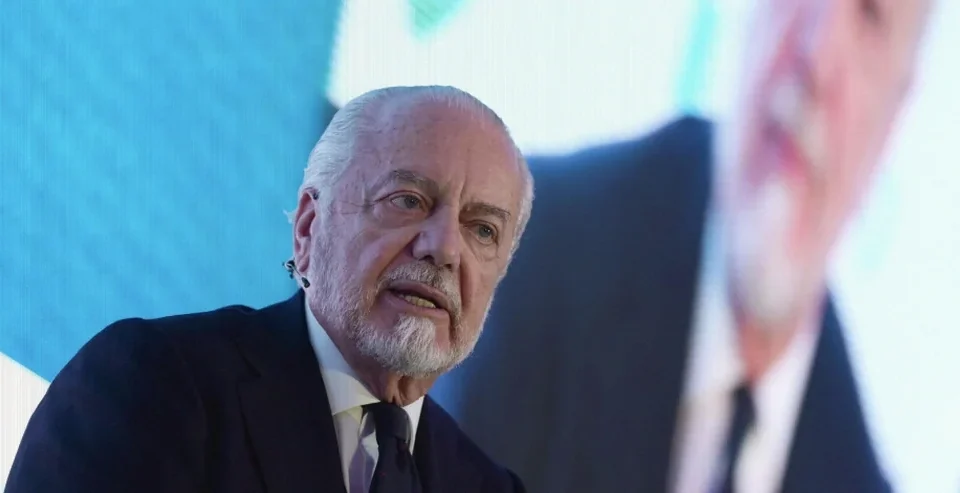
Aurelio De Laurentiis sees Napoli’s next chapter as a question of more than results on a Sunday afternoon. Speaking in Rome at the Teha Club, the Napoli president placed the club’s future alongside the changing demands of cinema, streaming and live sport: a strong team is no longer, by itself, enough to guarantee attention.
Key takeaways
- De Laurentiis said Napoli’s task is to protect an existing passion while winning over younger audiences who have many more entertainment choices.
- He traced Napoli’s rise from Serie C1 after the 2004 takeover to Serie A in 2007, regular European football and Scudetti in 2023 and 2025.
- The 77-year-old president argued that sustainable clubs are judged by the value, organisation, income and assets they create, not simply by their spending.
- He wants stadiums to become full-day experiences, with comfort, technology, food, shops and services for supporters and families.
- De Laurentiis called for a wider debate on football’s format, including stoppages and even the 15-minute half-time break.
From rescuing Napoli to building a durable club
De Laurentiis bought Napoli in September 2004, entering football from a career in film production. His first concern, he said, was not to manufacture support for the club but to understand how a side with such a substantial following had been allowed to fail.
Napoli began again in Serie C1 and returned to Serie A within three years. From there came a sustained presence in Europe and the Champions League, followed by league titles in 2023 and 2025. For De Laurentiis, however, the central achievement has been the construction of a club able to carry that sporting ambition over time.
“The passion was not created by me,” he said. “My responsibility was to build a business around it that could last.” He argued that affection alone can fill a stadium, even in Serie C, but cannot balance accounts, fund recruitment, establish a training centre or run a modern organisation.
His comparison with film was direct. A production costing €100 million is not automatically better than one made for €10 million, he said, just as a €100 million footballer is not necessarily ten times superior to a player signed for €10 million. Finding talent and taking decisions, including unpopular ones, remain essential.
De Laurentiis acknowledged that Napoli have made mistakes over two decades, whether in players, coaches, executives or investments. The difference, in his view, is that a sound club can recover from poor choices while a fragile one can be overwhelmed by them.
He urged Italian football to look beyond the familiar discussion of what owners spend. The more important questions, he argued, concern what they leave behind: organisation, expertise, revenue streams and assets. Spending money is simple; producing lasting value is much harder.
A different matchday and a stronger league product
The Napoli president also returned to a theme that has long shaped his thinking: the stadium. After visiting American venues during the World Cup, he said European clubs must treat grounds as part of the entertainment offer rather than merely a pitch surrounded by stands.
A stadium, he said, should be attractive, comfortable and technologically equipped, with restaurants, shops and services that make it somewhere a family is happy to spend several hours. If supporters are expected to leave home, drive, park, pay and devote four or five hours to a matchday, the club must earn that commitment rather than assume loyalty will do the work.
De Laurentiis does not propose copying American sport wholesale. European football has different traditions, competitions and local ties, he noted. But he believes Serie A can learn from the commercial approach of the NBA, NFL and MLB, particularly in product development, distribution, sponsorship, international markets and the promotion of individual stars.
That work, he said, ultimately improves club revenues and franchise values in the United States. His demand for Italy is a league structure that helps Napoli become more valuable by making the entire championship more valuable.
He also suggested that football should be willing to revisit conventions that have been treated as untouchable. The game’s presentation, length and interruptions all deserve discussion, he said, especially if the sport wants to keep younger viewers engaged.
The 15-minute interval was his clearest example. Supporters inside the stadium can remain absorbed in the occasion, but a child watching at home may turn to a phone, a games console or another form of entertainment before the second half begins. De Laurentiis asked why shortening, or even removing, the break could not at least be debated.
For the Napoli president, the challenge has changed since 2004. Then, the work was to rebuild an enterprise around a support base that already existed. Now, after a generation of growth and two recent Scudetti, the club must continue to deserve that devotion while reaching those who have not yet made Napoli part of their lives.