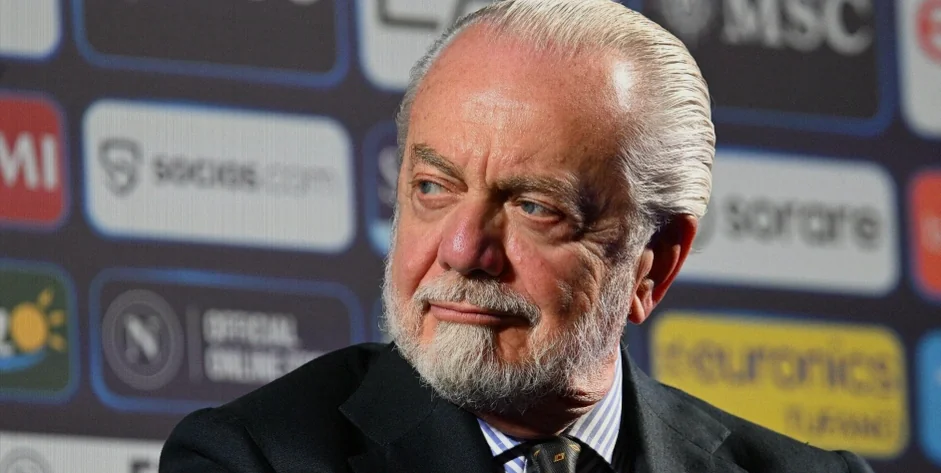
Aurelio De Laurentiis has long made Napoli’s presidency a public part of the Serie A story. His interventions have ranged from the club’s sporting decisions to stadium politics, the calendar, agents and the governance of European football, usually with the same insistence that the interests of clubs must not be pushed aside.
His latest target was Gerry Cardinale, the Milan chief. De Laurentiis said he would have removed Cardinale from a dinner, arguing that the American had made remarks which, in his view, made no sense.
Quick facts
- De Laurentiis criticised FIFA and UEFA over an increasingly crowded fixture list.
- He argued that players cannot be expected to complete 70 matches in one season.
- At the Italian Senate, he called for longer player contracts to curb the influence of agents.
- He described accepting Luciano Spalletti’s departure after Napoli’s title win as an error.
- Stadium ownership remains a major point of conflict between Napoli and the city authorities.
- He also publicly addressed Cristiano Giuntoli’s Juventus move, Maurizio Sarri’s Napoli record and disputes with UEFA president Aleksander Ceferin.
The calendar has been one of De Laurentiis’ most consistent themes. He accused UEFA of extending competitions in pursuit of greater revenues, then linked the enlarged burden on players to the arrival of FIFA’s Club World Cup.
“Players cannot play 70 games in a season; it becomes self-destruction,” he said. De Laurentiis accepted that such a load might be endured once, but questioned how footballers could sustain it year after year.
His criticism has also reached FIFA president Gianni Infantino, whom he mentioned while arguing that the game’s governing bodies were adding demands without sufficient regard for the people carrying out the work on the pitch.
At a Senate appearance, De Laurentiis turned to the financial pressures within the transfer system. He said agents’ leverage was a central issue behind football’s indebtedness, claiming that their involvement drove player costs and wages upwards.
His proposed remedy was a legal extension of permitted contract lengths to at least eight years. In De Laurentiis’ view, that would reduce the chance of an agent approaching other clubs after two seasons in order to secure a higher salary than the one originally agreed.
The Spalletti regret
The difficult campaign that followed Napoli’s third Scudetto brought another unusually candid moment from the president. After an Italian Super Cup defeat, De Laurentiis held a press conference in which he revisited the separation from Luciano Spalletti.
Spalletti had been allowed to leave on the understanding that he would not immediately take another job, before later accepting the Italy national-team role. De Laurentiis said he should have taken a firmer legal position rather than agreeing to the coach’s request out of gratitude for the title triumph.
“If you have won the Scudetto and say you love the city, you cannot simply change direction,” he said, suggesting that the departure risked sending a message that faith in the group had ended. He called his acceptance of Spalletti’s request a mistake.
The stadium question has produced a separate and enduring dispute with Naples’ municipal administrations. De Laurentiis has clashed with successive city authorities and has continued that argument with mayor Gaetano Manfredi.
He said that, if Manfredi were able to sell him the stadium, he could make it Italy’s finest within a year. De Laurentiis also raised alternatives in Campania, mentioning the Royal Palace of Caserta and Pompeii, while saying regional president was on his side.
The president’s relationship with former sporting director Cristiano Giuntoli also changed sharply once Giuntoli joined Juventus. At Napoli’s presentation of the new shirts carrying the tricolour badge in the summer of 2023, De Laurentiis reacted to Giuntoli identifying himself as a Juventus supporter.
He said he had not expected those remarks and added that, had he known, he might have parted ways with Giuntoli earlier.
Old disputes, familiar language
De Laurentiis’ objections to the football establishment were already clear in 2020, when he criticised UEFA president Aleksander Ceferin over an international break scheduled from August 29 to September 10 after the disrupted Covid-affected season.
He called the decision irresponsible and argued that there was a lack of respect for clubs, particularly with new coronavirus cases emerging. His point was direct: domestic football was being asked to restart while national teams were due to assemble.
There was also no soft closing to Maurizio Sarri’s Napoli spell. Following Sarri’s exit in the summer of 2018, De Laurentiis reflected that the team had played well during their three years together but had not delivered a trophy.
For De Laurentiis, that remains the dividing line. Napoli can discuss identity, infrastructure, finances and the calendar, but the president has repeatedly returned to the same standard: ambition must eventually leave something tangible in the club’s hands.