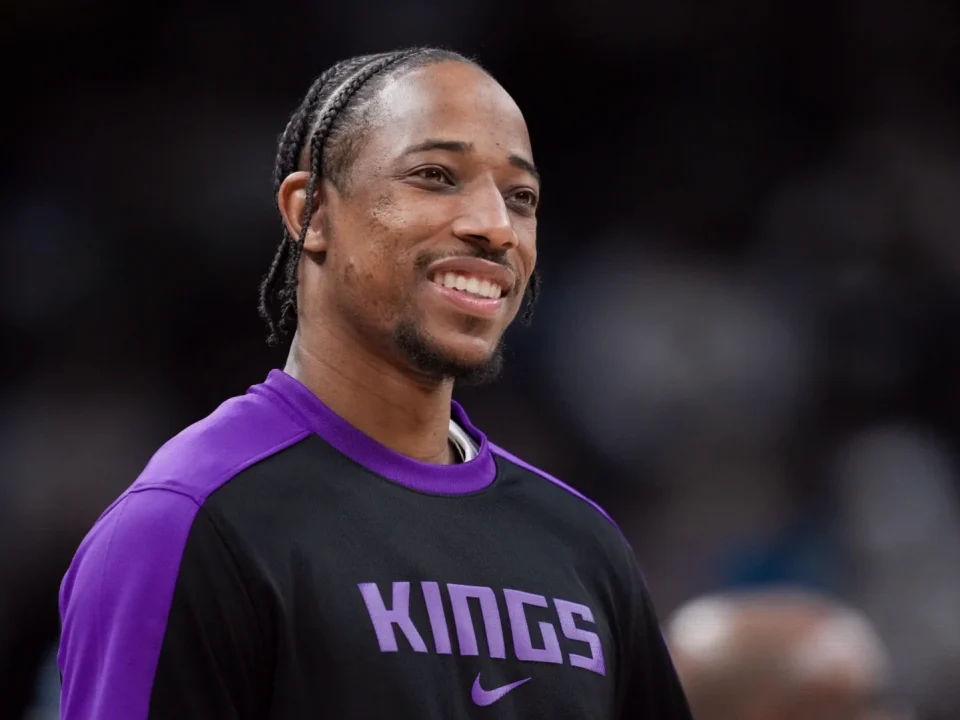
DeMar DeRozan is heading into his 18th NBA season with the Denver Nuggets, carrying the urgency of a player who knows the runway is shorter now. The 37-year-old six-time All-Star signed a one-year deal in early September after Sacramento released him in July, and he is treating the move as both a last-window basketball opportunity and a chance to expand his mental-health work in a new community.
Key takeaways
- DeRozan joins Denver for his 18th season after two years with the Kings, where he posted 18.4 points, 2.9 rebounds and 4.1 assists in 2025-26.
- Nikola Jokić, Jamal Murray and Aaron Gordon each contacted DeRozan before he chose the Nuggets.
- He is looking for a home in Denver and sees the unfamiliar setting as a way to keep growing rather than settling into routine.
- DeRozan continues to build mental-health advocacy around young men, emotional isolation and suicide prevention.
- His work includes the YouTube interview series “Dinners with DeMar” and the memoir “Above the Noise: My Story of Chasing Calm.”
A veteran joins Denver with the clock in view
DeRozan has a phrase he returns to when he gets a quiet moment: “It’s almost over.” He does not frame it as a bleak thought. For him, it is a reminder to squeeze everything out of the season ahead and leave the game with no unfinished business.
“It’s not a negative thing,” DeRozan said. “It’s a beautiful thing. You can’t do this forever, but while you’re in it, give it all you got, so when it’s time to walk away, you’re at ease with everything.”
The number still catches him off guard. Eighteen seasons was not something DeRozan envisioned when he entered the league, though he believes he can still contribute. At the same time, he recognizes how quickly a career moves once the years begin to stack up.
“When I came in the league, I never would have imagined or thought I’d be playing that long,” DeRozan said. “And when you get in, you don’t realize how fast and how much time goes by. … It’s a blessing to be able to play this long.”
His exit from Sacramento was difficult beyond the transaction itself. DeRozan spent two seasons with the Kings and developed close ties throughout the organization. He averaged 18.4 points, 2.9 rebounds and 4.1 assists during the 2025-26 campaign before being released in July.
“You gain relationships with players, staff, people within the organization,” he said. “It’s always tough to leave. I was extremely close with a lot of people.”
The release also brought the natural questions for an older player: whether the end is near, whether another opportunity will come, and what life looks like once basketball is no longer the daily structure. DeRozan said the decision ultimately comes down to how long a player is willing to keep meeting the physical, mental and emotional demands of the league.
Denver offered a fresh start, and the calls from Jokić, Murray and Gordon mattered. DeRozan saw a group of veterans who understand that championship windows do not stay open forever. He has also found comfort in the city’s quieter feel while searching for a place to live.
“It’s easy to get content with what you’re comfortable with, and, sometimes, you got to get out of your comfort zone to grow even more,” DeRozan said.
Building a platform beyond the floor
DeRozan has been one of the NBA’s most visible voices on depression and mental health since publicly discussing his own struggles in 2018. His openness helped push a broader conversation among players, including Kevin Love, and his advocacy has grown into writing, interviews and plans for visual storytelling.
His next interests stretch beyond the gym: art, film, writing and projects that help people tell their own stories. Film is particularly important to him because it can turn a personal experience into something audiences can see and connect with.
“Really putting these stories together from a visual standpoint, becoming a story you can watch,” DeRozan said. “We read stories, we hear stories, we pay attention and find inspiration from stories. … I think it would be amazing. We all got a story.”
“Dinners with DeMar” has become one outlet for those conversations. During a late-July taping in Los Angeles, DeRozan sat down with Lonzo Ball, his longtime friend, former Bulls teammate and fellow Southern California native. When Ball was asked about his mother, Tina, who previously suffered a stroke, he became emotional and cried.
DeRozan did not rush to fill the silence or redirect the moment. Ball spoke about the strain his mother’s health has placed on him and his family, while DeRozan offered support without taking over the discussion. DeRozan’s own mother has health challenges.
The work has become increasingly focused on boys and young men who feel pressure to carry pain alone. Men account for nearly 80 percent of suicide deaths nationally, while young Black men are dying by suicide at higher rates than White peers for the first time.
“We carry so much weight on our shoulders. We sweep so much stuff under the rug, so you don’t even realize how much until you uncover it,” DeRozan said. “You realize how much hurt, how much pain, how much stuff you compartmentalize. You never know when that breaking point may hit.
“The approach I try to take is being vulnerable and letting people know you’re not alone.”
He has seen the impact in direct conversations. A college student recently told DeRozan that his words made him feel understood. Another young man told him, “You saved my life.” DeRozan also remembers a father telling him that his son had been suicidal before hearing DeRozan discuss his experience.
“That means the world to me because a lot of times, it’s just me speaking honestly about things I’m going through, things that I may feel,” DeRozan said. “For people to come up to me and acknowledge that means I’m doing the right thing by being vulnerable and putting myself out there to have these conversations because it’s helping somebody. Even if it’s just one person, it’s helpful.”
DeRozan explored ways to work with California Gov. Gavin Newsom and first partner Jennifer Siebel Newsom on programs aimed at struggling boys and young men. He invited them to appear on his show and to attend one of his events, though scheduling conflicts prevented it. The move to Colorado gives him another place to pursue that work.
“Young men are struggling, and too many still feel like they’re supposed to handle everything themselves and keep what they’re going through inside,” said Brett Rapkin, the creator of “Dinners with DeMar.” “DeMar has the authenticity and reach to redefine what strength looks like for young men and use storytelling to create real cultural impact at scale.”
One of DeRozan’s tattoos reads, “Why would they care about you?” It recalls words he heard growing up in Compton, words meant to suggest that his feelings did not matter. He has turned that memory into motivation rather than allowing it to define him.
DeRozan said he still has difficult days himself. His message is not built on pretending to have every answer; it is rooted in giving people permission to be human, to cry and to step away when they need to.
“I’m far from perfect. I still have my days,” DeRozan said. “We’re still human. … It’s OK if you gotta cry or let it out, you know? It’s OK to take a moment for yourself.”
As he starts over in Denver, DeRozan is trying to make the remaining NBA time count while putting a clearer message in front of the young people he hopes to reach: You matter.