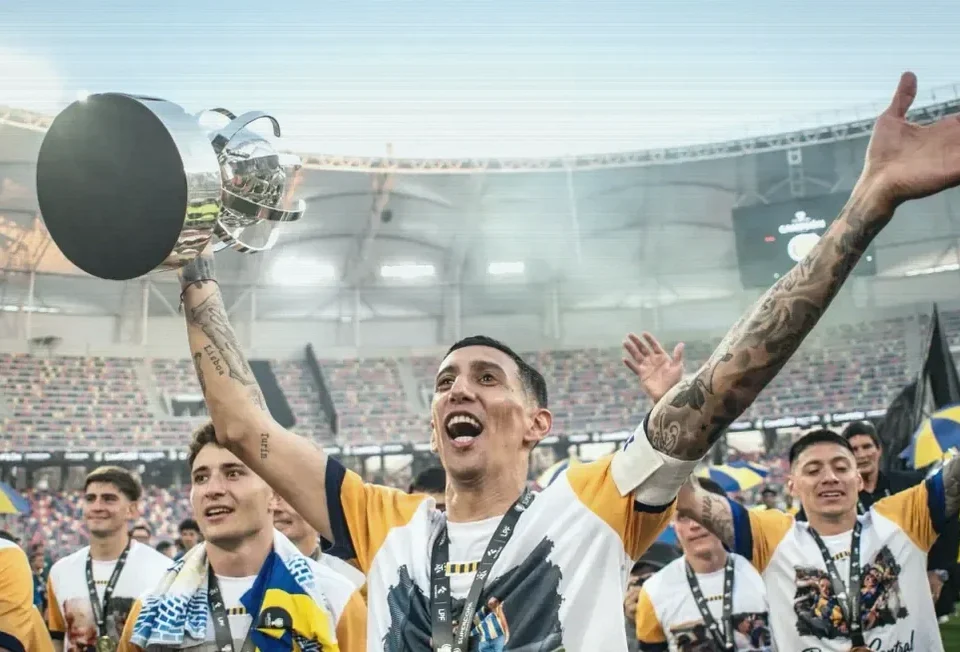
In Santiago del Estero, amid oppressive heat and an already bitter institutional backdrop, Ángel Di María gave Rosario Central a night of football to rise above the noise. The veteran forward scored twice as Central beat Estudiantes 3-1 in the Supercopa Internacional, securing a trophy on the pitch for the club where his career began.
Di María changes the final
Estudiantes had made the sharper start, with Alexis Castro scoring in the opening minute. But the side from La Plata lost Gabriel Neves and Jalil Elías to injuries before 20 minutes had passed, disrupting a promising opening spell.
Di María then turned the match. Before kick-off, he had watched Lionel Messi’s free-kick against the United States at the 2016 Copa América on his phone. When Central won a free-kick from a comparable area, he recalled the image and attempted the same kind of finish.
- Di María curled in the equaliser from the free-kick, later admitting that he had thought: “I’m not Leo, but maybe it will come off.”
- He put Rosario Central ahead from the penalty spot, converting with composure after the interval.
- In added time, Julián Fernández finished with the outside of his left foot into an empty net to complete the 3-1 victory.
For Di María, the evening carried particular weight: it was a competitive title won on the field with the club of his youth, after a final dominated by his quality.
Refereeing dispute overshadows the occasion
The match also became a source of fierce anger for Estudiantes, who felt key decisions from referee Darío Herrera and VAR official Jorge Baliño had gone against them.
- Estudiantes argued that Rosario Central’s Elías Verón should have received a second yellow card, leaving Central to play much of the second half with 10 men. Herrera did not punish the incident and VAR did not intervene.
- VAR did alert Herrera to a foul by Leandro González Pires on Enzo Copetti, an offence described by Estudiantes as minimal, and the review resulted in the penalty from which Di María scored Central’s second.
- At the other end late in the game, Estudiantes believed Ignacio Ovando handled the ball in an incident that could have brought them a penalty and a route back into the final. There was no VAR recommendation for an on-field review.
Juan Sebastián Verón, Estudiantes’ president, led the protests. During half-time he posted online: “The impunity involved in robbing you is unbelievable. It is unnecessary. Is this why they bring us all the way here? What a ridiculous production.”
After the final whistle, Verón went onto the pitch to confront Herrera, shouting: “This is all yours, thief.” Later, he struck a more measured note while maintaining his wider complaint: “It is very difficult to play when you are conditioned. Central are a very good team, but there was something else in the middle that brought it to this point.”
Asked what he had said to the referee, Verón replied sarcastically: “I congratulated him. I told him he had refereed very well.”
An old divide returns in Santiago
The dispute did not emerge from one final alone. Relations between Rosario Central and Estudiantes had been strained since the end of 2025, when the Argentine Football Association declared Central annual champions despite the distinction not having been set out before that competition began.
The AFA presented the trophy to a Central side led by Di María at its offices, then required Central’s next opponents to give them a guard of honour. That opponent was Estudiantes, whose players stood with their backs turned in protest — an episode that became known as “the back turn”.
There was another visible sign of the divide after this final. AFA president Claudio Tapia placed medals around the necks of Rosario Central’s champions, but did not take the stage to do the same for Estudiantes’ runners-up.
The tension reflects a deeper political disagreement between Tapia and Verón. The Estudiantes president has been among the leading critics of AFA-run competitions and their administration, while also backing private investment in Argentine football — a position strongly opposed by Tapia.
That conflict travelled to Santiago del Estero and helped turn a cup final into another flashpoint. Yet when the arguments finally gave way to the scoreline, it was Di María’s imitation of Messi, his calm penalty and Central’s late third goal that delivered the decisive story.