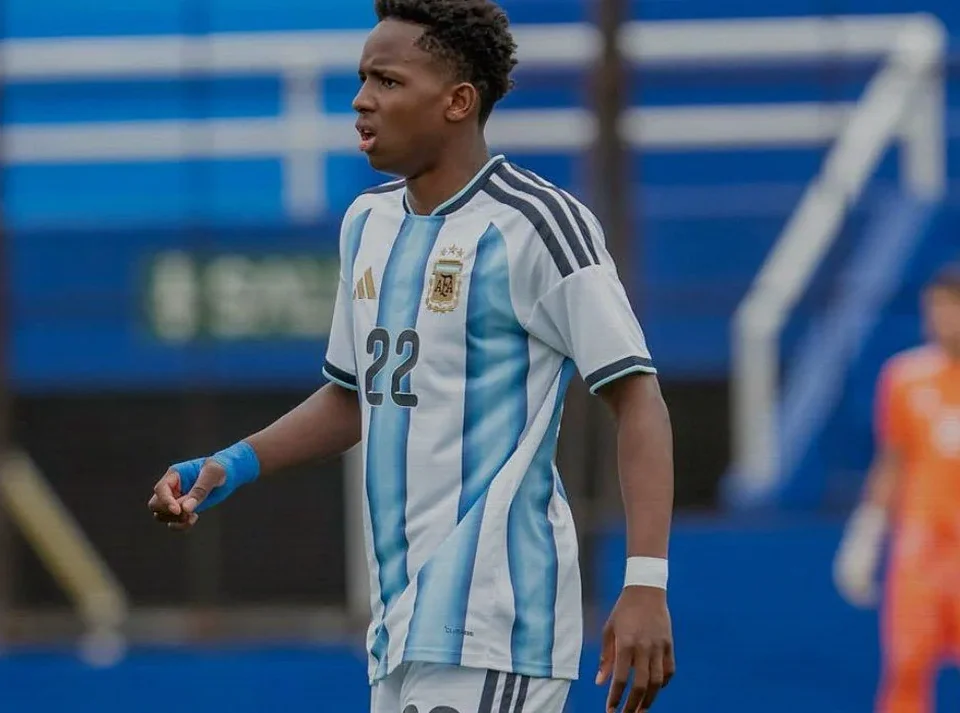
In Buenos Aires, Argentina’s Under-17 set-up has found itself discussing far more than a young forward’s finishing. Stephen Oscar “Kiki” Ramos, the Vélez Sarsfield prospect born in Port-au-Prince, has been called into the national youth squad, with attention turning to the nickname previously used for him inside the group.
Coach Diego Placente said the label was not intended as discrimination, describing Argentina’s football culture as one in which players commonly receive nicknames. He added that the squad has sought to follow Ramos’s preference and call him “Kiki”.
Placente addresses the nickname
-
Ramos’s selection for Argentina Under-17 brought renewed public discussion of his background and skin colour, including references to him as “Negro” within football circles.
-
Placente said he regarded the term as part of a broader custom of giving players informal names, citing examples in which fair-haired players may be called “Polaco” or “Ruso”. He said the intention was affectionate rather than hostile.
-
The Argentina coach acknowledged that the language can be viewed differently beyond that cultural setting, and that racism remains a serious issue elsewhere.
-
He said the national-team staff had adjusted their approach: “Within the national team, we say that we should try to call him ‘Kiki’.”
A call-up based on football
Placente insisted Ramos had earned his place through performances rather than as an inclusion gesture. “He is with the national team because he plays well, not because he is Black,” he said, adding that Ramos’s ability—not the limited number of Black players in Argentina squads—had brought him into contention.
At Vélez, Ramos had initially been behind Aguirre and Policella in the club’s highly rated 2009 age group. Placente said that, once those players moved up to the first team, Ramos received more opportunities and began scoring regularly.
The coach noted that Argentina monitor many players who are performing well at club level, but that international youth camps offer a different test from watching a player on video or in his familiar club surroundings.
From Port-au-Prince to Vélez
Ramos was born in Haiti’s capital in April 2009. At eight months old, he and three siblings were adopted by an Argentine family. The adoption process had begun before the devastating 2010 Haiti earthquake, which killed about 316,000 people and left more than 1.5 million without homes. Ramos survived and later travelled to Argentina, where he was raised by his adoptive family.
He developed through Vélez’s academy and has stood out for pace, one-against-one ability and positional versatility. He can operate from the wing or through the middle as a centre-forward.
His first Argentina Under-17 call-up arrived this year, and he could be among the players considered for the Under-17 World Cup in November.