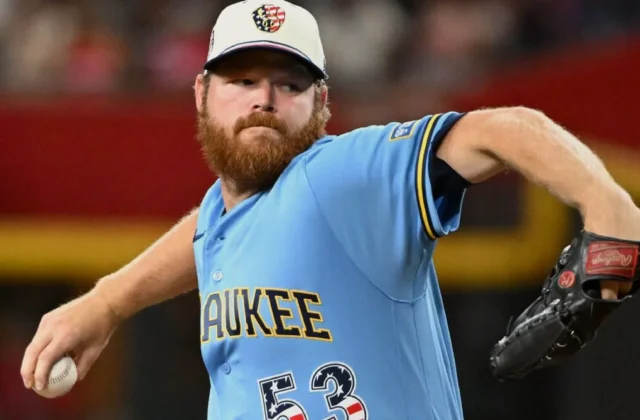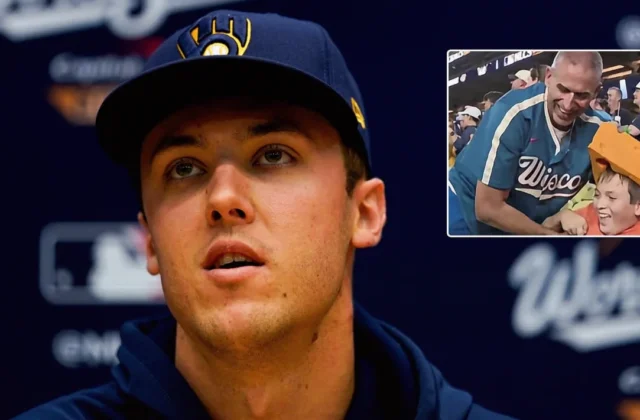
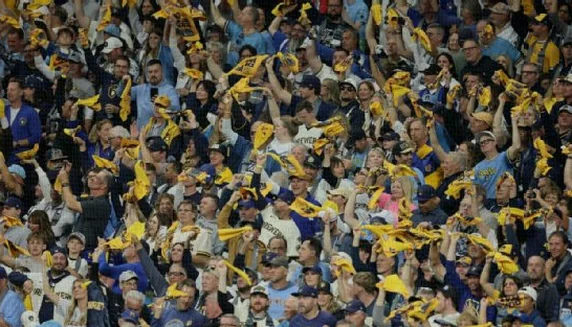
Milwaukee has spent late October with its sleeves rolled up, its flags out and its old stories back on the table. The Brewers are in the World Series for the first time since 1982, and a city that has waited 44 years for another shot has turned every watch party, tailgate and restaurant television into part of the ballpark.
At the Third Ward Beer Garden in Catalano Square, a Friday-night crowd erupted when a Brewers hitter worked an eight-pitch walk on the big screen. Across town near the Miller brewery, Saz’s State House owner Steve Sazama, 82, could barely say manager Pat Murphy’s name without feeling it. “I said his name, and I got goose bumps,” he said.
The feeling has carried through Milwaukee’s neighborhoods, from the Public Market to the bridges over the Milwaukee River, where Brewers flags have flown near the statue of Arthur Fonzarelli. In a city more accustomed to being overlooked than demanding the spotlight, the return of October baseball has landed with the force of a long-delayed family reunion.
A long line from Braves baseball to the Brew Crew
-
In 1957, the Milwaukee Braves drew what was then a record 2.1 million fans. Hank Aaron later recalled riding the streetcar to the park alongside fans streaming toward the stadium from the hills and bridges around Story Parkway.
-
Milwaukee historian John Gurda was 10 that year, watching the Braves in a Catholic school lunchroom after the nuns found the biggest television they could. By modern standards, he said, it would have been a small screen, but the students sat “spellbound.”
-
The Braves’ move to Atlanta in 1966 left Milwaukee feeling abandoned. Gurda called it “being jilted,” a wound that helps explain why the 1957 championship, the Brewers’ 1982 run and this fall’s breakthrough remain connected in the city’s memory.
-
The Brewers reached the World Series in 1982 after beating California, 4-3, in Game 5 of the American League Championship Series. Fans began pouring over the walls before Robin Yount’s throw from shortstop reached Cecil Cooper at first for the final out.
-
Jim Plaisted, now executive director of the Historic Third Ward Association, came over the left-field wall that afternoon, landed on the warning track and froze at the sound of the crowd. Once he got moving, he found himself in the mass of fans beside Yount. “Robin looked like, ‘Get me out of here,’” Plaisted recalled. “He was so scared.”
-
The Brewers then lost Game 7 in St. Louis. Steve Rypel was 9 and missed the weeknight game, only to wake the next morning and learn the result from his mother. He cried, and she assured him the club had done a great job and would return. At 53, Rypel sent her a message after Milwaukee got back to the Series: “Finally, you were right.” At first, she did not know what he meant. Then the 1982 promise came back to her.
-
Milwaukee went from 1983 through 2007 without even reaching the postseason. Sazama still remembers flying to St. Louis and back during the 1982 series on Ozark Air Lines, a detail from another baseball age.
-
In 2026, the Brewers swept the Dodgers to clinch their World Series berth, bringing the city back to the stage it had not seen since that 1982 club.
A city that sees itself in the roster
Gurda remembers the 1982 Brewers as a blue-collar group: Yount, Gorman Thomas and Pete Vuckovich, a club that fit an industrial Milwaukee still undergoing deindustrialization. The city has changed since then, but Gurda believes the common thread remains clear.
“There’s an unpretentiousness about the team and city,” he said. “Whether that’s accidental or kismet, it’s certainly opportune, because there aren’t any grandstanders on that team, so it matches the city.”
That character showed up everywhere around the Series buildup. Tailgates mixed Brewers flags with Packers flags. Fans gathered among parking lots bearing the names of Yount, Uecker, Kuenn, Molitor, Gantner, Spahn and Mathews. Dan Trimboli and Ryan Wilke pointed out that stadium-area land once held mills and factories where earlier generations worked. The old tanneries could be smelled where a new casino now stands, they said, and Red Star Yeast once put its own signature on much of the city.
Milwaukee still treasures the familiar local markers: supper clubs, Friday fish fries, Old Fashioneds, the lakefront art museum and the Deer District, where Bucks fans celebrated the 2021 NBA title. In the Third Ward, a cook stepped out of the kitchen at one restaurant to explain that the staff had laptops streaming World Series Game 1. “We mean business,” she said. The pappardelle bolognese, by all appearances, remained on form.
There is also an older soundtrack behind the moment. Many Milwaukeeans grew up hearing Bob Uecker’s voice through open windows and screen doors. They can draw a straight line from the two-run single that won a 4-3 game in 1982 to another roaring two-run single in a 4-3 win this season.
The ticket cost and the people missing from the picture
The World Series has brought a hard business reality, too. Entertainment prices have climbed across the board, and Milwaukee residents were still staring at phones before Friday’s first pitch, hoping ticket prices might fall toward $500. One person at a bar put the limit plainly: “I was born and raised here, but I don’t have three grand.”
Still, the emotional value has outrun the price tags for many fans. Ryan Weiss grew up on the dairy farm near Beaver Dam where his father, Bob Weiss, had also been raised. They made a tradition of attending every Brewers and Packers opener together, no matter how far Ryan had to travel. After the anthem, they would hug and tell each other, “Hey, see you here next year.”
Bob Weiss, remembered as an optimist, died at 65 in June 2023 after a long battle with leukemia. Ryan watched the Brewers finish their sweep of the Dodgers while attending a golf event in San Diego. His first thought was not about a ticket or a celebration.
“How much money would I give to have my Dad here right now,” he said.
Bob Piekenbrock, 64, voiced a similar wish while showing a visitor around a city where he seems to know half the population. He wished his father and grandfather could have seen this club reach the Series. At a tailgate, Janey Atchison and Kyle Steinke, who drove from Minneapolis, thought of departed family friends known as Big Al and Nate.
Those absences are part of the championship chase in Milwaukee, just as they were for Red Sox fans in 2004 and Cubs fans in 2016. A drought ending does not erase the people who waited through it. It brings them into the conversation.
Brewers fever in the underdog city
Milwaukee, the nation’s 31st-largest city, has never needed to be loud to care deeply. It sits 90 miles from Chicago and tends to regard itself as an underdog. Steve Smyczek, a lifelong Wisconsinite and collector of vintage beer advertisements, called it either “a small large city or a large small city,” depending on the view.
For now, there is no missing the mood.
“It’s bubbling over, man,” Smyczek said. “It’s crazy. Everybody’s got Brewers fever. You can’t avoid it anywhere.”
Cathy Trimboli, a former Milwaukee police captain, said the atmosphere matched the word players keep using. “It’s unbelievable,” she said. “You hear the players call it electric and they get the chills, right? It’s that.”
Dennis Pajot, a Milwaukee-born historian, does not remember the 1982 run feeling quite this wild. Plaisted, one of the fans who came over the wall during that old ALCS clincher, is still trying to absorb the new reality.
“I’m still pinching myself,” Plaisted said. “I still can’t imagine that this is really happening. And that they’re favored.”
For a city that waited through 44 Octobers without another World Series appearance, that may be the strangest and sweetest line of all.