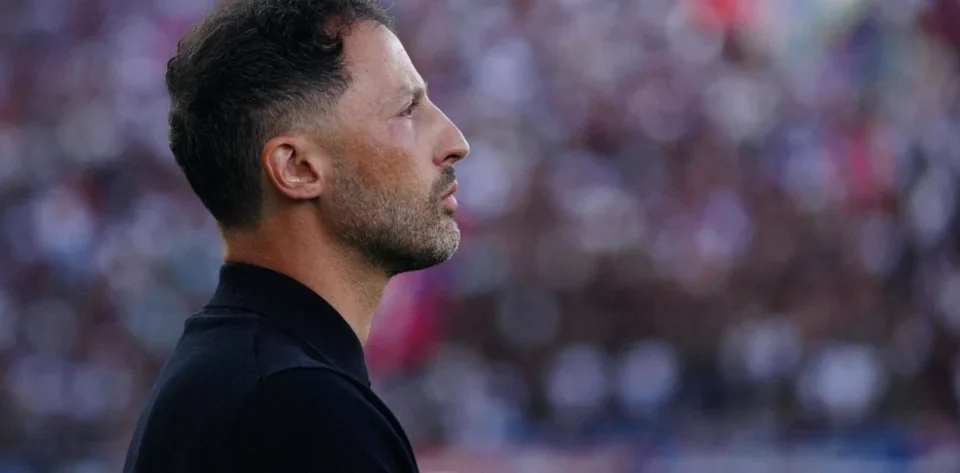
Serie A has often offered foreign coaches a grand entrance and a very short runway. Domenico Tedesco is the latest reminder: his Bologna spell lasted 97 days, four league rounds and one point, ending amid reported friction with the Rossoblù dressing room. Another imported idea of football had barely reached the pitch before the club moved on.
When Serie A runs out of patience
The coach and the club
Tedesco arrived with an established reputation from abroad, but Bologna’s start left no room for a longer experiment. Four matches and a single point were enough for his Italian chapter to close before it had found a rhythm.
It is a familiar pattern. Coaches arrive carrying titles, tactical convictions or international standing, only to find that results, boardroom anxiety and dressing-room dynamics can make patience scarce. Serie A has rarely waited long when a season appears to be slipping away.
Frank de Boer experienced that pressure at Inter in 2016. He replaced the departing Roberto Mancini in August, arriving from Ajax with four Dutch titles collected across six seasons. At 46, he was an accomplished figure in the Netherlands and certain of his methods. In Milan, however, the fit never settled. His Inter side recorded four victories, two draws and five defeats in 11 league fixtures before the club ended the appointment. The Italian spell became both the peak stage and the damaging low point of a coaching career that did not regain the same standing afterwards.
Genoa’s decision to appoint Andriy Shevchenko in November 2021 was similarly built around a larger project. The 777 Partners ownership group and president Alberto Zangrillo backed the former striker, who said the plan had persuaded him and that the club could achieve important things. The results were unforgiving: three draws, six defeats and no Serie A win in nine matches. Genoa dismissed him in January 2022, appointing Alexander Blessin, but the change did not prevent relegation to Serie B at the end of the campaign. Shevchenko has not taken another club coaching role since.
Some of these meetings have been even briefer. Guillermo Barros Schelotto became Palermo’s third coach of the 2015-16 season in January 2016, following Beppe Iachini and Davide Ballardini. Yet he could not sit on the bench because he lacked the required licence, with Giovanni Tedesco fulfilling that role. After a month, Schelotto resigned. He accepted that the rule had to be respected, but felt there was little point in remaining. Palermo had played five games under that arrangement, averaging one point per match and standing seven points clear of the relegation places.
Great reputations, difficult Italian seasons
Long before Tedesco, major names discovered how little their previous success could protect them in Italy.
Daniel Passarella arrived at Parma in November 2001 as a World Cup winner with Argentina in 1978, also part of the 1986 squad without playing, and a coach who had led River Plate to three league titles. His Parma tenure brought five matches and five defeats. The club had paid him five billion lire, meaning each loss effectively cost one billion. President Stefano Tanzi had publicly declared before Atalanta-Parma that Passarella would remain even after a defeat because the club believed in him. That belief did not last.
Carlos Bianchi’s Roma appointment in the 1996-97 season also came with considerable pedigree. His work before and after Rome, particularly at Boca Juniors, established his quality, but the relationship in the capital proved troublesome. Early in his time at the club, Bianchi wanted Francesco Totti sold to Sampdoria, judging the young forward insufficiently disciplined in tactical terms. The proposal did not happen. Franco Sensi dismissed Bianchi in April 1997 with Roma seventh; the team later dropped to 12th by the end of the season.
That same year brought César Luis Menotti to Sampdoria. The 1978 World Cup-winning Argentina manager was nearing 60 when president Enrico Mantovani turned to him after failing to persuade Falcao to take the post. Menotti’s stature did not translate into authority within the squad. Sampdoria won only three of his eight league matches, and he reached an agreement with the club to step down. He continued coaching for another decade, although his finest years were already behind him.
Gregorio Pérez had won three consecutive titles with Peñarol when Cagliari appointed him in 1997. In Sardinia, six matches produced four points and left the side third from bottom. Pérez asked president Massimo Cellino for time, confident that the team could recover, but was dismissed by telephone. Years later, Pérez offered a candid explanation: perhaps he had not been ready for Italian football.
Ideas without time
Julio Velázquez was one of the rare managerial misjudgements in Udinese’s recent history. The Spaniard arrived in the summer of 2018 from Alcorcón, then in Spain’s second division, describing himself as a tactical obsessive inspired by the country’s tiki-taka tradition. His team managed just two league victories in 12 rounds. A defeat to Empoli proved decisive and the Pozzo family made a change. Velázquez later said he had been given too little time in Udine to pass on his footballing ideas.
Oscar Hiljemark’s Pisa appointment in 2025-26 followed Alberto Gilardino’s dismissal and carried similar doubts. The Swede knew Italy from his playing years at Palermo and Genoa, but his previous coaching work at Aalborg in Denmark and Elfsborg in Sweden had not delivered notable success. Pisa won once, drew once and lost 13 times in his 15 matches in charge. Relegation to Serie B followed.
There was also Bora Milutinović’s short Italian stop in the autumn of 1987. Sporting director Franco Dal Cin selected him after Massimo Giacomini’s departure, but president Giampaolo Pozzo dismissed him ten days before Christmas. Milutinović was officially presented as technical director, while licensed coach Massimo Lombardo worked alongside him. Across eight matches, there were two home wins and six defeats.
Players complained that he did not know enough about the opposition. Milutinović, fresh from guiding Mexico to the World Cup quarter-finals, replied that the players should concern themselves with playing rather than their opponents. When the job ended, he returned to his hotel, packed his bags and resumed a coaching life that would take him across the world.
A hard lesson for the next appointment
None of these cases means that foreign coaches cannot thrive in Serie A. Their records elsewhere show precisely why clubs were drawn to them. But the championship has repeatedly demanded immediate results, clear authority and a swift understanding of a club’s internal balance.
For Bologna and Tedesco, 97 days were enough to make that lesson painfully clear. In a league where a difficult Sunday afternoon can reshape an entire season, a coach’s project is only as strong as the time granted to build it.
| SEO field | Content |
|---|---|
| SEO title | Foreign coaches in Serie A: Tedesco and the cost of short patience |
| SEO description | Domenico Tedesco’s short Bologna spell recalls the foreign coaches whose Serie A projects ended before they could take root. |