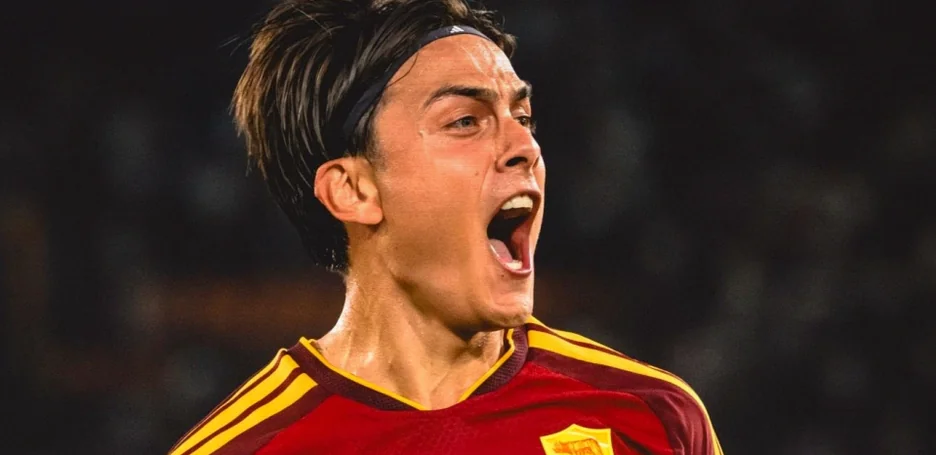
Paulo Dybala’s place at Roma is no longer being discussed as a calculated risk. Under Gian Piero Gasperini, it has become a simple principle: if the Argentine is fit, he plays. Six matches into the season, the numbers and the coach’s choices suggest that Dybala has entered this campaign with a level of physical continuity rarely seen in his recent career.
The decision
Gasperini arrived in Rome having heard the familiar warnings around Dybala: manage him carefully, limit his work, avoid overloading him. His response has been emphatic. The coach sees a player who completed a full summer programme without interruption and who now has the strength to sustain matches, including extra time if required.
“When I came in, people told me Paulo needed plenty of rest and fewer training sessions,” Gasperini said. “But he is a beast. His muscle fibres are exceptionally strong.”
Dybala had already offered a hint of his ambition during pre-season. Speaking to Ruggiero Rizzitelli on 22 July, at the historic Via Uffici del Vicario balcony in central Rome, he told supporters that the season could be enjoyable if he came through the preparation period without problems. That is precisely what happened, and it has changed the opening weeks of Roma’s campaign.
Across five Serie A fixtures and one Champions League outing, Dybala has played 497 minutes, an average of 82.9 per game. Among Roma’s outfield players, only Bryan Cristante, with 514 minutes, and Mario Hermoso, on 509, have been used more. Gianluca Mancini has played 466, Donyell Malen 432, Wesley 420 and Manu Koné 375.
There have been only two occasions in Dybala’s career when he had accumulated more minutes at this stage: 507 for Juventus in 2016-17, and 501 for Palermo in 2013-14, though that Palermo campaign was in Serie B.
“A player rests when he is tired,” Gasperini said. “I cannot put him to bed just because people think he should stop.”
The contrast with recent years is striking. José Mourinho regularly described Roma as two different sides depending on whether Dybala was available, while also acknowledging that physical problems had shaped his career. Mourinho once argued that, without his injury history, Dybala would have been playing for one of Europe’s leading clubs rather than Roma.
Claudio Ranieri held a similarly cautious view during his third spell in charge. He wanted Dybala on the field for every minute, but doubted whether his body would allow it. In the end, Ranieri also settled on the same condition that now guides Gasperini: Dybala should play whenever he is well.
That caution had reason behind it. Last season, Dybala suffered a semitendinosus tendon injury in his left thigh while striking the ball against Cagliari. Surgery ruled him out for the final three months of the campaign. He missed 15 matches in that season and had already sat out 22 games in the previous one.
Gasperini has described that earlier setback as unfortunate, believing the unusual meniscus issue that kept Dybala out for three months might have been handled differently. In the present, however, Roma are working from a different starting point.
A key figure has been Alessandro Pilati, the performance specialist Gasperini brought with him during the summer after their time together at Genoa. Pilati had previously helped Thiago Motta and Diego Perotti recover from recurring muscular problems, with Perotti having even considered retirement. Dybala has not faced that prospect, but the new training work appears to have given him a more durable platform.
There is also a personal dimension. The birth of his daughter Gia on 2 March has brought fresh energy to a player approaching his 33rd birthday. Roma’s staff and coach now see him in the mature phase of his career: perhaps with marginally less raw force than in his earliest years, but with better balance between fitness, experience and his technical influence.
Gasperini has gone as far as calling him probably the best player in Serie A when he is in this condition. “With Paulo on the pitch, we are definitely stronger,” he said. “I dislike words such as preserving, saving and resting. I ask him whether he wants to continue. If he says yes, he stays on, even when we are 4-0 up. You should not stop a player who is enjoying football.”
Dybala’s revised contract has also drawn attention. He earns €100,000 for each appearance of at least 45 minutes, up to 20 matches; beyond that threshold, the payment rises to €150,000. A substitute appearance of at least 20 minutes brings a further €75,000. Yet he also accepted a 72 per cent reduction in his basic salary this year, a gesture Gasperini has praised as evidence of his attachment to Roma and his desire to remain in the shirt.
Sunday’s picture
The stronger body has supported the familiar left foot. Dybala has already supplied four Serie A assists, the highest total in the division. Three came for Malen against Fiorentina and another set up Matías Soulé against Atalanta. Inter’s Andy Diouf and Frosinone’s Luca Schmid follow on three assists each.
His wider creative numbers underline the scale of his influence. Dybala has created 22 chances, one more than Calò and eight more than Federico Dimarco. He also leads the league for dangerous chances created, with eight, while Calò and Nicolò Barella have five apiece.
In the final 25 metres, Dybala has completed 125 accurate passes, ahead of Nico Paz on 112 and Douglas Luiz on 100. Those figures point to more than isolated moments of invention: Roma are repeatedly reaching their most dangerous areas through a player able to remain involved deep into matches.
His current return is ahead of his Juventus start in 2016-17. In his first six appearances that year, Dybala registered two assists; this time, he already has four. Roma’s hopes will depend on far more than one player, but Gasperini has made his choice clear. If Dybala can sustain this rhythm, Roma will have a leading figure capable of carrying their season into more ambitious territory.