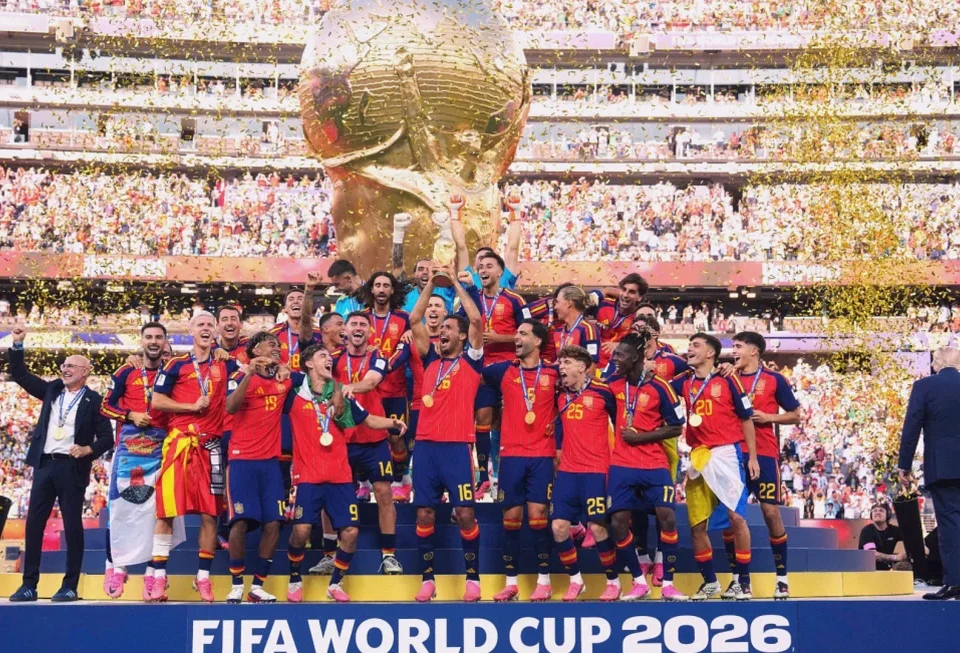
Months after Spain lifted their second World Cup title in the 2026 final in New Jersey, FIFA has released its full technical review of the tournament, drawing on all 104 matches played across the expanded competition. The study places the national-team game under close examination, tracing how leading sides built attacks, defended territory and adapted during the decisive moments of possession change.
Produced by FIFA’s Technical Study Group together with its Football Performance Insights department, the report runs to more than 500 pages and is now available through the FIFA Training Centre. Its purpose is not only to record the tactical patterns of the World Cup cycle that ended with Spain’s triumph, but also to give coaches, analysts and players material for the next international windows and tournaments.
Arsène Wenger, FIFA’s Chief of Global Football Development, described the World Cup as football at its highest level: a meeting point for elite players, coaches and football cultures, each arriving with distinctive ideas, identities and playing styles. For those studying the game, he said, the competition offers an exceptional chance to observe, learn and consider the direction in which football is moving.
The themes left by the 2026 tournament
A major strand of the review concerns build-up structures featuring three defenders. The analysis considers the different shapes teams used to begin attacks and how a back three could help sides move the ball beyond an opponent’s first line. It also studies positional rotations on the flanks, where teams exchanged roles to create space and disrupt defensive organisation.
The report highlights the growing importance of the inside channels, the spaces between central and wide areas, as routes for progression and chance creation. It identifies the players and specialist responsibilities that proved particularly valuable when teams sought to advance through or around compact defensive units.
Without the ball, FIFA’s analysts examined both high pressing and the immediate response after possession was lost. The review looks at the moments when teams chose to press high, the opportunities created by winning the ball near goal, and the effectiveness of counter-pressing in either regaining possession quickly or stopping an opponent’s transition before it developed.
Defensive blocks form another central section, with attention given to how national teams protected key zones, arranged themselves out of possession and altered their structures as matches demanded. At the other end of the turnover, the study assesses attacking transitions, identifying the factors that enabled sides to exploit the first moments after a recovery.
Goalkeepers are also given a prominent place in the tournament analysis. Their influence in possession, their positioning across different phases and the trends that emerged during the competition are all reviewed as part of an increasingly expansive role for the modern international goalkeeper.
Wenger said the document brings together what was seen at the 2026 World Cup and the technical and tactical movements shaping the event. He expressed hope that coaches, players and everyone involved in football development would challenge the findings, discuss them and learn from them. The lasting value of the tournament, he added, lies not simply in appreciating the spectacle, but in applying its lessons to help shape the game’s future.