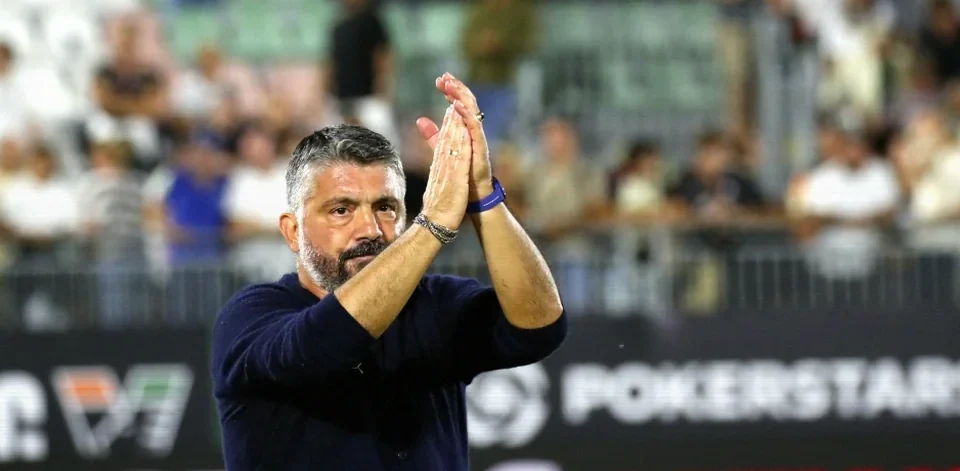
Lazio’s opening five rounds have given Rino Gattuso something more valuable than an early place near the summit: they have given the club a working belief in a difficult season. Four wins and a draw have brought 13 points, the strongest five-match start in the Biancocelesti’s league history, better even than the beginnings of their two title-winning campaigns. Lazio share first place with Roma and Inter, a position few would have anticipated amid an unsettled backdrop and a transfer window conducted without spending.
The coach and the club
Gattuso has made the early run feel earned rather than accidental. Lazio have collected their results with authority and, at times, an attractive style that challenges the old assumptions attached to the coach’s playing career. “Ringhio” remains the nickname most readily associated with him, but Gattuso has repeatedly stressed that coaching is a different profession from playing.
His work at Milan and Napoli had already pointed in this direction, while his time with the national team did not offer the same opportunity to develop it. At Lazio, the idea has taken clearer form: an assertive, contemporary side able to combine aggression with composed possession.
The starting structure is a 4-3-3, retained without major alteration when Lazio defend. With the ball, however, it can become a 3-3-4. The full-backs step into midfield, while Belahyane drops between the centre-backs. One of the two midfielders, at different times Frattesi or Taylor, operates centrally between the advancing full-backs. The other joins the striker, creating a four-man forward line.
The constant exchanges within that arrangement have made Lazio less predictable for opponents. It is not merely a change of positions but a system in motion, one which has helped turn a difficult-looking start into a shared lead at the top.
A demanding voice in the dressing room
Gattuso has not abandoned the intensity that defined his public image. After Lazio’s poor first half in Venice, Noslin revealed that the coach “shouted about everything” at the interval and broke some objects in the dressing room. The response was the point: Gattuso believed the side needed jolting and delivered the message in his own fashion.
He has also been explicit about the standards he sets. “I am relentless with the players, and I will always be that way,” he said. Yet his pressure on the group has been directed towards improvement, both individually and collectively, rather than punishment for its own sake.
Dialogue has been an equally important part of the approach. Gattuso has handled the squad through clear conversations, fairness and directness since the first day of pre-season. That has kept even less-used players involved and has allowed several footballers previously considered peripheral to become meaningful figures in Lazio’s rise.
Players brought back into the picture
The clearest recent case is Tijjani Noslin. Used as the centre-forward in the last two matches, the Dutchman scored in both and has moved ahead of Pinamonti, who is still short of full condition, as Lazio’s first-choice striker.
Noslin is not alone in benefiting from the coach’s management. Tavares has rediscovered the level he showed two years ago, while Belahyane has grown increasingly convincing as the deep midfielder. Cancellieri is now regularly selected ahead of Isaksen, and Floriani was handed a starting role after Marusic’s injury.
Frattesi’s description of the relationship within the squad was striking: “For someone like him, you would go to war without hesitation.” The wording was forceful, but it reflected the trust Gattuso has built. He has avoided creating favourites and has convinced players through actions as much as speeches.
A decision that defined the project
One decision in particular underlined that approach. Gattuso turned down Icardi even though the former Inter striker’s contract was close to being completed. Lazio had already made commitments to Pinamonti and Gudmundsson, who were preparing to join the club, and the coach did not want to withdraw those assurances.
Changing course at that point could have damaged the trust of the two forwards and potentially unsettled the wider group. By holding his position, Gattuso strengthened his standing inside the dressing room.
“Without all these problems, I would never have come to Lazio,” the coach said, partly in jest but with a serious point beneath it. A difficult environment and a zero-cost market might have become excuses for a poorer campaign. Instead, Gattuso has used those circumstances as a source of motivation.
Five matches do not decide a championship, but they can shape a club’s sense of itself. Lazio have begun with a record return, a shared lead and a coach whose authority is reaching beyond the touchline. The longer test now is to preserve that conviction through the Sunday afternoons still to come.