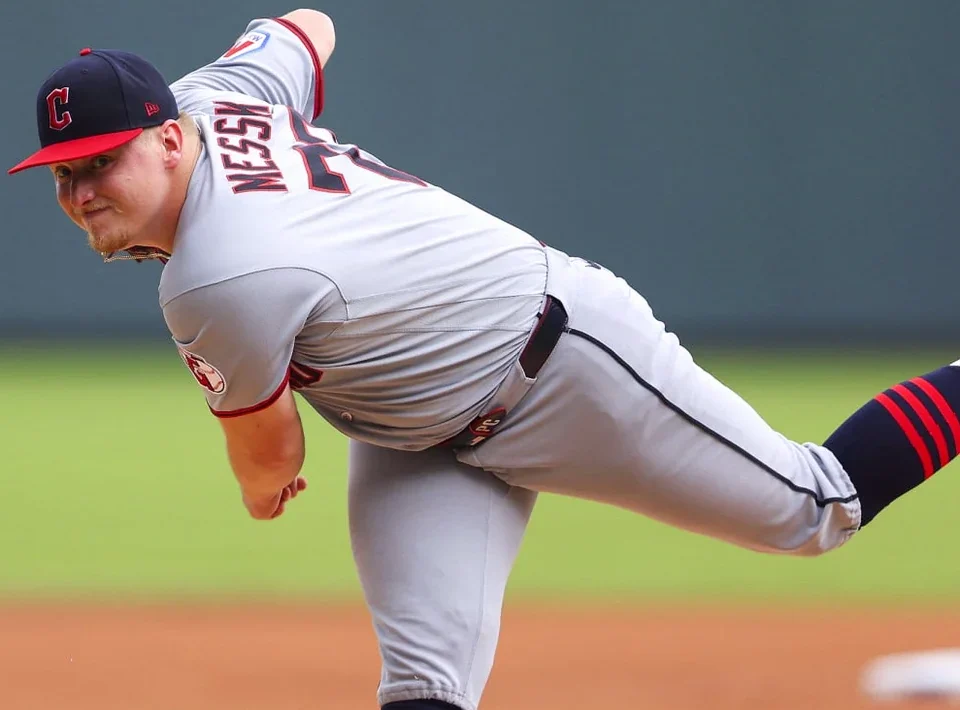
Parker Messick will carry a fastball that does not fit the usual power-pitcher blueprint into his first postseason start Saturday, when the Guardians open the American League Division Series at 1 p.m. ET against the backdrop of a full October slate.
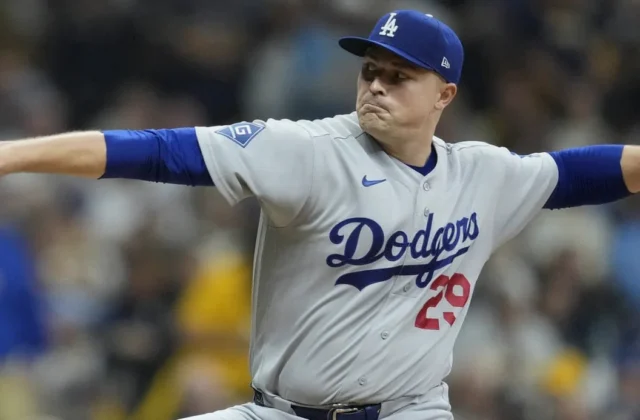
Jacob Misiorowski’s Brewers are also set for National League Division Series Game 1 at American Family Field, giving Saturday two very different versions of an elite four-seamer. Misiorowski brings the game’s most explosive starter’s velocity. Messick brings ride, command, deception and a heater that has become just as damaging.
Quick facts
- Messick posted a 2.56 ERA across 32 starts in his rookie season.
- His four-seam fastball produced a +26 run value, fourth among individual pitch types in 2026.
- Misiorowski’s four-seamer led that list at +29, followed by Cam Schlittler at +28.
- Messick averaged 94.4 mph, while Misiorowski averaged 101.6 mph.
- Guardians ALDS Game 1 is scheduled for Saturday at 1 p.m. ET/12 p.m. CT on TBS, truTV, UniMas and HBO Max.
Messick’s ERA was the best by a qualified rookie since José Fernandez finished at 2.19 for Miami in 2013. The left-hander’s four-seamer was at the center of that season: opponents batted .186 against it, with a .197 expected average, and he collected 101 strikeouts with the pitch.
Only Misiorowski and Schlittler recorded more fastball strikeouts. The run-value leaderboard also included Nolan McLean’s sinker at +27 and Dylan Cease’s slider at +24.
The velocity gap between Messick and Misiorowski is immense. Misiorowski threw 1,611 pitches this season that were faster than Messick’s top offering, a 97.7 mph four-seamer against Tampa Bay on July 26.
But Messick’s story changed when he began leaning into his best weapon. Through 16 starts, he used the four-seamer 31.1% of the time. On June 29, he threw it 51 times, a personal one-game high, and used it on 61.4% of his pitches.
From that point forward, Messick’s 52.1% four-seam usage ranked fourth among Major League pitchers with at least 750 pitches. Misiorowski led that group at 63.2%, followed by Chase Burns at 54.2%, Freddy Peralta at 53.2% and Gerrit Cole at 51.8%.
Messick’s heater arrives from a low 5.43-foot release point, even though he works with an over-the-top arm slot. His drop-and-drive delivery, quick tempo and ability to hide the ball create a look hitters do not easily pick up.
Twins catcher Ryan Jeffers called the pitch “unique, sneaky and quick” in July. That description holds up even with Messick sitting only in the 40th percentile in Major League fastball velocity.
Hitters swing beneath the four-seamer 52% of the time. It carries 16.5 inches of induced vertical break, or 1.2 inches more rise than average, allowing it to stay above bats more effectively than its radar-gun reading might suggest.
There is a touch of Nestor Cortes in the profile. Cortes recorded a +27 fastball run value in 2022 despite averaging 91.8 mph, relying on timing disruption and deception. Since 2021, only six pitchers have had a better single-season fastball run value than Messick’s 2026 mark; five of them threw harder.
Command gives Messick another edge. His four-seamer graded as the best among qualified pitchers in FanGraphs’ Location+ measure, and he posted the 10th-highest zone rate among left-handers with at least 500 four-seamers.
He does not simply throw strikes; he attacks the right part of the zone. Forty-nine percent of his four-seamers landed in the middle of the strike zone or above it, placing him among the top 15 left-handed starters. From that low release, the elevated fastball comes into the zone on a flat angle that makes the pitch difficult to square up.
Messick’s six-pitch mix prevents hitters from sitting on the heater. Against right-handed batters, he went to a four-seam/changeup combination 72% of the time, pairing an elevated fastball with a changeup kept at the bottom of the zone or below it more than 70% of the time.
Against lefties, his four-seamer and sinker accounted for 67% of his pitches. The two fastballs arrive at similar speeds but finish with different movement, and left-handed opponents managed only a .155 expected average against his fastballs, the lowest mark among left-handed pitchers with at least 50 plate appearances ending on a fastball.
The increased velocity has mattered, too. During a seven-start stint late in 2025, Messick averaged 92.8 mph with his fastball and opponents hit .302 against it. His velocity sat in the 21st percentile that year.
This season, his overall average velocity across the fastball family rose 1.5 mph, a year-over-year jump exceeded by only 10 qualified pitchers. He reached at least 96 mph 140 times after not doing it once in 2025.
“Every year, I’ve been learning what helps me and what works against me,” Messick said of the rise in velocity. “It’s about applying that to the delivery, finding the best version of it over a long stretch, and continuing to build from there.”
Saturday may bring a 96 or 97 mph reading, or it may not. For the Guardians, the more important October truth is already clear: Messick’s fastball has become a pitch opponents know is coming and still have not solved.